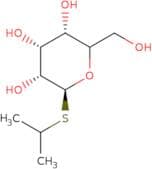
CAS 19165-11-8
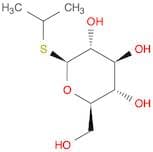
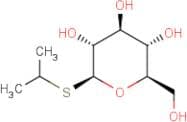
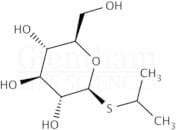
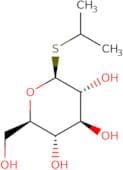
:isopropyl β-D-thioglucopyranoside
Description :
isopropyl β-D-thioglucopyranoside est un composé chimique caractérisé par sa structure en tant que thioglycoside, qui présente un groupe thiol (-SH) attaché à une portion de sucre, spécifiquement un glucopyranoside. Ce composé est généralement utilisé dans des applications biochimiques, en particulier dans l'étude des processus de glycosylation et comme substrat pour les glycosidases. Il est soluble dans l'eau et les solvants organiques, ce qui le rend polyvalent pour divers environnements de laboratoire. La présence du groupe isopropyle améliore sa stabilité et sa solubilité par rapport à d'autres thioglycosides. isopropyl β-D-thioglucopyranoside est souvent utilisé en chimie organique synthétique et en biochimie pour sa capacité à participer à des réactions de glycosylation, facilitant la formation de liaisons glycosidiques. De plus, il peut servir de groupe protecteur en chimie des glucides. Les données de sécurité indiquent que, comme de nombreux composés contenant des thiols, il doit être manipulé avec précaution en raison de sa réactivité et de sa toxicité potentielles. Dans l'ensemble, ses propriétés uniques en font un outil précieux en chimie des glucides et dans des domaines connexes.
Formule :C9H18O5S
InChI :InChI=1/C9H18O5S/c1-4(2)15-9-8(13)7(12)6(11)5(3-10)14-9/h4-13H,3H2,1-2H3
SMILES :CC(C)SC1C(C(C(C(CO)O1)O)O)O
Synonymes :- Propan-2-Yl 1-Thiohexopyranoside
Trier par
Degré de pureté (%)
0
100
|
0
|
50
|
90
|
95
|
100
5 produits concernés.
β-D-Glucopyranoside, 1-methylethyl 1-thio-
CAS :Formule :C9H18O5SDegré de pureté :95%Masse moléculaire :238.3012Isopropyl 1-thio-β-D-glucopyranoside
CAS :Isopropyl 1-thio-β-D-glucopyranosideMasse moléculaire :238.30122g/molIsopropyl-β-D-thioglucopyranoside
CAS :Isopropyl-β-D-thioglucopyranoside is a hydrogen bond donor that has been shown to inhibit the glyceraldehyde-3-phosphate dehydrogenase enzyme, which is involved in lipid biosynthesis. It has been used for the diagnosis of malariae and has potential as a biomarker for diagnosing human tissues. Isopropyl-β-D-thioglucopyranoside may be useful in the study of protein synthesis, due to its ability to bind to recombinant proteins and block the formation of intermolecular hydrogen bonds. Isopropyl-β-D-thioglucopyranoside is also expressed at high levels in Mycobacterium tuberculosis strains (e.g., ESX-1 secretion system protein) and inhibits cell growth in culture.Formule :C9H18O5SDegré de pureté :Min 95%Couleur et forme :PowderMasse moléculaire :238.3 g/molIsopropyl-β-D-thioglucopyranoside
CAS :Isopropyl-beta-D-thioglucopyranoside is a carbohydrate derivative that has the same chemical formula as glucose but with a different spatial arrangement. It is also known as beta-D-thioglucose or thioisopropylglucose, and it is an intermolecular hydrogen bond donor and acceptor. Isopropyl-beta-D-thioglucopyranoside absorbs light at wavelengths of 265 nm, 280 nm, and 320 nm. Carbohydrates are compounds containing carbon, hydrogen and oxygen atoms in a ratio of 1:2:1 by weight, with the general formula CHON. They consist of many isomers that differ from each other in the configurations of their carbonyl group and hydroxyl group. The molecular system for isopropyl-beta-D-thioglucopyranoside consists of one molecule with two hydrogen bonds to two other molecules.Formule :C9H18O5SMasse moléculaire :238.3 g/mol