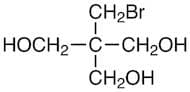
CAS 19184-65-7
:2-(Bromométhyl)-2-(hydroxyméthyl)-1,3-propanediol
Description :
2-(Bromométhyl)-2-(hydroxyméthyl)-1,3-propanediol, avec le numéro CAS 19184-65-7, est un composé organique caractérisé par la présence de groupes fonctionnels bromométhyle et hydroxyméthyle attachés à une structure de propane. Ce composé apparaît généralement sous forme de liquide ou de solide incolore à jaune pâle, selon sa pureté et sa forme. Il est soluble dans l'eau et divers solvants organiques, ce qui améliore son utilité dans la synthèse chimique et les applications. Le groupe bromométhyle en fait un électrophile potentiel, lui permettant de participer à des réactions de substitution nucléophile, tandis que le groupe hydroxyméthyle peut s'engager dans des liaisons hydrogène, influençant sa réactivité et ses interactions avec d'autres molécules. Ce composé est souvent utilisé dans la synthèse de molécules organiques plus complexes et peut servir d'intermédiaire dans des applications pharmaceutiques ou agrochimiques. Des précautions de sécurité doivent être prises lors de la manipulation de ce composé, car il peut présenter des risques pour la santé en raison de la présence de brome et de sa réactivité.
Formule :C5H11BrO3
InChI :InChI=1S/C5H11BrO3/c6-1-5(2-7,3-8)4-9/h7-9H,1-4H2
Code InChI :InChIKey=MMHHBAUIJVTLFZ-UHFFFAOYSA-N
SMILES :C(CBr)(CO)(CO)CO
Synonymes :- 1,3-Propanediol, 2-(bromomethyl)-2-(hydroxymethyl)-
- 2,2-Bis(hydroxymethyl)-3-hydroxypropyl bromide
- 2-(Bromomethyl)-2-(hydroxymethyl)-1,3-propanediol
- Monobromoneopentyl triol
- Monobromopentaerythritol
- Nsc 151735
- Pentaerythritol monobromide
- Pentaerythritol monobromohydrin
- Tris(hydroxymethyl)(bromomethyl)methane
- 2-(Bromomethyl)-2-(hydroxymethyl)propane-1,3-diol
Trier par
Degré de pureté (%)
0
100
|
0
|
50
|
90
|
95
|
100
5 produits concernés.
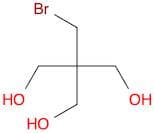
2-(Bromomethyl)-2-(hydroxymethyl)-1,3-propanediol
CAS :Formule :C5H11BrO3Degré de pureté :>98.0%(GC)Couleur et forme :White to Almost white powder to crystalMasse moléculaire :199.041,3-Propanediol, 2-(bromomethyl)-2-(hydroxymethyl)-
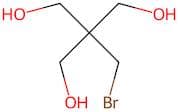
CAS :Formule :C5H11BrO3Degré de pureté :97%Couleur et forme :SolidMasse moléculaire :199.04302-(Bromomethyl)-2-(hydroxymethyl)propane-1,3-diol
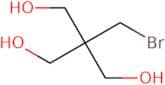
CAS :2-(Bromomethyl)-2-(hydroxymethyl)propane-1,3-diolFormule :C5H11BrO3Degré de pureté :98%Couleur et forme : white crystalline powderMasse moléculaire :199.04g/mol2-(Bromomethyl)-2-(hydroxymethyl)propane-1,3-diol
CAS :Degré de pureté :97%Masse moléculaire :199.04400632-(Bromomethyl)-2-(hydroxymethyl)-1,3-propanediol
CAS :2-(Bromomethyl)-2-(hydroxymethyl)-1,3-propanediol is a synthetic compound that is used as a stabilizer in polymers. It has magnetic properties and crystallizes in an orthorhombic system. This substance also has an aryl group and a chlorine substituent. 2-(Bromomethyl)-2-(hydroxymethyl)-1,3-propanediol reacts with the phosphite trialkyl to form polyvalent phosphorus compounds, which are residues of the trialkyl. The insecticidal properties of this compound may be due to its ability to inhibit the growth of insects by affecting the metabolism of arthropods. The hydrocarbon residue may be due to its synthesis from bromoethane and methanol.Formule :C5H11BrO3Degré de pureté :Min. 95%Masse moléculaire :199.04 g/mol