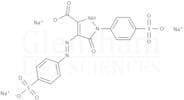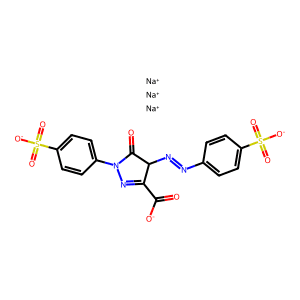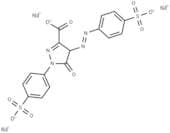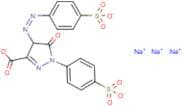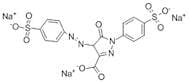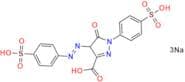
CAS 1934-21-0
:Tartrazine
- Tartraphenine
- Tartrazin
- Trinatrium-5-hydroxy-1-(4-sulfophenyl)-4-(4-sulfophenylazo)pyrazol-3-carboxylat
- Dihydro-5-oxo-1-(4-sulfophenyl)-4-((4-sulfophenyl)azo)-1H-pyrazole-3-carboxylic acid, trisodium salt
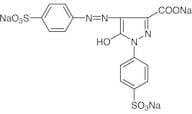
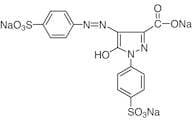
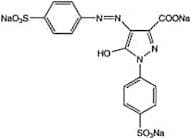
- trisodium 5-hydroxy-1-(4-sulfonatophenyl)-4-[(E)-(4-sulfonatophenyl)diazenyl]-1H-pyrazole-3-carboxylate
- C.I. Acid Yellow 23
- C.I. Food Yellow 4
- Tartrazine
- Filter Yellow
- Tartrazine C.I.19140
- Food Yellow No.4
- C.I. Acid Yellow 23, trisodium salt
- Trisodium 1-(4-sulfonatophenyl)-4-(4-sulfonatophenylazo)-5-pyrazolone-3-carboxylate
- C.I. 640
- trisodium (4E)-5-oxo-1-(4-sulfonatophenyl)-4-[(4-sulfonatophenyl)hydrazono]-4,5-dihydro-1H-pyrazole-3-carboxylate
- C.I. Acid Yellow 23, trisodium salt (VAN) (8CI)
- 1H-Pyrazole-3-carboxylic acid, 4,5-dihydro-5-oxo-1-(4-sulfophenyl)-4-[(4-sulfophenyl)azo]-, trisodium salt
- Tartrazine
- 4,5-dihydro-5-oxo-1-(4-sulfophenyl)-4-[(4-sulfophenyl)azo]-1H-Pyrazole-3-carboxylic acid, trisodium salt
- FD&C Yellow No. 5
- Trisodium 1-(4-sulfophenyl)-4-((4-sulfophenyl)azo)-1H-pyrazole-3-carboxylate
- C.I. Acid Yellow 23
- 1H-Pyrazole-3-carboxylic acid, 4,5-dihydro-5-oxo-1-(4-sulfophenyl)-4-[2-(4-sulfophenyl)diazenyl]-, sodium salt (1:3)
- C.I. 19140
- Tartrazine C
- trisodium (4Z)-5-oxo-1-(4-sulfonatophenyl)-4-[(4-sulfonatophenyl)hydrazono]-4,5-dihydro-1H-pyrazole-3-carboxylate
- C.I. Acid Yellow 23, trisodium salt
- Acid Yellow 23
- Voir plus de synonymes
Food Yellow No. 4
CAS :Formule :C16H9N4Na3O9S2Couleur et forme :White - Yellow SolidMasse moléculaire :534.36Acid Yellow 23
CAS :Formule :C16H9N4Na3O9S2Degré de pureté :>98.0%(HPLC)Couleur et forme :Orange to Brown powder to crystalMasse moléculaire :534.36Tartrazine
CAS :It can be employed as a biological stain and a food colorant. This Thermo Scientific Chemicals brand product was originally part of the Alfa Aesar product portfolio. Some documentation and label information may refer to the legacy brand. The original Alfa Aesar product / item code or SKU reference hFormule :C16H9N4Na3O9S2Couleur et forme :Powder, OrangeMasse moléculaire :534.361H-Pyrazole-3-carboxylic acid,4,5-dihydro-5-oxo-1-(4-sulfophenyl)-4-[(4-sulfophenyl)azo]-, trisodiumsalt
CAS :Formule :C16H9N4Na3O9S2Degré de pureté :97%Couleur et forme :SolidMasse moléculaire :534.3634Tartrazine (C.I. 19140)
CAS :Formule :C16H19N4Na3O9S2Degré de pureté :≥ 85.0%Couleur et forme :Light-orange to orange powderMasse moléculaire :534.37Tartrazine
CAS :Formule :C16H9N4Na3O9S2Degré de pureté :85%Couleur et forme :SolidMasse moléculaire :534.36Tartrazine
CAS :Produit contrôléFormule :C16H9N4O9S2NaCouleur et forme :NeatMasse moléculaire :534.36Tartrazine solution
CAS :Formule :C16H19N4Na3O9S2Couleur et forme :Yellow solutionMasse moléculaire :534.37Tartrazine
CAS :Tartrazine, a food colorant with potential health risks, may be genotoxic and carcinogenic with long-term use.Formule :C16H9N4Na3O9S2Degré de pureté :98.77% - 98.82%Couleur et forme :Yellow Solid PowderMasse moléculaire :534.36Tartrazine
CAS :TartrazineFormule :C16H9N4O9S2·3NaDegré de pureté :99%Couleur et forme : orange powderMasse moléculaire :534.36g/molTartrazine
CAS :Applications As a dye for wool and silks; as colorant in food, drugs, and cosmetics. In biochemistry as an adsorption-elution indicator for chloride estimations. Tartrazine (otherwise known as E number E102, C.I. 19140, or FD&C Yellow 5) is a synthetic lemon yellow azo dye used as a food coloring. Tartrazine appears to cause the most allergic and intolerance reactions of all the azo dyes, particularly among asthmatics and those with an aspirin intolerance. Dyes and metabolites, Environmental Testing.A recent report has shown that Tartrazine may be useful in 3D bio-printing of organ-like architectures.
References Rowe, K.S., et al.: J. Pedriatics, 125, 691 (1994), Tanaka, T., et al.: Food Chem. Toxicol., 44, 179 (2006); Chem. and Eng News Page 4 May 6, 2019Formule :C16H9N4O9S2·3NaCouleur et forme :YellowMasse moléculaire :534.36Tartrazine
CAS :Tartrazine is a yellow synthetic food dye that has been used since the late 1800s. It is classified as a non-steroidal anti-inflammatory drug (NSAID). Tartrazine binds to the response element on DNA, which inhibits gene transcription and causes cell death. The rate constant for this reaction was determined using crystalline cellulose as the substrate. Mouse monoclonal antibodies were used to measure the rate constant of transfer reactions between tartrazine and optical sensor. The optimum concentration for tartrazine was determined using toxicity studies in rats.Formule :C16H9N4Na3O9S2Degré de pureté :Min. 95%Couleur et forme :PowderMasse moléculaire :534.37 g/molTartrazine, 87%
CAS :Formule :C16H9N4O9S2Na3Degré de pureté :min. 87%Couleur et forme :Orange, PowderMasse moléculaire :534.4


![1H-Pyrazole-3-carboxylic acid,4,5-dihydro-5-oxo-1-(4-sulfophenyl)-4-[(4-sulfophenyl)azo]-, trisodi…](/_next/image/?url=https%3A%2Fstatic.cymitquimica.com%2Fproducts%2FIN%2Fthumb%2FDA00I2XZ.jpg&w=3840&q=75)