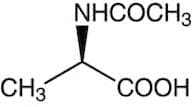
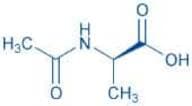
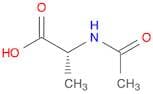
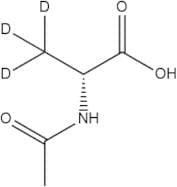
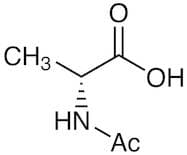
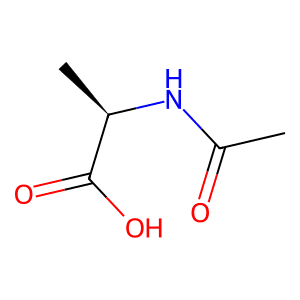
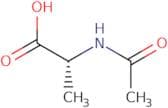
CAS 19436-52-3
:N-Acétyl-D-alanine
Description :
N-Acétyl-D-alanine est un dérivé d'acide aminé caractérisé par la présence d'un groupe acétyle attaché au groupe amino de la D-alanine. Ce composé est typiquement un solide cristallin blanc à blanc cassé, soluble dans l'eau et dans des solvants organiques polaires, ce qui indique la présence de ses groupes fonctionnels polaires. N-Acétyl-D-alanine est souvent utilisé dans la recherche biochimique et la synthèse, en particulier dans les études impliquant la synthèse de peptides et la modification des protéines. Sa structure lui permet de participer à diverses réactions biochimiques, ce qui en fait un élément de base précieux dans la synthèse de molécules plus complexes. L'acétylation des acides aminés peut influencer leur réactivité et leur activité biologique, ce qui est significatif dans le contexte de la conception et du développement de médicaments. De plus, les dérivés N-acétylés sont souvent étudiés pour leurs rôles dans les voies métaboliques et leurs applications thérapeutiques potentielles. Comme pour de nombreuses substances chimiques, la manipulation doit être effectuée avec précaution, en suivant les protocoles de sécurité appropriés pour atténuer les risques associés à leur utilisation.
Formule :C5H9NO3
InChI :InChI=1S/C5H9NO3/c1-3(5(8)9)6-4(2)7/h3H,1-2H3,(H,6,7)(H,8,9)/t3-/m1/s1
Code InChI :InChIKey=KTHDTJVBEPMMGL-GSVOUGTGSA-N
SMILES :[C@H](NC(C)=O)(C(O)=O)C
Synonymes :- (2R)-2-Acetamidopropanoic acid
- (R)-(+)-N-Acetylalanine
- (R)-2-(Acetylamino)propanoic acid
- <span class="text-smallcaps">D</span>-Alanine, N-acetyl-
- Ac-D-Ala-Oh
- Acetyl-<span class="text-smallcaps">D</span>-alanine
- Alanine, N-acetyl-, <span class="text-smallcaps">D</span>-
- N-Acetyl-<span class="text-smallcaps">D</span>-alanine
- NSC 203819
- Alanine, N-acetyl-, D-
- Acetyl-D-alanine
- D-Alanine, N-acetyl-
- N-Acetyl-D-alanine
- N-ALPHA-ACETYL-D-ALANINE
- N-Acetyl-D-alanine,98%
- D-Alanine, N-acetyl- (9CI)
- AC-D-ALA-OH USP/EP/BP
- N-acetyl-D-alanine sigma gr
- acetyl-dextro-alanine
- (R)-2-(Acetylamino)propionic acid
- (2R)-2-(Acetylamino)propionic acid
- N-Acetyl-D-α-alanine;N-Acetyl-D-alanine
- (2S)-2-(Acetylamino)propanoic acid
- N-alpha-Actetyl-D-alanine
- (R)-2-ACETAMIDOPROPANOIC ACID
- Acetyl-D-alanine≥ 98% (Assay)
- (2R)-2-acetamidopropanoicaci
- N-Ac-D-Ala-OH
- N-Acetyl-D-alanine-d4
- N-ACETYL-D-ALA
- Voir plus de synonymes
Trier par
Degré de pureté (%)
0
100
|
0
|
50
|
90
|
95
|
100
9 produits concernés.
N-Acetyl-D-alanine, 98%
CAS :N-Acetyl-D-alanine may be used with other D-aminoacylated amino acids as a substrate for the identification, differentiation and characterization of D-aminoacylase(s)/amidohydrolase(s). N-acetyl-D-alanine may be used to study aglycon pocket specific binding on vancomycin. This Thermo Scientific ChemFormule :C5H9NO3Degré de pureté :98%Masse moléculaire :131.13Ac-D-Ala-OH
CAS :Bachem ID: 4002334.
Formule :C5H9NO3Degré de pureté :> 99%Couleur et forme :White PowderMasse moléculaire :131.13Ac-D-Ala-OH
CAS :Formule :C5H9NO3Degré de pureté :97%Couleur et forme :SolidMasse moléculaire :131.1299N-Acetyl-D-alanine
CAS :Formule :C5H9NO3Degré de pureté :≥ 98.0%Couleur et forme :White to off-white powderMasse moléculaire :131.13Ac-D-Ala-OH
CAS :Formule :C5H9NO3Degré de pureté :>97.0%(T)(HPLC)Couleur et forme :White to Light yellow powder to crystalMasse moléculaire :131.13N-Acetyl-D-alanine
CAS :N-Acetyl-D-alanineFormule :C5H9NO3Degré de pureté :97% by nmr (Typical Value in Batch COA)Couleur et forme : white to light yellow powderMasse moléculaire :131.13g/molac-d-ala-oh
CAS :Formule :C5H9NO3Degré de pureté :98%Couleur et forme :SolidMasse moléculaire :131.131Acetyl-D-alanine
CAS :Acetyl-D-alanine is a natural amino acid that has been shown to bind to the surface of Staphylococcus aureus and inhibit the growth of this bacteria. It has been shown to have significant stereoselective binding constants with bacterial cells. Acetyl-D-alanine has also been shown to form at a higher rate than other amino acids, which may be due to its glycopeptide structure. Acetyl-D-alanine is also soluble in organic solvents such as DMSO and acetone, making it easier for researchers to study its biological function. Acetyl-D-alanine is most often used in preparative hplc chromatography because it can be easily separated from other solutes by size, shape, or charge. Acetyl-D-alanine has been shown to inhibit the growth of Staphylococcus aureus in vitro. Acetyl-D-alanineFormule :C5H9NO3Degré de pureté :Min. 98 Area-%Masse moléculaire :131.13 g/mol