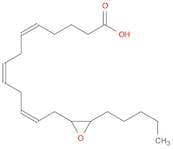
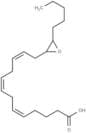
CAS 197508-62-6
:Acide 14(15)-époxy-5Z,8Z,11Z-éicosatriénoïque
- 5,8,11-Tridecatrienoic acid, 13-(3-pentyloxiranyl)-, (5Z,8Z,11Z)-
- 5,8,11-Tridecatrienoic acid, 13-(3-pentyloxiranyl)-, (all-Z)-
- 5,8,11-Tridecatrienoic acid, 13-(3-pentyl-2-oxiranyl)-, (5Z,8Z,11Z)-
- 14,15-Epoxyeicosatrienoic acid
- (5Z,8Z,11Z)-13-(3-Pentyl-2-oxiranyl)-5,8,11-tridecatrienoic acid
(±)14(15)-EET
CAS :(±)14(15)-EET is a metabolite of arachidonic acid that is formed via epoxidation of arachidonic acid by cytochrome P450.[1],[2] It prevents increases inFormule :C20H32O3Couleur et forme :SolidMasse moléculaire :320.47314(15)-epoxy-5(Z),8(Z),11(Z)-eicosatrienoic acid
CAS :Formule :C20H32O3Degré de pureté :>98%Couleur et forme :In solution, EthanolMasse moléculaire :320.514,15-Epoxyeicosatrienoic Acid
CAS :Produit contrôléApplications Epoxyeicosatrienoic Acid (EET) has antihypertensive and anti-inflammatory properties and play a role in the maintenance of renal vascular function. N,N'-dicyclohexylurea (DCU) increased release of 14,15-EET when the cells were stimulated with a calcium ionophore.Also, it is derived from Arachidonic Acid >97% (A765000), which is an essential fatty acid and a precursor in the biosynthesis of prostaglandins, thromboxanes, and leukotrienes. Arachidonic Acid occurs in liver, brain, glandular organs, and depot fats of animals, in small amounts in human depot fats, and Arachidonic Acid is also a constituent of animal phosphatides.
References Zhao, X., et al.: J. Am. Soc. Nephrol., 15, 1244 (2004); Fang, X., et al.: J. Biol. Chem., 276, 14867 (2001); Kurosawa, T., et al.: J. Cell. Physiol., 219, 606 (2009); Mazalli, M., et al.: J. Agric. Food Chem., 57, 5028 (2009);Formule :C20H32O3Couleur et forme :NeatMasse moléculaire :320.466