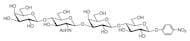
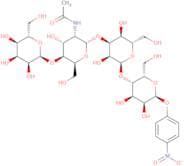
CAS 197526-33-3
:N-[(2S,3S,4R,5S,6S)-2-[(2S,3S,4S,5S,6S)-2-[(2S,3S,4R,5S,6S)-4,5-dihydroxy-2-(hydroxyméthyl)-6-(4-nitrophénoxy)tetrahydropyrane-3-yl]oxy-3,5-dihydroxy-6-(hydroxyméthyl)tetrahydropyrane-4-yl]oxy-4-hydroxy-6-(hydroxyméthyl)-5-[(2S,3S,4S,5R,6S)-3,4,5-trihydroxy
Description :
La substance chimique portant le nom "N-[(2S,3S,4R,5S,6S)-2-[(2S,3S,4S,5S,6S)-2-[(2S,3S,4R,5S,6S)-4,5-dihydroxy-2-(hydroxyméthyl)-6-(4-nitrophénoxy)tetrahydropyrane-3-yl]oxy-3,5-dihydroxy-6-(hydroxyméthyl)tetrahydropyrane-4-yl]oxy-4-hydroxy-6-(hydroxyméthyl)-5-[(2S,3S,4S,5R,6S)-3,4,5-trihydroxy" et le numéro CAS "197526-33-3" est une molécule organique complexe caractérisée par de multiples stéréocentres et des groupes fonctionnels hydroxyles. Ce composé présente probablement une solubilité significative dans des solvants polaires en raison de ses nombreux groupes hydroxyles, qui peuvent former des liaisons hydrogène avec l'eau. La présence d'un groupe nitrophénoxy suggère un potentiel d'activité biologique, possiblement en tant qu'inhibiteur ou modulateur dans des voies biochimiques. L'intrication stéréochimique indique que la molécule peut avoir des interactions spécifiques avec des cibles biologiques, ce qui la rend intéressante en chimie médicinale. Sa complexité structurelle peut également influencer sa stabilité, sa réactivité et ses propriétés pharmacocinétiques. Dans l'ensemble, cette substance représente une classe de composés qui pourraient avoir des applications en pharmacie ou en biochimie, justifiant une enquête plus approfondie sur ses propriétés et ses utilisations potentielles.
Formule :C32H48N2O23
InChI :InChI=1/C32H48N2O23/c1-10(39)33-17-20(42)26(55-31-23(45)21(43)18(40)13(6-35)51-31)15(8-37)53-29(17)57-28-19(41)14(7-36)52-32(25(28)47)56-27-16(9-38)54-30(24(46)22(27)44)50-12-4-2-11(3-5-12)34(48)49/h2-5,13-32,35-38,40-47H,6-9H2,1H3,(H,33,39)/t13-,14-,15-,16-,17-,18-,19-,20+,21-,22+,23-,24-,25-,26+,27+,28-,29-,30+,31-,32-/m0/s1
Synonymes :- Gal beta(1-4)GlcNAc beta(1-3)Gal beta(1-4)Glc-beta-pNP
- 4-Nitrophenyl b-lacto-N-neotetraoside
- GALΒ(1-4)GLCNACΒ(1-3)GALΒ(1-4)GLC-Β-PNP
- β-D-Glucopyranoside, 4-nitrophenyl O-β-D-galactopyranosyl-(1→4)-O-2-(acetylamino)-2-deoxy-β-D-glucopyranosyl-(1→3)-O-β-D-galactopyranosyl-(1→4)-
- 4-Nitrophenyl O-beta-D-galactopyranosyl-(1-4)-O-2-(acetylamino)-2-deoxy-beta-D-glucopyranosyl-(1-3)-O-beta-D-galactopyranosyl-(1-4)-beta-D-glucopyranoside
Trier par
Degré de pureté (%)
0
100
|
0
|
50
|
90
|
95
|
100
2 produits concernés.
Galβ(1-4)GlcNAcβ(1-3)Galβ(1-4)Glc-β-pNP
CAS :Formule :C32H48N2O23Couleur et forme :White - Yellow Solid FormMasse moléculaire :828.734-Nitrophenyl b-lacto-N-neotetraoside
CAS :4-Nitrophenyl b-lacto-N-neotetraoside is a potent antibiotic that inhibits bacterial growth by binding to the beta subunit of DNA gyrase. This drug has been shown to be effective against methicillin resistant Staphylococcus aureus (MRSA) and Clostridium perfringens, although is not active against acid-fast bacteria such as Mycobacterium tuberculosis or Mycobacterium avium complex. Gatifloxacin has shown anti-inflammatory properties, which may be due to its inhibition of prostaglandin synthesis.Degré de pureté :Min. 95%Masse moléculaire :828.72 g/mol