CAS 198560-10-0
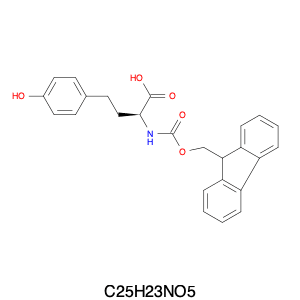
:FMOC-HOMO-L-TYROSINE
- (S)-N-Alpha-(9-Fluorenylmethoxycarbonyl)-2-Amino-4-Hydroxybenzenebutanoic Acid
- (S)-2-(9H-Fluoren-9-Ylmethoxycarbonylamino)-4-(4-Hydroxy-Phenyl)-Butyric Acid
- N-Alpha-(9-Fluorenylmethyloxycarbonyl)-L-Homo-Tyrosine
- Fmoc-Tyr(Noch2)-Oh
- Fmoc-Homotyr-Oh
- Fmoc-Homo-Tyrosine
- Fmoc-Hty-Oh
- (2S)-2-(9H-fluoren-9-ylmethoxycarbonylamino)-4-(4-hydroxyphenyl)butanoic acid
Fmoc-Homo-L-Tyrosine
CAS :Formule :C25H23NO5Degré de pureté :98%Couleur et forme :SolidMasse moléculaire :417.4538(S)-2-((((9H-Fluoren-9-yl)methoxy)carbonyl)amino)-4-(4-hydroxyphenyl)butanoic acid
CAS :(S)-2-((((9H-Fluoren-9-yl)methoxy)carbonyl)amino)-4-(4-hydroxyphenyl)butanoic acidDegré de pureté :98%Masse moléculaire :417.46g/molFmoc-L-homotyrosine
CAS :Fmoc-L-homotyrosine is a tyrosine kinase inhibitor. Tyrosine kinases are enzymes that catalyze the transfer of phosphate groups from ATP to tyrosine residues in proteins, which play a role in many cellular processes. Fmoc-L-homotyrosine binds to the ATP binding site in the active site of these enzymes, preventing phosphorylation and thus preventing protein function. This compound has been shown to inhibit neurotensin receptors in vitro and has also been shown to be an endogenous ligand for this receptor. Fmoc-L-homotyrosine binds to allosteric sites on the neurotensin receptor, causing conformational changes that activate transduction pathways and increase signaling. The mechanism of inhibition is not yet fully understood but is thought to be due to steric hindrance or allosteric binding.
Formule :C25H23NO5Degré de pureté :Min. 95%Masse moléculaire :417.45 g/mol