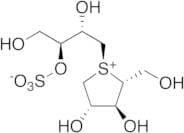
![(1S,2S)-3-[(2R,3S,4S)-3,4-dihydroxy-2-(hydroxymethyl)tetrahydrothiophenium-1-yl]-2-hydroxy-1-(hydr…](/_next/image/?url=https%3A%2Fstatic.cymitquimica.com%2Fcas-image%2Fthumb-webp%2F395482-1s-2s-3-2r-3s-4s-34-dihydroxy-2-hydroxymethyl-tetrahydrothiophenium-1-yl-2-hydroxy-1-hydroxymethyl-propyl-sulfate-non-preferred-name.webp&w=3840&q=75)
CAS 200399-47-9
:(1S,2S)-3-[(2R,3S,4S)-3,4-dihydroxy-2-(hydroxyméthyl)tetrahydrothiophénium-1-yl]-2-hydroxy-1-(hydroxyméthyl)propyl sulfate (nom non préféré)
- (2S,3S)-4-[(2R,3S,4S)-3,4-dihydroxy-2-(hydroxymethyl)tetrahydrothiophenium-1-yl]-1,3-dihydroxybutan-2-yl sulfate (non-preferred name)
Salacinol
CAS :Produit contrôléApplications Salacinol is a α-glucosidase inhibitor discovered from the herb, Salacia reticulata. Salacinol is used as an antidiabetic agent.
References Matsuda, H. et al.: Chem. Pharmac. Bull., 47, 1725 (1999); Mohan, S. et al.: Carb. Res., 342, 1551 (2007); Muraoka, O. et al.: J. Nat. Med., 65, 142 (2011);Formule :C9H18O9S2Couleur et forme :Off-WhiteMasse moléculaire :334.364Salacinol
CAS :Salacinol is a naturally occurring sulfonium ion, which is a bioactive compound found primarily in the roots and stems of the plant Salacia reticulata. This plant is native to regions of South Asia, particularly India and Sri Lanka, and is traditionally used in Ayurvedic medicine. Salacinol's mode of action involves the inhibition of alpha-glucosidase, an enzyme responsible for breaking down carbohydrates into glucose. By inhibiting this enzyme, salacinol reduces the postprandial rise in blood glucose levels, thus demonstrating antidiabetic potential.
Formule :C9H18O9S2Degré de pureté :Min. 95%Masse moléculaire :334.37 g/molSalacinol
CAS :Salacinol is a naturally occurring alpha-glucosidase inhibitor isolated from an Ayurvedic traditional medicine Salacia reticulata.Formule :C9H18O9S2Couleur et forme :SolidMasse moléculaire :334.37