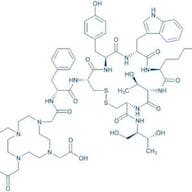
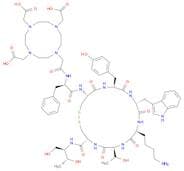
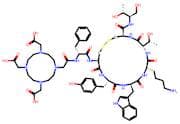
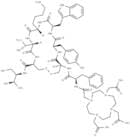
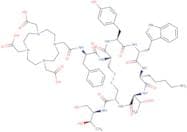
CAS 204318-14-9
:2,2',2''-[10-(2-{[(2R)-1-{[(4R,7S,10S,13R,16S,19R)-10-(4-aminobutyl)-4-{[(2R,3R)-1,3-dihydroxybutan-2-yl]carbamoyl}-16-(4-hydroxybenzyl)-7-[(1R)-1-hydroxyéthyl]-13-(1H-indol-3-ylméthyl)-6,9,12,15,18-pentaoxo-1,2-dithia-5,8,11,14,17-pentaazacycloicosan-19-
Description :
La substance chimique portant le nom "2,2',2''-[10-(2-{[(2R)-1-{[(4R,7S,10S,13R,16S,19R)-10-(4-aminobutyl)-4-{[(2R,3R)-1,3-dihydroxybutan-2-yl]carbamoyl}-16-(4-hydroxybenzyl)-7-[(1R)-1-hydroxyéthyl]-13-(1H-indol-3-ylméthyl)-6,9,12,15,18-pentaoxo-1,2-dithia-5,8,11,14,17-pentaazacycloicosan-19-" et le numéro CAS "204318-14-9" est une molécule organique complexe caractérisée par sa structure complexe, qui comprend plusieurs groupes fonctionnels et stéréocentres. Ce composé présente probablement une activité biologique significative en raison de ses caractéristiques structurelles, qui peuvent inclure des groupes amine, hydroxyle et carbonyle, contribuant à ses interactions potentielles avec des cibles biologiques. La présence d'un noyau de pentaazacycloicosane suggère un cadre cyclique unique qui peut influencer sa pharmacocinétique et sa pharmacodynamie. De plus, la stéréochimie indiquée par les désignations (R) et (S) implique que la molécule peut avoir des arrangements spatiaux spécifiques qui sont cruciaux pour sa fonction biologique. Dans l'ensemble, cette substance représente un exemple sophistiqué de chimie organique synthétique avec des applications potentielles en chimie médicinale ou en développement de médicaments.
Formule :C65H92N14O18S2
InChI :InChI=1/C65H92N14O18S2/c1-39(81)51(36-80)72-64(96)53-38-99-98-37-52(73-60(92)48(28-41-10-4-3-5-11-41)68-54(84)32-76-20-22-77(33-55(85)86)24-26-79(35-57(89)90)27-25-78(23-21-76)34-56(87)88)63(95)70-49(29-42-15-17-44(83)18-16-42)61(93)71-50(30-43-31-67-46-13-7-6-12-45(43)46)62(94)69-47(14-8-9-19-66)59(91)75-58(40(2)82)65(97)74-53/h3-7,10-13,15-18,31,39-40,47-53,58,67,80-83H,8-9,14,19-30,32-38,66H2,1-2H3,(H,68,84)(H,69,94)(H,70,95)(H,71,93)(H,72,96)(H,73,92)(H,74,97)(H,75,91)(H,85,86)(H,87,88)(H,89,90)/t39-,40-,47+,48-,49+,50-,51-,52+,53+,58+/m1/s1
Trier par
Degré de pureté (%)
0
100
|
0
|
50
|
90
|
95
|
100
5 produits concernés.
DOTA-(Tyr³)-Octreotide
CAS :Somatostatin analog for tumor scintigraphy and radionuclide therapy.Formule :C65H92N14O18S2Degré de pureté :98.4%Couleur et forme :WhiteMasse moléculaire :1421.662,2',2''-(10-(2-(((R)-1-(((4R,7S,10S,13R,16S,19R)-13-((1H-Indol-3-yl)methyl)-10-(4-aminobutyl)-4-(((2R,3R)-1,3-dihydroxybutan-2-yl)carbamoyl)-16-(4-hydroxybenzyl)-7-((R)-1-hydroxyethyl)-6,9,12,15,18-pentaoxo-1,2-dithia-5,8,11,14,17-pentaazacycloicosan-19-yl)amino)-1-oxo-3-phenylpropan-2-yl)amino)-2-oxoethyl)-1,4,7,10-tetraazacyclododecane-1,4,7-triyl)triacetic acid
CAS :Formule :C65H92N14O18S2Degré de pureté :98%Couleur et forme :SolidMasse moléculaire :1421.6390Edotreotide
CAS :Edotreotide (SMT-487) is an Indicator and Reagent. It also is used in the Diagnosis and Staging of Tumors Expressing Somatostatin Receptors.Formule :C65H92N14O18S2Degré de pureté :96.95%Couleur et forme :SolidMasse moléculaire :1421.64Edotreotide trifluoroacetate
CAS :Edotreotide trifluoroacetate is a diagnostic agent that is used to diagnose hepatic steatosis. It is a synthetic analog of somatostatin, which can be synthesized by the reaction of trifluoroacetic acid and hydroxyl compounds. Edotreotide trifluoroacetate is radiolabeled with technetium-99m and administered intravenously. The drug binds to receptors on the surface of proximal tubule cells in the liver, causing an uptake of this radionuclide in the area of interest. This diagnostic agent has also been shown to inhibit insulin release from pancreatic beta cells and improve glucose tolerance in patients with type 2 diabetes mellitus.Formule :C65H92N14O18S2·xC2HF3O2Degré de pureté :Min. 95%Couleur et forme :Powder