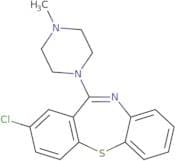
CAS 2058-52-8
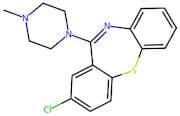
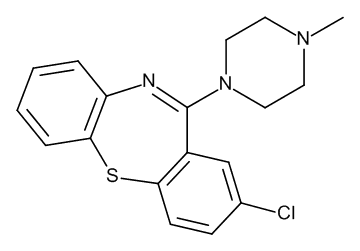
:Clotiapine
- 2-Chloro-11-(4-Methylpiperazin-1-Yl)Dibenzo[B,F][1,4]Thiazepine
- 2-Chloro-11-(4-methyl-1-piperazinyl)dibenzo(b,f)(1,4)thiazepine
- 2-Chloro-11-(4-methylpiperazino)dibenzo(b,f)(1,4)thiazepine
- Brn 0568276
- Clothiapin
- Clothiapine
- Clothiapine [USAN:BAN]
- Clotiapina
- Clotiapina [INN-Spanish]
- Clotiapinum
- Clotiapinum [INN-Latin]
- Deliton
- Dibenzo(b,f)(1,4)thiazepine, 2-chloro-11-(4-methyl-1-piperazinyl)-
- Dibenzothiazepine
- Entumin
- Entumine
- Etomine
- Etumine
- Hf 2159
- Lw 2159
- S-805C
- Unii-Z05Hcy0X1T
- W 130
- Voir plus de synonymes
13-chloro-10-(4-methylpiperazin-1-yl)-2-thia-9-azatricyclo[9.4.0.0,3,8]pentadeca-1(11),3(8),4,6,9,12,14-heptaene
CAS :Formule :C18H18ClN3SDegré de pureté :99%Couleur et forme :SolidMasse moléculaire :343.8736Clothiapine
CAS :Clothiapine is an atypical antipsychotic of the dibenzothiazepine chemical class.Formule :C18H18ClN3SDegré de pureté :99.93%Couleur et forme :SolidMasse moléculaire :343.87Clothiapine-d8
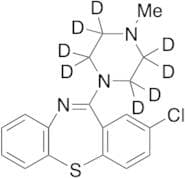
CAS :Produit contrôléApplications Clothiapine-d8, is the labeled analogue of Clothiapine (C588550), a atypical antipsychotic of the dibenzothiazepine chemical class. It has shown efficacy in treatment-resistant schizophrenic patients.
Not a dangerous good if item is equal to or less than 1g/ml and there is less than 100g/ml in the package
References Schmutz, J., et al.: Helvetica Chimica Acta 50, 245 (1967); Geller, V., et al.: Schizophrenia Research 80 (2-3), 343 (2005);Formule :C18H10D8ClN3SCouleur et forme :NeatMasse moléculaire :351.92Clothiapine
CAS :Produit contrôléStability Hygroscopic
Applications Clothiapine, is a atypical antipsychotic of the dibenzothiazepine chemical class. It has shown efficacy in treatment-resistant schizophrenic patients.
Not a dangerous good if item is equal to or less than 1g/ml and there is less than 100g/ml in the package
References Schmutz, J., et al.: Helvetica Chimica Acta 50, 245 (1967); Geller, V., et al.: Schizophrenia Research 80 (2-3), 343 (2005);Formule :C18H18ClN3SCouleur et forme :NeatMasse moléculaire :343.87Clothiapine
CAS :Produit contrôléClothiapine is a psychotropic agent, which is a type of drug used in psychiatry. It is sourced from the dibenzothiazepine class of compounds. As a thioxanthene derivative, clothiapine acts as a dopamine receptor antagonist, specifically targeting D2 receptors. This mode of action results in its antipsychotic effects by modulating neurotransmitter pathways in the brain, particularly those involving dopamine, which is often implicated in psychiatric disorders.
Formule :C18H18ClN3SDegré de pureté :Min. 95%Masse moléculaire :343.88 g/mol
![13-chloro-10-(4-methylpiperazin-1-yl)-2-thia-9-azatricyclo[9.4.0.0,3,8]pentadeca-1(11),3(8),4,6,9,…](/_next/image/?url=https%3A%2Fstatic.cymitquimica.com%2Fproducts%2FIN%2Fthumb%2FDA002ADN.jpg&w=3840&q=75)