CAS 20859-02-3
:L-tert-Leucine
Description :
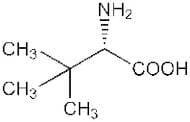
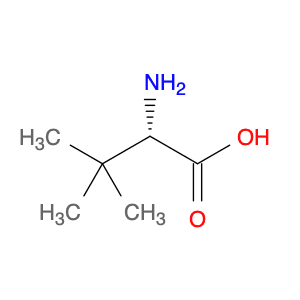
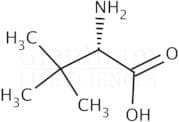
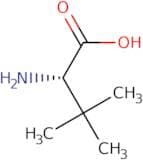
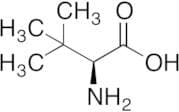
L-tert-Leucine, avec le numéro CAS 20859-02-3, est un dérivé d'acide aminé caractérisé par sa structure à chaîne ramifiée, qui est une marque distinctive de la leucine et de ses dérivés. C'est un composé non polaire et hydrophobe, ce qui le rend moins soluble dans l'eau par rapport aux acides aminés plus polaires. L-tert-Leucine présente un groupe tert-butyle attaché au carbone alpha, ce qui contribue à ses propriétés stériques uniques et influence ses interactions dans les systèmes biologiques. Ce composé est souvent utilisé dans la synthèse peptidique et comme élément de base dans le développement de produits pharmaceutiques et biochimiques. Sa chiralité, étant la forme L, est significative dans les contextes biologiques, car elle peut affecter l'activité et la fonction des peptides et des protéines. De plus, L-tert-Leucine peut participer à diverses réactions chimiques, y compris l'acylation et l'amidation, ce qui en fait un réactif polyvalent dans la synthèse organique. Dans l'ensemble, ses caractéristiques structurelles et ses propriétés font de L-tert-Leucine un composé important tant dans les applications de recherche que dans les applications industrielles.
Formule :C6H13NO2
InChI :InChI=1/C6H13NO2/c1-6(2,3)4(7)5(8)9/h4H,7H2,1-3H3,(H,8,9)
Code InChI :InChIKey=NPDBDJFLKKQMCM-SCSAIBSYSA-N
SMILES :[C@H](C(C)(C)C)(C(O)=O)N
Synonymes :- (2S)-2-Amino-3,3-dimethylbutanoic acid
- (S)-2-Amino-3,3-dimethylbutanoic acid
- (S)-2-Amino-3,3-dimethylbutyric acid
- (S)-tert-Butylglycine
- (S)-tert-Leucine
- 2-Amino-3,3-Dimethyl-Butanoic Acid
- 3-Methyl-<span class="text-smallcaps">L</span>-valine
- 3-Methyl-l-valine
- 3-Methylvaline
- <span class="text-smallcaps">L</span>-2-Amino-3,3-dimethylbutyric acid
- <span class="text-smallcaps">L</span>-Pseudoleucine
- <span class="text-smallcaps">L</span>-Valine, 3-methyl-
- <span class="text-smallcaps">L</span>-tert-Butylglycine
- <span class="text-smallcaps">L</span>-tert-Leucine
- Butyric acid, 2-amino-3,3-dimethyl-, <span class="text-smallcaps">L</span>-
- D-t-Butylglycine
- H-Tle-OH
- L-tert-Leucine
- L-valine,3-methyl
- NSC 203785
- Nsc203785
- tert-<span class="text-smallcaps">L</span>-Leucine
- tert-Butyl-<span class="text-smallcaps">L</span>-glycine
- β-Methyl-<span class="text-smallcaps">L</span>-valine
- Butyric acid, 2-amino-3,3-dimethyl-, L-
- β-Methyl-L-valine
- L-LEUCINE
- LEU
- L-α-tert-Butylglycine
- L-2-AMINO-4-METHYLVALERIC ACID
- L-2-(T-BUTYL)GLYCINE
- (2S)-2-Amino-3,3-dimethylbutanoicacid
- L-2-AMINO-4-METHYLPENTANOIC ACID
- L-TERT-LEUCINE, 99% (99% EE/GLC)
- FEMA 3297
- L-A-AMINO-G-METHYL VALERIC ACID
- LEUCINE
- H-LEU-OH
- (S)-(+)-LEUCINE
- L-LEU
- H-L-LEU-OH
- (S)-2-AMINO-4-METHYLPENTANOIC ACID
- LEUCINE, L-
- RARECHEM AB PP 3754
- L-A-AMINOISOCAPROIC ACID
- Voir plus de synonymes
Trier par
Degré de pureté (%)
0
100
|
0
|
50
|
90
|
95
|
100
10 produits concernés.
L-tert-Leucine
CAS :Formule :C6H13NO2Degré de pureté :>98.0%(T)Couleur et forme :White to Almost white powder to crystalMasse moléculaire :131.18L-tert-Leucine, 99%
CAS :L-tert-Leucine is an essential amino acid and makes up one third of our muscle protein. It can be used as a food additive. It is used in the formation of sterols. It is used in the production of cobalt oxazoline palladacycles complex, which acts as a catalyst in the rearrangement of prochiral N-arylFormule :C6H13NO2Degré de pureté :99%Couleur et forme :White, Crystals or powder or crystalline powderMasse moléculaire :131.18L-Valine, 3-methyl-
CAS :Formule :C6H13NO2Degré de pureté :98%Couleur et forme :SolidMasse moléculaire :131.1729Ref: IN-DA002JSN
1gÀ demander5gÀ demander10g20,00€25g23,00€50g28,00€5kg530,00€100g28,00€10kgÀ demander200g52,00€25kgÀ demander500g80,00€3-Methyl-L-valine
CAS :3-Methyl-L-valineFormule :C6H13NO2Degré de pureté :97%Couleur et forme : light beige powderMasse moléculaire :131.17g/molL-tert-Leucine
CAS :Formule :C6H13NO2Degré de pureté :98%Couleur et forme :SolidMasse moléculaire :131.175L-tert-Leucine
CAS :L-tert-Leucine is a chiral compound that inhibits the activity of metalloproteases, enzymes that catalyze the breakdown of proteins. L-tert-Leucine has been shown to inhibit proteolytic activity in recombinant cells and bacterial strain such as Escherichia coli, Pseudomonas aeruginosa, and Bacillus subtilis. L-tert-Leucine binds to the active site of metalloproteases by competitive inhibition, inhibiting the breakdown of proteins. This compound also prevents degradation of dinucleotide phosphate and chiral synthesis. The enantiopure form of this compound is used as a substrate for kinetic studies with type strains of various metalloprotease enzymes.Formule :C6H13NO2Degré de pureté :(%) Min. 95%Couleur et forme :White PowderMasse moléculaire :131.17 g/molL-tert-Leucine
CAS :Produit contrôléApplications L-tert-Leucine acts as a catalyst for the enantioselective oxidative coupling and cyclization of benzophenathrenols to oxa[9]helicenes.
References Sako, M., et al.: J. Amer. Chem. Society., 138, 11481-11484 (2016)Formule :C6H13NO2Couleur et forme :NeatMasse moléculaire :131.17