CAS 2086-96-6
:(+)-Tétrahydroberbérine
Description :
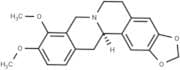
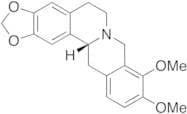
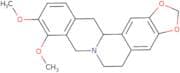
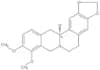
(+)-Tétrahydroberbérine est un alcaloïde d'origine naturelle dérivé de la plante Berberis, connu pour ses propriétés thérapeutiques potentielles. Il se caractérise par sa structure moléculaire, qui comprend un cadre de tétrahydroisoquinoline, contribuant à son activité biologique. Ce composé se trouve généralement sous forme cristalline et présente une couleur jaunâtre. (+)-Tétrahydroberbérine est reconnu pour sa capacité à interagir avec divers cibles biologiques, y compris son rôle dans la modulation des voies métaboliques et ses effets potentiels sur le métabolisme du glucose et les profils lipidiques. Il a suscité de l'intérêt dans le domaine de la pharmacologie pour ses applications possibles dans le traitement de conditions telles que le diabète et le syndrome métabolique. Le composé est soluble dans des solvants organiques mais a une solubilité limitée dans l'eau, ce qui peut affecter sa biodisponibilité. De plus, sa stéréochimie joue un rôle crucial dans ses effets pharmacologiques, l'énantiomère (+) étant souvent au centre des recherches en raison de son activité améliorée par rapport à d'autres formes. Dans l'ensemble, (+)-Tétrahydroberbérine représente un domaine d'étude significatif en chimie des produits naturels et en applications médicinales.
Formule :C20H21NO4
InChI :InChI=1S/C20H21NO4/c1-22-17-4-3-12-7-16-14-9-19-18(24-11-25-19)8-13(14)5-6-21(16)10-15(12)20(17)23-2/h3-4,8-9,16H,5-7,10-11H2,1-2H3/t16-/m1/s1
Code InChI :InChIKey=VZTUIEROBZXUFA-MRXNPFEDSA-N
SMILES :O(C)C1=C2CN3[C@@](C=4C(=CC5=C(C4)OCO5)CC3)(CC2=CC=C1OC)[H]
Synonymes :- d-Canadine
- (13aR)-5,8,13,13a-Tetrahydro-9,10-dimethoxy-6H-benzo[g]-1,3-benzodioxolo[5,6-a]quinolizine
- 6H-Benzo[g]-1,3-benzodioxolo[5,6-a]quinolizine, 5,8,13,13a-tetrahydro-9,10-dimethoxy-, (R)-
- Berbine, 9,10-dimethoxy-2,3-(methylenedioxy)-, (+)-
- 6H-Benzo[g]-1,3-benzodioxolo[5,6-a]quinolizine, 5,8,13,13a-tetrahydro-9,10-dimethoxy-, (13aR)-
Trier par
Degré de pureté (%)
0
100
|
0
|
50
|
90
|
95
|
100
3 produits concernés.
(R)-(+)-Tetrahydroberberine
CAS :<p>(R)-(+)-Tetrahydroberberine, the inactive isomer of (S)-(-)-Tetrahydroberberine, serves as an experimental control. The latter, an alkaloid and intermediate in berberine biosynthesis, exhibits insecticidal activity [1].</p>Formule :C20H21NO4Couleur et forme :SolidMasse moléculaire :339.39(R)-(+)-Canadine
CAS :Produit contrôlé<p>Applications (R)-(+)-Canadine is a protoberberine alkaloid with central depressant action and adenylate cyclase inhibitor activity.<br>References Sheppard, H. & Burghardt, C.: Biochem. Pharmacol., 27, 1113 (1978); Yamahara, J. et al.: Chem. Pharm. Bull., 24, 1909 (1976)<br></p>Formule :C20H21NO4Couleur et forme :NeatMasse moléculaire :339.39(R)-(+)-Canadine
CAS :<p>(R)-(+)-Canadine is a naturally occurring alkaloid, which is an isoquinoline compound most commonly sourced from plants like Berberis and Corydalis species. It plays a crucial role in the plant's defense mechanisms, particularly due to its structural and functional properties. The mode of action of (R)-(+)-Canadine involves the inhibition of various enzymes, including those linked to microbial growth. This gives it significant antimicrobial properties, which have been studied for potential applications in combating bacterial infections. Additionally, (R)-(+)-Canadine exhibits interactions with cellular ion channels, contributing to its broader pharmacological effects.</p>Formule :C20H21NO4Degré de pureté :Min. 95%Masse moléculaire :339.4 g/mol