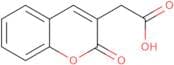
CAS 20862-58-2
:Acide 2-oxo-2H-1-benzopyrane-3-acétique
Description :
Acide 2-oxo-2H-1-benzopyrane-3-acétique (CAS 20862-58-2) est un composé chimique qui appartient à la classe des flavonoïdes, spécifiquement à un type de dérivé de coumarine. Ce composé présente une structure de benzopyran, caractérisée par un anneau de benzène et un anneau de pyran fusionnés, et contient un groupe fonctionnel acide acétique et un groupe cétone en position 2. Sa structure moléculaire contribue à ses activités biologiques potentielles, y compris des propriétés antioxydantes et anti-inflammatoires. Le composé est généralement un solide blanc à blanc cassé et est soluble dans des solvants organiques. Il peut présenter divers effets pharmacologiques, ce qui le rend intéressant en chimie médicinale et en recherche de produits naturels. Comme de nombreux composés organiques, sa stabilité et sa réactivité peuvent être influencées par des facteurs environnementaux tels que le pH et la température. Les données de sécurité doivent être consultées pour la manipulation et l'utilisation, comme pour toute substance chimique.
Formule :C11H8O4
Synonymes :- 2-(2-oxochromen-3-yl)ethanoic acid
- (2-Oxo-2H-chromen-3-yl)acetic acid
- 2-(2-OXO-2H-CHROMEN-3-YL)ACETIC ACID
- 2H-1-Benzopyran-3-acetic acid, 2-oxo-
- 2-(2-oxochromen-3-yl)acetic acid
- 2-(2-oxo-3-chromenyl)acetic acid
- Acetic acid, 2-(coumarin-3-yl)-
- AKOS MSC-0227
- Coumarin-3-acetic acid
- 2-(2-ketochromen-3-yl)acetic acid
Trier par
Degré de pureté (%)
0
100
|
0
|
50
|
90
|
95
|
100
1 produits concernés.
(2-Oxo-2H-chromen-3-yl)acetic acid
CAS :(2-Oxo-2H-chromen-3-yl)acetic acid is a molecule that has been shown to have antibacterial activity against Staphylococcus aureus and other bacteria. It is an amide that reacts with lysine residues in the bacterial cell wall, which leads to inhibition of growth. (2-Oxo-2H-chromen-3-yl)acetic acid also has conjugates with malic acid, which can be used as a fluorescent indicator for its presence in bacterial cells. This compound has been shown to be active against Gram-positive and Gram-negative bacteria, but not against Mycobacterium tuberculosis or Mycobacterium avium complex. The dilution method is used to determine the concentration of this compound in bacterial cells.
Formule :C11H8O4Degré de pureté :Min. 95%Couleur et forme :PowderMasse moléculaire :204.18 g/mol