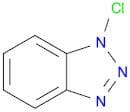
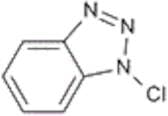
CAS 21050-95-3
:1-Chlorobenzotriazole
- 1-Chloro-1,2,3-benzotriazole
- 1-Chloro-1H-1,2,3-benzotriazole
- 1-Chloro-benzotriazole
- 1-Chlorobenzotriazole
- 1H-Benzotriazole, 1-chloro-
- Ai3-61733
- N-Chlorobenzotriazole
- Nsc 186037
- 1-Chloro-1H-benzotriazole
- 1-chloro-1H-benzo[d][1,2,3]triazole
1-Chlorobenzotriazole
CAS :Produit contrôléApplications Oxidation and chlorination reagent.
Formule :C6H4ClN3Couleur et forme :NeatMasse moléculaire :153.571-Chloro-1H-benzo[d][1,2,3]triazole
CAS :Formule :C6H4ClN3Degré de pureté :97%Couleur et forme :SolidMasse moléculaire :153.571H-Benzotriazole, 1-chloro-
CAS :Formule :C6H4ClN3Degré de pureté :95%Couleur et forme :SolidMasse moléculaire :153.56911-Chlorobenzotriazole
CAS :1-Chlorobenzotriazole is a nucleophilic reagent that can be used in analytical chemistry, such as the determination of propranolol hydrochloride. It reacts with phospholipid membranes by transferring a chlorine atom to the hydroxyl group on the lipid molecule. The reaction mechanism is not well understood, but it has been shown that the deuterium isotope effect is not involved in this reaction. 1-Chlorobenzotriazole is unsymmetrical and can react with both acidic and alkaline solutions. Hydrochloric acid is often used to activate this compound, which will then react with an amine group to form an iminium ion. Kinetics data for this compound show that activation energies are required for reactions involving nucleophiles, such as ketones, alcohols, or amines.
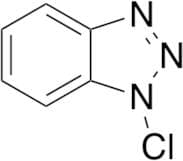
Formule :C6H4ClN3Degré de pureté :Min. 95%Masse moléculaire :153.57 g/mol
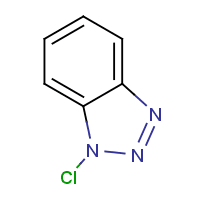


![1-Chloro-1H-benzo[d][1,2,3]triazole](/_next/image/?url=https%3A%2Fstatic.cymitquimica.com%2Fproducts%2F10%2Fthumb%2FF236974.jpg&w=3840&q=75)