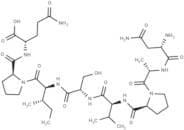
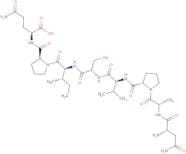
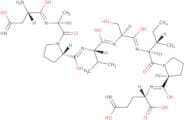
CAS 211439-12-2
:L-Glutamine, L-asparaginyl-L-alanyl-L-prolyl-L-valyl-L-sérinyl-L-isoleucyl-L-prolyl-
Description :
La substance chimique portant le nom "L-Glutamine, L-asparaginyle-L-alanyle-L-prolyle-L-valyle-L-séryle-L-isoleucine-L-prolyle-" et le numéro CAS 211439-12-2 est un peptide composé de plusieurs acides aminés, spécifiquement L-glutamine et plusieurs autres L-acides aminés. Ce composé se caractérise par sa structure, qui comprend une séquence d'acides aminés liés par des liaisons peptidiques, contribuant à son activité biologique potentielle. Les peptides comme celui-ci peuvent jouer des rôles significatifs dans divers processus physiologiques, y compris la synthèse des protéines, la signalisation cellulaire et la régulation métabolique. La présence de plusieurs L-acides aminés suggère que ce peptide peut présenter des propriétés conformationnelles spécifiques, influençant sa stabilité et ses interactions avec des cibles biologiques. De plus, la séquence d'acides aminés peut déterminer la solubilité, la réactivité et la fonctionnalité globale du peptide dans les systèmes biologiques. De tels composés sont souvent étudiés pour leur potentiel thérapeutique, y compris des applications en nutrition, médecine et biochimie. Cependant, des études détaillées seraient nécessaires pour comprendre pleinement ses propriétés spécifiques et ses utilisations potentielles.
Formule :C36H60N10O12
Trier par
Degré de pureté (%)
0
100
|
0
|
50
|
90
|
95
|
100
4 produits trouvés.
L-Asparaginyl-L-alanyl-L-prolyl-L-valyl-L-seryl-L-isoleucyl-L-prolyl-L-glutamine
CAS :Formule :C36H60N10O12Degré de pureté :97%Couleur et forme :SolidMasse moléculaire :824.9214Davunetide
CAS :Davunetide: neuroprotective 8-amino acid peptide, improves daily function in schizophrenia, boosts memory in mild cognitive impairment.Formule :C36H60N10O12Degré de pureté :98%Couleur et forme :SolidMasse moléculaire :824.92NAP
CAS :NAP is a neuroprotective peptide, which is derived from activity-dependent neuroprotective protein (ADNP), with a mechanism involving microtubule stabilization and neuronal protection. It exhibits the ability to protect neurons from various types of damage, including oxidative stress and conditions mimicking neurodegenerative diseases. NAP enhances axonal transport and increases the resilience of neurons to insults that would typically result in cell death. This peptide has shown promise in preclinical studies for its potential to halt or reverse cognitive decline, making it a focal point for research into therapeutic strategies for disorders like Alzheimer's disease and other tauopathies. The peptide operates by binding to microtubules, promoting stability, and facilitating efficient transport of cellular components. Studies have highlighted its role in traversing the blood-brain barrier, which makes it a viable candidate for central nervous system-targeted therapies. Researchers continue to explore its efficacy and possible applications in improving cognitive function and providing neuroprotection in aging populations.Degré de pureté :(Hplc-Ms) Min. 98 Area-%NAP
CAS :NAP is a potent, selective and orally bioavailable inhibitor of bacterial nitrate reductase. It has been shown to have broad-spectrum activity against Gram-positive and Gram-negative bacteria. NAP inhibits the synthesis of DNA, which is essential for the bacterial cell cycle. It binds to the active site of the enzyme, thereby inhibiting the reduction of nitrite to nitric oxide. NAP also displays high selectivity for bacteria with respect to mammalian cells. This agent has been shown to be effective in treating bowel disease by reducing nitrate levels in the gut, as well as in models of neuronal death caused by cerebral ischemia.Formule :C36H60N10O12Degré de pureté :(Hplc-Ms) Min. 98 Area-%Masse moléculaire :824.93 g/mol