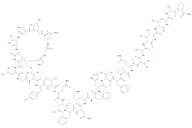
CAS 21215-62-3
:calcitonine M
Description :
calcitonine M, identifié par le numéro CAS 21215-62-3, est un peptide synthétique qui imite l'hormone naturelle calcitonine, produite par la glande thyroïde. Cette substance est principalement connue pour son rôle dans la régulation des niveaux de calcium dans le corps en inhibant l'activité des ostéoclastes, réduisant ainsi la résorption osseuse et favorisant la formation osseuse. calcitonine M se caractérise par sa structure peptidique, qui consiste en une séquence spécifique d'acides aminés conférant son activité biologique. Il est généralement administré par injection et est utilisé dans des contextes cliniques pour traiter des conditions telles que l'ostéoporose et la maladie de Paget, où il est nécessaire d'augmenter la densité osseuse. Le peptide présente une demi-vie relativement courte dans la circulation, nécessitant un dosage et une administration soigneux. De plus, calcitonine M peut avoir des caractéristiques de stabilité et de solubilité variables selon sa formulation, ce qui peut influencer sa pharmacocinétique et son efficacité thérapeutique. Dans l'ensemble, calcitonine M représente un agent thérapeutique important dans la gestion des troubles liés aux os.
Formule :C151H226N40O45S3
InChI :InChI=1/C151H228N40O45S3/c1-17-75(8)118(144(229)163-67-114(205)183-117(74(6)7)143(228)162-64-112(203)165-77(10)150(235)190-50-29-38-106(190)124(158)209)185-125(210)76(9)166-145(230)120(79(12)194)186-131(216)92(45-47-109(155)200)170-142(227)107-39-30-51-191(107)151(236)103(58-85-35-25-20-26-36-85)180-148(233)122(81(14)196)188-139(224)99(59-87-63-159-71-164-87)176-133(218)96(55-83-31-21-18-22-32-83)174-128(213)90(37-27-28-49-152)168-136(221)101(61-111(157)202)177-134(219)97(56-84-33-23-19-24-34-84)175-137(222)102(62-116(207)208)178-129(214)91(44-46-108(154)199)171-147(232)121(80(13)195)187-138(223)98(57-86-40-42-88(198)43-41-86)179-146(231)119(78(11)193)184-115(206)66-161-127(212)94(53-72(2)3)172-130(215)93(48-52-239-16)169-141(226)105(70-238)182-149(234)123(82(15)197)189-140(225)104(68-192)181-132(217)95(54-73(4)5)173-135(220)100(60-110(156)201)167-113(204)65-160-126(211)89(153)69-237/h18-26,31-36,40-43,63,71-82,89-107,117-123,192-198,237-238H,17,27-30,37-39,44-62,64-70,152-153H2,1-16H3,(H2,154,199)(H2,155,200)(H2,156,201)(H2,157,202)(H2,158,209)(H,159,164)(H,160,211)(H,161,212)(H,162,228)(H,163,229)(H,165,203)(H,166,230)(H,167,204)(H,168,221)(H,169,226)(H,170,227)(H,171,232)(H,172,215)(H,173,220)(H,174,213)(H,175,222)(H,176,218)(H,177,219)(H,178,214)(H,179,231)(H,180,233)(H,181,217)(H,182,234)(H,183,205)(H,184,206)(H,185,210)(H,186,216)(H,187,223)(H,188,224)(H,189,225)(H,207,208)/t75-,76-,77-,78+,79+,80+,81+,82+,89-,90-,91-,92-,93-,94-,95-,96-,97-,98-,99-,100-,101-,102-,103-,104-,105-,106-,107-,117-,118-,119-,120-,121-,122-,123-/m0/s1
Synonymes :- Thyrocalcitonin Human
- Calcitonin human
- H-Cys-Gly-Asn-Leu-Ser-Thr-Cys-Met-Leu-Gly-Thr-Tyr-Thr-Gln-Asp-Phe-Asn-Lys-Phe-His-Thr-Phe-Pro-Gln-Thr-Ala-Ile-Gly-Val-Gly-Ala-Pro-NH2 (Disulfide bond)
Trier par
Degré de pureté (%)
0
100
|
0
|
50
|
90
|
95
|
100
7 produits concernés.
Calcitonin, human, 96%
CAS :For cellular and molecular biology applications
Degré de pureté :96%Couleur et forme :White, PowderCalcitonin (human)
CAS :Calcitonin is a peptide hormone involved in calcium and phosphorus homeostasis. Its inhibitory effect on osteoclast activity lowers blood calcium levels and positively influences bone mass density.Formule :C151H226N40O45S3Degré de pureté : 96.1%Couleur et forme :WhiteMasse moléculaire :3417.9Calcitonin (human)
CAS :Endogenous calcitonin receptor agonist. Lowers systemic blood calcium levels and inhibits bone resorption.Formule :C151H226N40O45S3Degré de pureté :98%Couleur et forme :White Lyophilized PowderMasse moléculaire :3417.87Calcitonin (Human)
CAS :Calcitonin is a hormone produced by the C cells (also known as parafollicular cells) in the thyroid gland. Its main function is to regulate the levels of calcium and phosphate in the blood. Calcitonin works by inhibiting the activity of osteoclasts, which are cells that break down bone tissue and release calcium and phosphate into the bloodstream. This leads to a decrease in the amount of calcium and phosphate in the blood. Calcitonin is released in response to high levels of calcium in the blood, and it acts to reduce these levels by increasing the excretion of calcium by the kidneys and inhibiting the absorption of calcium by the intestines. It also promotes the storage of calcium in the bones, which helps to maintain their strength and density. Calcitonin may be used therapeutically to treat conditions such as osteoporosis and hypercalcemia (high levels of calcium in the blood) or even diagnostically as a marker for tumors in medullary thyroid cancer. This product has a disulfide bond between Cys1-Cys7 and is available as a 0.1mg vial.Formule :C151H226N40O45S3Degré de pureté :Min. 95%Masse moléculaire :3,417.8 g/molCalcitonin (Human)
CAS :Calcitonin is a hormone produced by the C cells (also known as parafollicular cells) in the thyroid gland. Its main function is to regulate the levels of calcium and phosphate in the blood. Calcitonin works by inhibiting the activity of osteoclasts, which are cells that break down bone tissue and release calcium and phosphate into the bloodstream. This leads to a decrease in the amount of calcium and phosphate in the blood. Calcitonin is released in response to high levels of calcium in the blood, and it acts to reduce these levels by increasing the excretion of calcium by the kidneys and inhibiting the absorption of calcium by the intestines. It also promotes the storage of calcium in the bones, which helps to maintain their strength and density. Calcitonin may be used therapeutically to treat conditions such as osteoporosis and hypercalcemia (high levels of calcium in the blood) or even diagnostically as a marker for tumors in medullary thyroid cancer. This product has a disulfide bond between Cys1-Cys7 and is available as a 0.5mg vial.Formule :C151H226N40O45S3Degré de pureté :Min. 95%Masse moléculaire :3,417.8 g/molCalcitonin (human) trifluoroacetate salt
CAS :Trifluoroacetate saltFormule :C151H226N40O45S3Degré de pureté :Min. 95%Masse moléculaire :3,417.85 g/molCALCITONIN, HUMAN
CAS :Formule :C151H226N40O45S3Degré de pureté :97%Couleur et forme :SolidMasse moléculaire :3417.846139999987