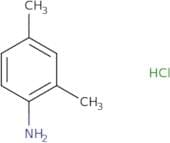
CAS 21436-96-4
:chlorhydrate de 2,4-diméthylaniline
Description :
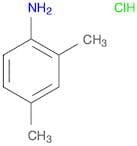
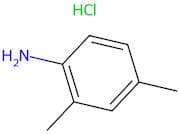
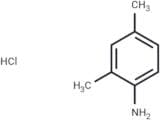
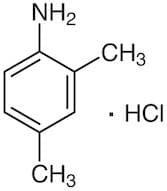
chlorhydrate de 2,4-diméthylaniline est un composé organique qui appartient à la classe des anilines, qui sont des amines aromatiques. Il se caractérise par la présence de deux groupes méthyle attachés au cycle benzénique aux positions 2 et 4, ainsi qu'un groupe amino (-NH2) qui est protoné sous forme de sel hydrochlorique. Ce composé apparaît généralement comme un solide cristallin blanc à blanc cassé et est soluble dans l'eau en raison de la présence du chlorhydrate, qui améliore sa solubilité par rapport à la forme de base libre. Il a des applications dans divers domaines, y compris la fabrication de colorants, les produits pharmaceutiques et comme intermédiaire dans la synthèse organique. Le composé présente des propriétés basiques en raison du groupe amino, ce qui lui permet de participer à diverses réactions chimiques, telles que les substitutions nucléophiles. Des précautions de sécurité doivent être prises lors de la manipulation de cette substance, car elle peut présenter des risques pour la santé, notamment des irritations cutanées et respiratoires. Un stockage approprié dans un endroit frais et sec, loin des substances incompatibles, est également recommandé pour maintenir sa stabilité.
Formule :C8H12ClN
InChI :InChI=1/C8H11N.ClH/c1-6-3-4-8(9)7(2)5-6;/h3-5H,9H2,1-2H3;1H
Code InChI :InChIKey=HFXISSJBRAPVLG-UHFFFAOYSA-N
SMILES :CC1=C(N)C=CC(C)=C1.Cl
Synonymes :- 1-Amino-2,4-dimethylbenzene hydrochloride
- 2,4-Dimethylaniline Hydrochloride (1:1)
- 2,4-Dimethylanilinium chloride
- 2,4-Dimethylbenzenamine hydrochloride
- 2,4-Xylidine, hydrochloride
- 2-Methyl-p-toluidine hydrochloride
- 4-Amino-1,3-dimethylbenzene hydrochloride
- 4-Amino-1,3-xylene hydrochloride
- 4-Amino-3-methyltoluene hydrochloride
- 4-Methyl-o-toluidine hydrochloride
- Benzenamine, 2,4-dimethyl-, hydrochloride
- Benzenamine, 2,4-dimethyl-, hydrochloride (1:1)
- Ccris 255
- m-4-Xylidine hydrochloride
- m-Xylidine hydrochloride
- 2,4-Dimethylaniline hydrochloride
- 4-amino-1,3-xylenehydrochloride
- 2,4-Dimethylaniline HCl
- 4-amino-1,3-dimethylbenzenehydrochloride
- 2,4-DIMETHYLANILINE HYDROCHLORIDE 98+%
- 1-amino-2,4-dimethylbenzenehydrochloride
- 4-amino-3-methyltoluenehydrochloride
- 4-methyl-o-toluidinehydrochloride
- 2-methyl-p-toluidinehydrochloride
- 2,4-dimethylbenzenaminehydrochloride
- Voir plus de synonymes
Trier par
Degré de pureté (%)
0
100
|
0
|
50
|
90
|
95
|
100
6 produits concernés.
2,4-Dimethylaniline Hydrochloride
CAS :Formule :C8H12ClNDegré de pureté :98%Couleur et forme :SolidMasse moléculaire :157.64062,4-Dimethylaniline hydrochloride
CAS :2,4-Dimethylaniline hydrochlorideDegré de pureté :99%Masse moléculaire :157.64g/mol2,4-Xylidine hydrochloride
CAS :2,4-Xylidine hydrochloride is a bioactive chemical.Formule :C8H12ClNCouleur et forme :SolidMasse moléculaire :157.642,4-Dimethylaniline Hydrochloride
CAS :Formule :C8H11N·HClDegré de pureté :>98.0%(T)(HPLC)Couleur et forme :White to Light yellow powder to crystalMasse moléculaire :157.642,4-Dimethylaniline Hydrochloride
CAS :2,4-Dimethylaniline hydrochloride is a nitrogen containing compound that can be found in the environment. It has been shown to have antimicrobial activity against gram-positive bacteria and fungi. The mechanism of 2,4-dimethylaniline hydrochloride is through the transfer of electrons from cytochrome c oxidase to molecular oxygen (O2). This electron transfer results in the oxidation of 2,4-dimethylaniline hydrochloride and the reduction of molecular oxygen (O2) to water (H2O). 2,4-Dimethylaniline hydrochloride also has a basic structure with two nitrogen atoms that are able to form intermolecular hydrogen bonding interactions. The matrix effect may have an impact on the analytical method used for this compound. The kinetic studies were done at low temperature and high concentrations. Solid phase microextraction was used as an analytical method for this compound. Coordination geometry was not discussed in this articleFormule :C8H11N·HClDegré de pureté :Min. 95%Masse moléculaire :157.64 g/mol