CAS 2148-31-4
:N-acétyl-S-(1,2-dichlorovinyle)-L-cystéine
Description :
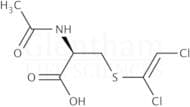
N-acétyl-S-(1,2-dichlorovinyle)-L-cystéine, avec le numéro CAS 2148-31-4, est un composé synthétique qui appartient à la classe des composés organosulfurés. Il présente une structure de cystéine, qui est un acide aminé contenant un groupe thiol, et est modifié avec un groupe N-acétyle et un moiety dichlorovinyle. Ce composé est remarquable pour son activité biologique potentielle, en particulier dans le contexte de son rôle en tant que métabolite de certains pesticides organochlorés. Sa structure permet des interactions avec des systèmes biologiques, ce qui peut entraîner divers effets biochimiques. La présence du groupe dichlorovinyle suggère une réactivité potentielle, en particulier dans les réactions de substitution nucléophile, en raison de la nature attractrice des électrons des atomes de chlore. De plus, la modification N-acétyle peut influencer la solubilité et la stabilité dans les environnements biologiques. Dans l'ensemble, N-acétyl-S-(1,2-dichlorovinyle)-L-cystéine est d'un intérêt en toxicologie et en chimie environnementale, en particulier en ce qui concerne ses implications pour la santé humaine et les systèmes écologiques.
Formule :C7H9Cl2NO3S
InChI :InChI=1S/C7H9Cl2NO3S/c1-4(11)10-5(7(12)13)3-14-6(9)2-8/h2,5H,3H2,1H3,(H,10,11)(H,12,13)/t5-/m0/s1
Code InChI :InChIKey=LPPJGTSPIBSYQO-YFKPBYRVSA-N
SMILES :[C@@H](CSC(=CCl)Cl)(NC(C)=O)C(O)=O
Synonymes :- (R)-2-Acetamido-3-((1,2-dichlorovinyl)thio)propanoic acid
- <span class="text-smallcaps">L</span>-Cysteine, N-acetyl-S-(1,2-dichloroethenyl)-
- Alanine, N-acetyl-3-[(1,2-dichlorovinyl)thio]-
- Alanine, N-acetyl-3-[(1,2-dichlorovinyl)thio]-, <span class="text-smallcaps">L</span>-
- N-Acetyl S-(1,2-dichlorovinyl)-<span class="text-smallcaps">L</span>-cysteine
- N-Acetyl-S-(1,2-dichloroethenyl)-<span class="text-smallcaps">L</span>-cysteine
- N-Acetyl-S-(1,2-dichlorovinyl)-L-cysteine
- L-Cysteine, N-acetyl-S-(1,2-dichloroethenyl)-
- Alanine, N-acetyl-3-[(1,2-dichlorovinyl)thio]-, L-
- N-Acetyl-S-(1,2-dichloroethenyl)-L-cysteine
Trier par
Degré de pureté (%)
0
100
|
0
|
50
|
90
|
95
|
100
4 produits concernés.
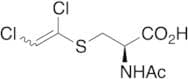
N-Acetyl-S-(1,2-dichloroethenyl)-L-cysteine
CAS :Produit contrôléApplications Trichloroethylene metabolite
References Werner, M., et al.: Chem. Res. Toxicol., 9, 41 (1996), Bruning, T., et al.: Toxicol. Sci., 41, 157 (1998), Newman, D., et al.: Drug Metab. Disposition, 35, 43 (2007),Formule :C7H9Cl2NO3SCouleur et forme :NeatMasse moléculaire :258.12N-Acetyl-S-(1,2-dichloroethenyl)-L-cysteine-13C,d3
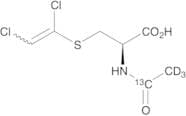
CAS :Produit contrôléApplications Labelled trichloroethylene metabolite
References Werner, M., et al.: Chem. Res. Toxicol., 9, 41 (1996), Bruning, T., et al.: Toxicol. Sci., 41, 157 (1998), Newman, D., et al.: Drug Metab. Disposition, 35, 43 (2007),Formule :C613CH6D3Cl2NO3SCouleur et forme :NeatMasse moléculaire :262.13N-Acetyl-S-(1,2-dichloroethenyl)-L-cysteine
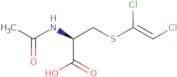
CAS :N-Acetyl-S-(1,2-dichloroethenyl)-L-cysteine is a reactive compound that is formed from the metabolism of acetaminophen. It has been shown to cause oxidative injury in the mitochondria of proximal tubule cells. N-Acetyl-S-(1,2-dichloroethenyl)-L-cysteine disrupts mitochondrial membrane potential and causes ATP depletion. It also causes mitochondrial dysfunction by inhibiting respiratory chain activity and lowering cytosolic calcium levels. N-Acetyl-S-(1,2-dichloroethenyl)-L-cysteine has been shown to be toxic in animals and humans. The main analytical method used to detect this compound is the tetrazolium dye assay.Formule :C7H9Cl2NO3SDegré de pureté :Min. 95%Masse moléculaire :258.12 g/mol