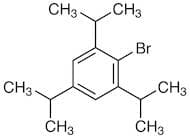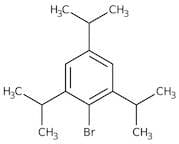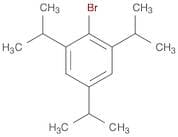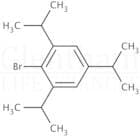
CAS 21524-34-5
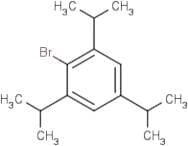
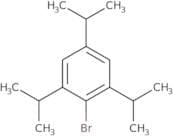
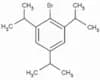
:2-Bromo-1,3,5-triisopropylbenzène
Description :
2-Bromo-1,3,5-triisopropylbenzène est un composé organique caractérisé par sa structure aromatique, comportant un atome de brome et trois groupes isopropyles attachés à un anneau de benzène. La présence du substituant brome introduit un halogène, qui peut influencer la réactivité et les propriétés physiques du composé, telles que les points d'ébullition et de fusion. Les groupes isopropyles contribuent à la masse stérique et au caractère hydrophobe de la molécule, affectant sa solubilité dans divers solvants. En général, des composés comme celui-ci présentent une solubilité modérée à faible dans l'eau, mais sont plus solubles dans des solvants organiques. Le composé peut être utilisé dans la synthèse organique et comme intermédiaire dans la production d'autres substances chimiques. Sa réactivité peut être influencée par l'atome de brome, qui peut subir des réactions de substitution nucléophile. Des considérations de sécurité doivent être prises en compte lors de la manipulation de ce composé, car les composés bromés peuvent présenter des risques pour la santé. Dans l'ensemble, 2-Bromo-1,3,5-triisopropylbenzène est un composé notable dans le domaine de la chimie organique en raison de ses caractéristiques structurelles uniques et de ses applications potentielles.
Formule :C15H23Br
InChI :InChI=1/C15H23Br/c1-9(2)12-7-13(10(3)4)15(16)14(8-12)11(5)6/h7-11H,1-6H3
SMILES :CC(C)c1cc(C(C)C)c(c(c1)C(C)C)Br
Synonymes :- 1-Bromo-2,4,6-triisopropylbenzene
- 2,4,6-Triisopropylbromobenzene
- 2-Bromo-1,3,5-Tri(Propan-2-Yl)Benzene
- 1,3,5-Triisopropyl-2-bromobenzene
- 1-Bromo-2,4,6-(triisopropyl)benzene
Trier par
Degré de pureté (%)
0
100
|
0
|
50
|
90
|
95
|
100
7 produits concernés.
2-Bromo-1,3,5-triisopropylbenzene
CAS :Formule :C15H23BrDegré de pureté :>95.0%(GC)Couleur et forme :Colorless to Light yellow clear liquidMasse moléculaire :283.252-Bromo-1,3,5-triisopropylbenzene, 96%
CAS :2-Bromo-1,3,5-triisopropylbenzene is used in Suzuki reaction. It is found to effect highly selective ring closures of homoallylic alcohols to substituted tetrahydrofurans. This Thermo Scientific Chemicals brand product was originally part of the Alfa Aesar product portfolio. Some documentation and lFormule :C15H23BrDegré de pureté :96%Couleur et forme :Clear colorless to pale yellow, LiquidMasse moléculaire :283.252-Bromo-1,3,5-triisopropylbenzene
CAS :Formule :C15H23BrDegré de pureté :97%Couleur et forme :LiquidMasse moléculaire :283.24712-Bromo-1,3,5-triisopropylbenzene
CAS :2-Bromo-1,3,5-triisopropylbenzene
Formule :C15H23BrDegré de pureté :97%Couleur et forme : colourless liquidMasse moléculaire :283.25g/mol2-Bromo-1,3,5-triisopropylbenzene
CAS :Formule :C15H23BrDegré de pureté :97%Couleur et forme :SolidMasse moléculaire :283.2532-Bromo-1,3,5-triisopropylbenzene
CAS :2-Bromo-1,3,5-triisopropylbenzene is an ethylene acetal that is prepared by the catalyzed reaction of aryl chlorides and anhydrous zinc bromide in the presence of triethylamine. The selectivities of this method are high because it can produce mainly a single isomer. The stereoselectivity is also high because the reaction proceeds with the formation of only one stereoisomer. The mechanism for this reaction involves a nucleophilic substitution of the halogenated aryl chloride with the trialkylborane, which generates two different products. This product has been used in the synthesis of biphenyls and nitro compounds.
Formule :C15H23BrDegré de pureté :Min. 95%Couleur et forme :Colorless Clear LiquidMasse moléculaire :283.25 g/mol