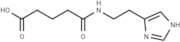
CAS 219694-63-0
:Ingavirine
Description :
Ingavirine, avec le numéro CAS 219694-63-0, est un médicament antiviral principalement utilisé dans le traitement de la grippe et d'autres infections virales. Il se caractérise par son mécanisme d'action, qui implique la modulation de la réponse immunitaire et l'inhibition de la réplication virale. Ingavirine est connu pour sa capacité à augmenter la production d'interférons, qui sont des protéines jouant un rôle crucial dans la défense de l'organisme contre les infections virales. La substance est généralement administrée par voie orale et est reconnue pour son profil de toxicité relativement faible. Ingavirine est souvent noté pour son action rapide et est généralement prescrit pour une utilisation dans les premières étapes des infections virales. Sa structure chimique comprend un noyau d'imidazole, contribuant à son activité biologique. Bien qu'il soit efficace contre diverses souches de grippe, son utilisation doit être guidée par un avis médical, en tenant compte des contre-indications potentielles et des interactions avec d'autres médicaments. Dans l'ensemble, Ingavirine représente une option significative dans la thérapie antivirale, en particulier dans les régions où la grippe est prévalente.
- 5-[2-(1H-imidazol-5-yl)ethylamino]-5-oxopentanoic acid
- 5-((2-(1H-imidazol-5-yl)ethyl)amino)-5-oxopentanoic acid
Trier par
Degré de pureté (%)
0
100
|
0
|
50
|
90
|
95
|
100
6 produits concernés.
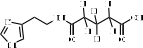
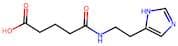
4-{[2-(1H-imidazol-5-yl)ethyl]carbamoyl}butanoic acid
CAS :Formule :C10H15N3O3Degré de pureté :95%Couleur et forme :SolidMasse moléculaire :225.2444Ingavirin-d6
CAS :Formule :C10H9D6N3O3Couleur et forme :White To Off-White SolidMasse moléculaire :231.285-((2-(1H-Imidazol-5-yl)ethyl)amino)-5-oxopentanoic acid
CAS :5-((2-(1H-Imidazol-5-yl)ethyl)amino)-5-oxopentanoic acidDegré de pureté :95%Masse moléculaire :225.25g/molIngavirin
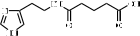
CAS :Formule :C10H15N3O3Couleur et forme :White To Off-White SolidMasse moléculaire :225.254-{[2-(1H-Imidazol-5-yl)ethyl]carbamoyl}butanoic acid
CAS :4-{[2-(1H-Imidazol-5-yl)ethyl]carbamoyl}butanoic acid (4AICB) is a potent replication inhibitor of the influenza virus. It targets the viral RNA polymerase (RdRP), which is essential for virus replication and transcription. 4AICB inhibits the activity of RdRP by binding to its active site, thereby preventing the initiation of transcription. This mechanism of action has been shown to be effective against influenza A viruses and other RNA viruses. In addition, this drug has been shown to inhibit growth factor signaling pathways in human hematopoietic cells, which may be responsible for its anti-inflammatory effects. 4AICB also possesses pharmacokinetic properties that make it an ideal candidate for use as a diagnostic agent or as a treatment for inflammatory diseases. It can be administered orally or intravenously and is rapidly absorbed from the gastrointestinal tract or injected sites into systemic circulation, with rapidFormule :C10H15N3O3Degré de pureté :Min. 95%Couleur et forme :PowderMasse moléculaire :225.24 g/molIngavirin
CAS :Ingavirin, a novel inhibitor of the influenza virus reproduction, inhubits the formation of the virus specific hemagglutinin.Formule :C10H15N3O3Degré de pureté :98%Couleur et forme :SolidMasse moléculaire :225.24
![4-{[2-(1H-imidazol-5-yl)ethyl]carbamoyl}butanoic acid](/_next/image/?url=https%3A%2Fstatic.cymitquimica.com%2Fproducts%2FIN%2Fthumb%2FDA01BXR0.jpg&w=3840&q=75)



![4-{[2-(1H-Imidazol-5-yl)ethyl]carbamoyl}butanoic acid](/_next/image/?url=https%3A%2Fstatic.cymitquimica.com%2Fproducts%2F3D%2Fthumb%2FUIA69463.jpg&w=3840&q=75)