CAS 221308-01-6
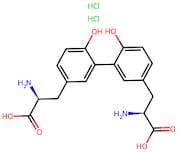
:Chlorhydrate de L,L-Dityrosine
- 3,3'-Dityrosine Hydrochloride
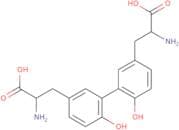
- (α3S,α3'S)-α3,α3'-DiaMino-6,6'-dihydroxy-[1,1'-biphenyl]-3,3'-dipropanoic Acid Hydrochloride
- L,L-Dityrosine dihydrochloride
- o,o'-Dityrosine Hydrochloride
- 3,3'-Bityrosine Hydrochloride
- Dityrosine Hydrochloride
- [S-(R*,R*)]- α,α'-DiaMino-6,6'-dihydroxy-[1,1'-biphenyl]-3,3'-
- (2S,2'S)-3,3'-(6,6'-dihydroxybiphenyl-3,3'-diyl)bis(2-aminopropanoic acid)
- o,o-Dityrosine Hydrochloride
- dipropanoic Acid Hydrochloride
- Bityrosine Hydrochloride
- Voir plus de synonymes
L,L-Dityrosine hydrochloride
CAS :L,L-Dityrosine hydrochlorideDegré de pureté :≥98%Masse moléculaire :433.28g/molRef: 54-BUP22197
5mgÀ demander10mgÀ demander25mgÀ demander50mgÀ demander100mgÀ demander500mg1.431,00€L,L-Dityrosine hydrochloride
CAS :L,L-Dityrosine hydrochloride, also known as o,o'-Dityrosine hydrochloride, is a compound found in acid hydrolysates of various biological materials, notably theFormule :C18H22Cl2N2O6Degré de pureté :99.455%Couleur et forme :SolidMasse moléculaire :433.28L,L-Dityrosine Dihydrochloride
CAS :Produit contrôléStability Hygroscopic
Applications Dityrosine (DY), a tyrosine dimer formed by 3,3’-biaryl bond formation can be used as a biomarker to detect oxidative protein damage and selective proteolysis. Fluorescence intensity decays of Dityrosine are generally characterized by two decay components, one with a lifetime in the range of 150 to 800 ps and another between 2.5 and 4.5 ns.
References Libertini, L., et al.: Biophys. J., 47, 765 (1985), Huggins, T., et al.: J. Biol. Chem., 268, 12341 (1993), Malencik, D., et al.: Biochemistry, 35, 4375 (1996),Formule :C18H20N2O6·2ClHCouleur et forme :NeatMasse moléculaire :433.28L,L-Dityrosine-13C12 Dihydrochloride
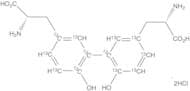
CAS :Produit contrôléFormule :C6C12H22Cl2N2O6Couleur et forme :NeatMasse moléculaire :372.273L,L-Dityrosine dihydrochloride
CAS :Dityrosine is an amino acid derivative that has been shown to be formed by the oxidation of the amino acid L-tyrosine. It is a reactive molecule that can cause oxidative injury, as well as being involved in the pathology of various diseases such as atherosclerosis and diabetes. Dityrosine is also a potential biomarker for neuronal death, as it has been found in increased amounts in the brain tissue of patients with Alzheimer's disease. Dityrosine can be used as a tool for analyzing protein structure and enzyme activity, due to its ability to react with basic proteins and enzymes at high temperatures.
Formule :C18H20N2O6•(HCl)2Degré de pureté :Min. 95%Masse moléculaire :433.28 g/mol