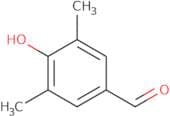
CAS 2233-18-3
:3,5-Diméthyl-4-hydroxybenzaldéhyde
Description :
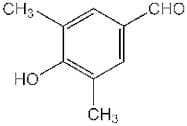
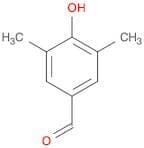
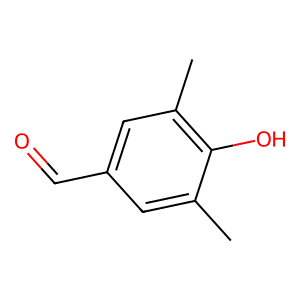
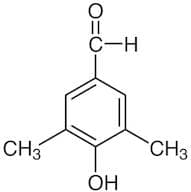
3,5-Diméthyl-4-hydroxybenzaldéhyde, avec le numéro CAS 2233-18-3, est un composé organique appartenant à la classe des aldéhydes aromatiques. Il présente un cycle benzénique substitué par deux groupes méthyles aux positions 3 et 5, un groupe hydroxyle à la position 4 et un groupe fonctionnel aldéhyde. Ce composé est généralement caractérisé par son apparence allant du jaune pâle au brun clair et possède une odeur aromatique distinctive. Il est soluble dans des solvants organiques tels que l'éthanol et l'éther, mais sa solubilité dans l'eau est limitée en raison de ses groupes méthyles hydrophobes. La présence du groupe hydroxyle contribue à sa réactivité, lui permettant de participer à diverses réactions chimiques, y compris l'oxydation et la condensation. 3,5-Diméthyl-4-hydroxybenzaldéhyde est souvent utilisé dans la synthèse organique et peut servir d'intermédiaire dans la production de colorants, de parfums et de produits pharmaceutiques. Ses propriétés en font un composé précieux tant pour la recherche que pour les applications industrielles.
Formule :C9H10O2
InChI :InChI=1/C9H10O2/c1-6-3-8(5-10)4-7(2)9(6)11/h3-5,11H,1-2H3
Code InChI :InChIKey=UYGBSRJODQHNLQ-UHFFFAOYSA-N
SMILES :C(=O)C1=CC(C)=C(O)C(C)=C1
Synonymes :- 3,5-Dimethyl-4-hydroxybenzaldehyde
- 4-Formyl-2,6-xylenol
- Benzaldehyde, 4-hydroxy-3,5-dimethyl-
- NSC 128405
- 4-Hydroxy-3,5-dimethylbenzaldehyde
- BUTTPARK 96\57-68
- 4-hydroxy-3,5-dimethyl-benzaldehyd
- 3,5-Dimethyl-4-Hydroxybenzalde
- 3,5-Dimethyl-4-Hydorxybenzaldehyde
- 4-Hydroxy-3,5-dimethylbenzaldehyde, TECH
- Syringnldehyde
Trier par
Degré de pureté (%)
0
100
|
0
|
50
|
90
|
95
|
100
6 produits concernés.
4-Hydroxy-3,5-dimethylbenzaldehyde, 97+%
CAS :This Thermo Scientific Chemicals brand product was originally part of the Alfa Aesar product portfolio. Some documentation and label information may refer to the legacy brand. The original Alfa Aesar product / item code or SKU reference has not changed as a part of the brand transition to Thermo Sci
Formule :C9H10O2Degré de pureté :97+%Couleur et forme :White to cream or yellow to orange or pale brown, Crystals or Crystalline powderMasse moléculaire :150.183,5-Dimethyl-4-hydroxybenzaldehyde
CAS :Formule :C9H10O2Degré de pureté :97%Couleur et forme :SolidMasse moléculaire :150.17453,5-Dimethyl-4-hydroxybenzaldehyde
CAS :3,5-Dimethyl-4-hydroxybenzaldehydeFormule :C9H10O2Degré de pureté :≥95%Couleur et forme : off-white powderMasse moléculaire :150.17g/mol4-Hydroxy-3,5-dimethylbenzaldehyde
CAS :Formule :C9H10O2Degré de pureté :>98.0%(T)Couleur et forme :White to Light yellow to Dark green powder to crystalMasse moléculaire :150.184-Hydroxy-3,5-dimethylbenzaldehyde
CAS :4-Hydroxy-3,5-dimethylbenzaldehyde (HDA) is an aromatic hydrocarbon that can be found in plants. It is a product of the oxidation of hydroxyl groups by inorganic acids and has been shown to induce hepatic steatosis in mice. This reaction is mediated by malic acid, which reacts with the benzyl group to form a cavity. The molecular modeling study of this reaction mechanism shows that the carboxylate group deprotonates, which leads to the formation of a carbocation intermediate when it attacks the aromatic ring. The aromatic ring opens up during this step, leading to a carbocation. The carbocation then collapses and hydrogen from the hydroxyl group attaches to carbon 2 on C4, forming HDA and releasing water.Formule :C9H10O2Degré de pureté :Min. 95%Couleur et forme :Off-White PowderMasse moléculaire :150.17 g/mol4-Hydroxy-3,5-dimethylbenzaldehyde
CAS :Formule :C9H10O2Degré de pureté :97%Couleur et forme :Crystalline Powder,PowderMasse moléculaire :150.177