CAS 225110-25-8
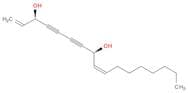
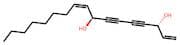
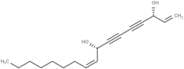
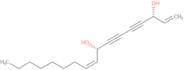
:1,9-Heptadécadiène-4,6-diine-3,8-diol,(3R,8S,9Z)-
Description :
1,9-Heptadécadiene-4,6-diyne-3,8-diol, également connu sous son numéro CAS 225110-25-8, est un composé organique complexe caractérisé par sa structure unique comportant plusieurs doubles et triples liaisons, comme l'indique la présence de groupes fonctionnels diene et diyne. Ce composé contient une longue chaîne carbonée, spécifiquement 17 atomes de carbone, ce qui contribue à sa nature hydrophobe. La présence de groupes hydroxyles (-OH) aux positions 3 et 8 introduit des caractéristiques polaires, permettant une liaison hydrogène potentielle et une solubilité accrue dans des solvants polaires. La stéréochimie de la molécule est définie par la configuration (3R,8S,9Z), indiquant des arrangements spatiaux spécifiques des substituants autour des centres chiraux et de la double liaison. De telles caractéristiques structurelles peuvent influencer sa réactivité, sa stabilité et ses applications potentielles en synthèse organique ou comme sonde biochimique. Dans l'ensemble, ce composé illustre la complexité et la diversité des molécules organiques, en particulier celles avec plusieurs groupes fonctionnels et configurations stéréochimiques.
Formule :C17H24O2
Synonymes :- (+)-(3R,8S)-Falcarindiol
- 3(R),8(S),9(Z)-Falcarindiol
Trier par
Degré de pureté (%)
0
100
|
0
|
50
|
90
|
95
|
100
6 produits concernés.
Falcarindiol
CAS :Formule :C17H24O2Degré de pureté :98%Couleur et forme :LiquidMasse moléculaire :260.3713(+)-(3R,8S)-Falcarindiol
CAS :(+)-(3R,8S)-FalcarindiolDegré de pureté :≥98%Masse moléculaire :260.37g/mol(+)-(3R,8S)-Falcarindiol
CAS :(+)-(3R,8S)-Falcarindiol is a potential new anticancer agent that exerts its activity through inducing ER stress and apoptosis.Formule :C17H24O2Degré de pureté :97.06%Couleur et forme :SolidMasse moléculaire :260.37(3R,8S)-Falcarindiol
CAS :(3R,8S)-Falcarindiol is a glycol ether that is found in the bark of the Dichapetalum cymosum tree. It has been shown to have potent anti-infective properties and can be used as an adjuvant treatment for infectious diseases. (3R,8S)-Falcarindiol has been shown to exhibit significant cytotoxicity against HL-60 cells and dextran sulfate, which may be due to its ability to inhibit energy metabolism by blocking enzymes such as succinic dehydrogenase. The anti-inflammatory effects of (3R,8S)-falcarindiol are due to its inhibition of prostaglandin synthesis and production of nitric oxide. This compound also inhibits apoptosis in Hl-60 cells by acting as a substrate for abcg2, one of the proteins involved in apoptosis pathways. Analysis of this compound is done using preparative high performance liquid chromatography.Formule :C17H24O2Degré de pureté :Min. 98 Area-%Couleur et forme :Clear LiquidMasse moléculaire :260.37 g/mol(3R,8S)-Falcarindiol
CAS :Produit contrôléApplications Falcarindiol was isolated as an algicidal principle against the harmful red tide dinoflagellate, Heterocapsa circularisquama, from Notopterygii Rhizoma through bioassay-guided separation.To determine the ambiguous absolute structure of this active principle, all three stereoisomers as well as falcarindiol were synthesized. As a result of intensive analytical of their physicochemical properties, the configuration of Falcarinfiol was revealed to be 3R,8S. (3S,8S)- and (3S,8R)-isomers were found to exhibit more potent algicidal activity than (3R,8S)-Falcarindiol isolated from Notopterygii Rhizoma.
References Nitz, S., et al.: J. Agric. Food Chem., 38, 1445 (1990), Alamsjah, M., et al.: J. Appl. Phycol., 20, 713 (2008),Formule :C17H24O2Couleur et forme :NeatMasse moléculaire :260.371