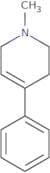
CAS 23007-85-4
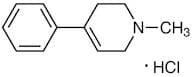
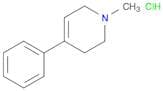
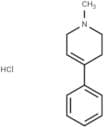
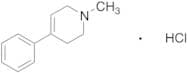
:Chlorhydrate de pyridine, 1,2,3,6-tétrahydro-1-méthyl-4-phényl- (1:1)
Description :
Chlorhydrate de pyridine, 1,2,3,6-tétrahydro-1-méthyl-4-phényl- (1:1), avec le numéro CAS 23007-85-4, est un composé chimique qui appartient à la classe des dérivés de tétra-hydropyridine. Il présente un cycle pyridine qui a été saturé à des positions spécifiques, résultant en une structure bicyclique. La présence d'un groupe méthyle et d'un groupe phényle contribue à ses propriétés uniques, y compris une activité biologique potentielle. En tant que sel de chlorhydrate, il est généralement rencontré sous forme solide, ce qui améliore sa solubilité dans l'eau et d'autres solvants polaires. Ce composé peut présenter divers effets pharmacologiques, ce qui le rend intéressant en chimie médicinale. Ses caractéristiques incluent un point de fusion relativement bas et une stabilité modérée dans des conditions standard. La forme chlorhydrate est souvent utilisée pour améliorer les propriétés de manipulation et de stockage du composé. Les données de sécurité doivent être consultées pour un bon maniement, comme pour toute substance chimique, afin d'assurer des pratiques de laboratoire sûres.
Formule :C12H15N·ClH
InChI :InChI=1S/C12H15N.ClH/c1-13-9-7-12(8-10-13)11-5-3-2-4-6-11;/h2-7H,8-10H2,1H3;1H
Code InChI :InChIKey=KOWJANGMTAZWDT-UHFFFAOYSA-N
SMILES :CN1CCC(=CC1)C2=CC=CC=C2.Cl
Synonymes :- 1-Methyl-4-Phenyl-1,2,3,6-Tetra-*Hydropyridine Hy
- 1-Methyl-4-Phenyl-1,2,3,6-Tetrahydropyridine Hydrochloride (1:1)
- 1-Methyl-4-phenyl-1,2,3,6-tetrahydropyridine hydrochloride
- Pyridine, 1,2,3,6-tetrahydro-1-methyl-4-phenyl-, hydrochloride
- Pyridine, 1,2,3,6-tetrahydro-1-methyl-4-phenyl-, hydrochloride (1:1)
Trier par
Degré de pureté (%)
0
100
|
0
|
50
|
90
|
95
|
100
6 produits concernés.
1-Methyl-4-phenyl-1,2,3,6-tetrahydropyridine Hydrochloride
CAS :Formule :C12H15N·HClDegré de pureté :>98.0%(HPLC)Couleur et forme :White to Light yellow powder to crystalMasse moléculaire :209.72Pyridine, 1,2,3,6-tetrahydro-1-methyl-4-phenyl-, hydrochloride (1:1)
CAS :Formule :C12H16ClNDegré de pureté :%Couleur et forme :SolidMasse moléculaire :209.7151MPTP hydrochloride
CAS :MPTP hydrochloride is a precursor of MPP+, a dopamine neurotoxin with blood-brain barrier permeability.Formule :C12H16ClNDegré de pureté :96.35% - >99.99%Couleur et forme :SolidMasse moléculaire :209.72Ref: TM-T4081
5mg34,00€1mL*10mM (DMSO)50,00€10mg52,00€25mg80,00€50mg131,00€100mg177,00€200mg281,00€500mg447,00€1-Methyl-4-phenyl-1,2,3,6-tetrahydropyridine Hydrochloride
CAS :Produit contrôléApplications 1-Methyl-4-phenyl-1,2,3,6-tetrahydropyridine hydrochloride is a dopaminergic neurotoxin that reportedly causes a severe and irreversible Parkinsonian condition in humans and monkeys.
Not a dangerous good if item is equal to or less than 1g/ml and there is less than 100g/ml in the package
References Burns, R.S., et al.: Proc. Natl. Acad.Sci. USA, 80, 4546 (1983), Langston, J.W., et al.: Science, 219, 979 (1983), Mogi, M., et al.: Neurosci. Lett., 250, 25 (1998), Przedborski, S. and Jackson-Lewis, V., Mov. Disord., 13, 35 (1998),Formule :C12H15N·ClHCouleur et forme :NeatMasse moléculaire :209.721-Methyl-4-phenyl-1,2,3,6-tetrahydropyridine hydrochloride
CAS :Produit contrôlé1-Methyl-4-phenyl-1,2,3,6-tetrahydropyridine hydrochloride (MPTP) is a neurotoxin that causes Parkinson's disease in humans and animals. It is an analog of dopamine, which blocks the enzyme that breaks down dopamine. MPTP causes degeneration of dopaminergic neurons in the substantia nigra pars compacta, leading to clinical symptoms such as bowel disease, loss of motor control, and mood disorders. MPTP also affects the neurotransmitter gamma-aminobutyric acid (GABA), by inhibiting its production and release from nerve cells. The result is neuronal death through oxidative stress and inflammation. This drug has been shown to cause locomotor activity impairment in rats and mice due to its effect on the caudate putamen region of the brain. The clinical relevance of this finding is not yet known. MPTP is a neurotoxin that mimics natural compounds found in plants such asFormule :C12H15N·HClDegré de pureté :Min 98%Couleur et forme :White PowderMasse moléculaire :209.71 g/mol