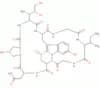
CAS 23109-05-9
:α-Amanitine
- alpha-Amanitin
- Brn 1071138
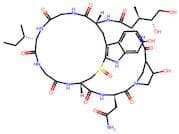
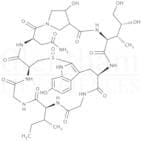
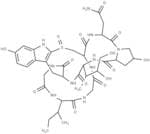
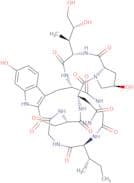
- Cyclic(L-asparaginyl-4-hydroxy-L-prolyl-(R)-4,5-dihydroxy-L-isoleucyl-6-hydroxy-2-mercapto-L-tryptophylglycyl-L-isoleucylglycyl-L-cysteinyl), cyclic (4-8)-sulfide, (R)-S-oxide
- Hsdb 3458
- alpha-Amanitine
- alpha-Amatoxin
- 9,18-(Iminoethaniminoethaniminoethaniminomethano)pyrrolo(1',2':8,9)(1,5,8,11,14)thiatetraazacyclooctadecino(18,17-b)indole, cyclic peptide deriv.
- 2-[29-(Butan-2-Yl)-21-(3,4-Dihydroxybutan-2-Yl)-2,14-Dihydroxy-11-Oxido-5,8,20,23,24,27,30,33-Octaoxo-1,2,3,5,6,7,8,9,10,12,17,18,19,20,21,22,23,23A-Octadecahydro-9,18-(Epiminoethanoiminoethanoiminoethanoiminomethano)Pyrrolo[1',2':8,9][1,5,8,11,14]Thiatetraazacyclooctadecino[18,17-B]Indol-6-Yl]Acetamide
- 2-[(2R,6S,9R,11R,18S,21S,23aS,29S)-29-[(2S)-butan-2-yl]-21-[(2R,3R)-3,4-dihydroxybutan-2-yl]-2,14-dihydroxy-11-oxido-5,8,20,23,24,27,30,33-octaoxo-1,2,3,5,6,7,8,9,10,12,17,18,19,20,21,22,23,23a-octadecahydro-9,18-(epiminoethanoiminoethanoiminoethanoiminomethano)pyrrolo[1',2':8,9][1,5,8,11,14]thiatetraazacyclooctadecino[18,17-b]indol-6-yl]acetamide
α-Amanitin, from Amanita Phalloides
CAS :α-Amanitin, from Amanita PhalloidesFormule :C39H54N10O14SDegré de pureté :93.6% (310nm) (Typical Value in Batch COA)Couleur et forme :PowderMasse moléculaire :918.96966g/molα-Amanitine
CAS :Formule :C39H54N10O14SDegré de pureté :(UV) ≥ 97.0%Couleur et forme :White to off-white solidMasse moléculaire :918.97α-Amanitin
CAS :alpha-Amanitin is the principal toxin of poisonous mushrooms, exerting its toxic function by inhibiting RNA-polymerase II.Formule :C39H54N10O14SDegré de pureté :96.44% - ≥90%Couleur et forme :SolidMasse moléculaire :918.97α-Amanitin
CAS :a-Amanitin is a cyclic peptide that is found in mushrooms of the genus "Amanita", which can cause toxic effects if eaten. It has been shown to inhibit the growth of cancer cells by inhibiting mitochondrial membrane potential and reducing dna synthesis, as well as by triggering apoptosis. The structural analysis of a-amanitin has shown that it binds to surface glycoproteins on myeloma cells and triggers the activation of toll-like receptors (TLRs), which initiate an immune response against myeloma cells. This cyclic peptide also has been shown to reduce hepatic steatosis in mice by affecting mitochondrial membrane potential and inducing metabolic changes.
Indocyanine green, a fluorescent dye, has been shown to prevent α-amanitin toxicity in mice (Wang et al, 2023), and could be a possible antidote to poisoning by Amanita, such as death cap mushroom Amanita phalloides, which is the cause of over 90% of fatal mushroom poisoning.Formule :C39H54N10O14SDegré de pureté :Min. 95 Area-%Couleur et forme :White PowderMasse moléculaire :918.97 g/mol