CAS 2351218-88-5
:Trier par
Degré de pureté (%)
0
100
|
0
|
50
|
90
|
95
|
100
3 produits concernés.
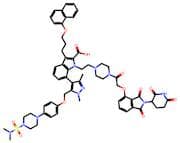
7-(5-((4-(4-(N,N-Dimethylsulfamoyl)piperazin-1-yl)phenoxy)methyl)-1,3-dimethyl-1H-pyrazol-4-yl)-1-(2-(4-(2-((2-(2,6-dioxopiperidin-3-yl)-1,3-dioxoisoindolin-4-yl)oxy)acetyl)piperazin-1-yl)ethyl)-3-(3-
CAS :7-(5-((4-(4-(N,N-Dimethylsulfamoyl)piperazin-1-yl)phenoxy)methyl)-1,3-dimethyl-1H-pyrazol-4-yl)-1-(2-(4-(2-((2-(2,6-dioxopiperidin-3-yl)-1,3-dioxoisoindolin-4-yl)oxy)acetyl)piperazin-1-yl)ethyl)-3-(3-Degré de pureté :98%Masse moléculaire :1163.32g/moldMCL1-2
CAS :dMCL1-2 is a PROTAC-based MCL1 degrader, binding at 30 nM, and induces apoptosis in leukemia.Formule :C61H66N10O12SDegré de pureté :98%Couleur et forme :SolidMasse moléculaire :1163.3dMCL1-2
CAS :N-Acetyl-3,4-dihydro-2-(2,6-dioxo-3-piperidinopyrimidin-1(2H)-yl)isoindoline-4-carboxylic acid is a potent immunostimulatory and anticancer drug. It is a homologous compound that induces activation of the immune system through h3 acetylation. NAA [N-Acetyl-3,4-dihydro-2-(2,6-dioxo-3piperidinopyrimidin 1(2H)-yl)isoindoline 4 carboxylic acid] has been shown to have regulatory effects on a number of other cell types. In vitro studies with MDA MB231 breast cancer cells showed that NAA induced apoptosis in these cells through the inhibition of histone h3 acetylation and increased expression of effector proteins such as all trans ret
Formule :C61H66N10O12SDegré de pureté :Min. 95%Masse moléculaire :1,163.3 g/mol