CAS 235433-36-0
:Peptide de Libération de la Prolactine (1-31) (humain)
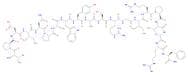
- H-Ser-Arg-Thr-His-Arg-His-Ser-Met-Glu-Ile-Arg-Thr-Pro-Asp-Ile-Asn-Pro-Ala-Trp-Tyr-Ala-Ser-Arg-Gly-Ile-Arg-Pro-Val-Gly-Arg-Phe-NH2
Prolactin-Releasing Peptide (12-31) (human)
CAS :Bachem ID: 4028744.
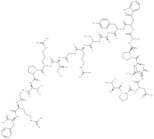
Formule :C104H158N32O26Degré de pureté :96.12%Masse moléculaire :2272.6L-Phenylalaninamide, L-threonyl-L-prolyl-L-α-aspartyl-L-isoleucyl-L-asparaginyl-L-prolyl-L-alanyl-L-tryptophyl-L-tyrosyl-L-alanyl-L-seryl-L-arginylglycyl-L-isoleucyl-L-arginyl-L-prolyl-L-valylglycyl-L-arginyl-
CAS :Formule :C104H158N32O26Masse moléculaire :2272.5661Prolactin Releasing Peptide (12-31), human
CAS :Prolactin Releasing Peptide (1-31), human is a high affinity GPR10 ligand that cause the release of the prolactinFormule :C104H158N32O26Degré de pureté :98%Couleur et forme :SolidMasse moléculaire :2272.57Prolactin-Releasing Peptide (Human)
CAS :Prolactin-Releasing Peptide (Human) is a peptide that belongs to the class of inhibitors. It is a protein inhibitor that binds to the receptor and inhibits the activation of the receptor by its ligand. The binding of this peptide to the receptor prevents it from transmitting signals to other cells, thereby blocking cell function. Prolactin-Releasing Peptide (Human) has been shown to inhibit ion channels and can be used as a research tool in cell biology and pharmacology studies. This product is high purity and has not been shown to have any side effects on humans or animals when administered at therapeutic doses.
Formule :C160H252N56O42SDegré de pureté :Min. 95%Masse moléculaire :3,664.1 g/molProlactin-Releasing Peptide (12-31) (human)
CAS :Please enquire for more information about Prolactin-Releasing Peptide (12-31) (human) including the price, delivery time and more detailed product information at the technical inquiry form on this page
Formule :C104H158N32O26Degré de pureté :Min. 95%Masse moléculaire :2,272.57 g/mol