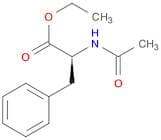
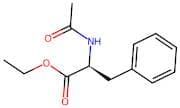
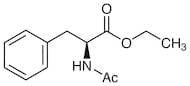
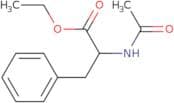
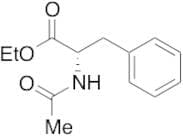
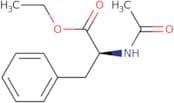
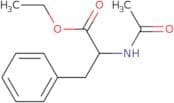
CAS 2361-96-8
:Éthyl ester de l'acétyl-L-phénylalanine
- <span class="text-smallcaps">L</span>-N-Acetylphenylalanine ethyl ester
- <span class="text-smallcaps">L</span>-Phenylalanine, N-acetyl-, ethyl ester
- Ac-Phe-OEt
- Acetyl-<span class="text-smallcaps">L</span>-phenylalanine ethyl ester
- Acetylphenylalanine ethyl ester
- Alanine, N-acetyl-3-phenyl-, ethyl ester, <span class="text-smallcaps">L</span>-
- Ethyl N-acetyl-<span class="text-smallcaps">L</span>-phenylalaninate
- N-Acetyl-<span class="text-smallcaps">L</span>-phenylalanine ethyl ester
- N-Acetylphenylalanine ethyl ester
- ethyl N-acetyl-3-phenyl-L-alaninate
- ethyl N-acetyl-L-phenylalaninate
- ethyl N-acetylphenylalaninate
- L-Phenylalanine, N-acetyl-, ethyl ester
- N-Acetyl-L-phenylalanine ethyl ester
- Acetyl-L-phenylalanine ethyl ester
- Voir plus de synonymes
(S)-Ethyl 2-acetamido-3-phenylpropanoate
CAS :Formule :C13H17NO3Degré de pureté :98%Couleur et forme :SolidMasse moléculaire :235.2790N-Acetyl-L-Phenylalanine Ethyl Ester
CAS :N-Acetyl-L-Phenylalanine Ethyl EsterDegré de pureté :98%Masse moléculaire :235.28g/molAc-Phe-OEt
CAS :Formule :C13H17NO3Degré de pureté :>98.0%(HPLC)Couleur et forme :White to Light yellow powder to crystalMasse moléculaire :235.28Ac-Thz-Tle-Leu-Gln-MCA
CAS :A prototype fluorogenic substrate targeting the SARS-CoV and SARS-CoV-2 Main Protease (Mpro). The main protease (Mpro), also called endopeptidase C30 or 3C-like proteinase (3CLpro), controls viral replication activities and is a prime therapeutical target. Both substrates and inhibitors of SARS-CoV-2 Mpro are currently of interest to researchers of the coronavirus. This product can be used as a Prototype Fluorescence Substrate for SARS-CoV Mpro/SARS-CoV-2 Mpro Proteases.Formule :C13H17NO3Degré de pureté :Min. 95%Masse moléculaire :235.28 g/molAcetyl-L-phenylalanine Ethyl Ester
CAS :Produit contrôléApplications Acetyl-L-phenylalanine ethyl ester is a derivative of L-Phenylalanine (P319415), a nonpolar, essential amino acid that naturally occurs in the human body and is also used to treat patients with depression. Acetyl-L-phenylalanine ethyl ester is also used to inhibit pepsin-catalyzed reactions.
References Auer, H. & Doty, P.: Biochemistry, 5, 1708 (1966); Birkmayer, W., et al.: J. Neural Transm., 59, 81 (1984); Borison, R., et al.: Res. Commun. Chem. Path., 21, 363 (1978); Kitson, T., et al.: Biochem. J., 122, 241 (1971)Formule :C13H17NO3Couleur et forme :NeatMasse moléculaire :235.28(S)-Ethyl 2-acetamido-3-phenylpropanoate
CAS :Formule :C13H17NO3Degré de pureté :98%Couleur et forme :SolidMasse moléculaire :235.283Acetyl-L-phenylalanine ethyl ester
CAS :Acetyl-L-phenylalanine ethyl ester is a substrate analogue that competes with the natural substrate, L-phenylalanine, for binding sites on the enzyme. The acetyl group of acetyl-L-phenylalanine ethyl ester reacts with the amino acid residues of L-phenylalanine to form covalent linkages. This prevents the enzyme from catalyzing reactions involving L-phenylalanine and other substrates. Acetyl-L-phenylalanine ethyl ester binds to cytochalasin B and inhibits its ability to bind to actin filaments, thus inhibiting cell growth. The high salt concentration in this experiment allows for separation of the protein from other cellular components by sephadex g-100 chromatography. Kinetic studies have been done on human serum albumin, which is a protein that can bind acetyl-L-phenylalanine ethl ester with a
Formule :C13H17NO3Degré de pureté :Min. 95%Masse moléculaire :235.28 g/molAc-Phe-OEt
CAS :Ac-Phe-OEt is a covalently conjugated bifunctional peptide that has been synthesized by linking the amino acid phenylalanine to the amino acid ethyl ester of oleic acid. Ac-Phe-OEt exhibits a high affinity for bacterial serine proteases (Km=0.1 μM) and lysine residues (Ki=4 μM). This peptide also binds to immobilized cytochalasin, which prevents the formation of amyloid fibrils. Ac-Phe-OEt can be used in enzyme catalysis as an inhibitor or competitive inhibitor, as well as being immobilized on surfaces. The kinetic data suggests that Ac-Phe-OEt competes with lysine residues for binding to bacterial serine proteases and inhibits their activity.Formule :C13H17NO3Degré de pureté :Min. 95%Masse moléculaire :235.28 g/mol