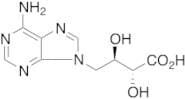
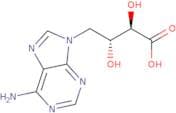
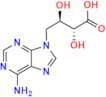
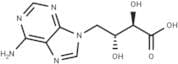
CAS 23918-98-1
:Éritadénine
Description :
Éritadénine, avec le numéro CAS 23918-98-1, est un dérivé de purine et un analogue de nucléoside d'origine naturelle. Il est principalement connu pour son rôle dans le métabolisme de l'adénosine et se trouve dans certaines espèces de champignons, en particulier dans l'espèce de champignon *Pleurotus ostreatus* (champignon huître). Éritadénine se caractérise par sa capacité à inhiber l'enzyme S-adénosylhomocystéine hydrolase, qui joue un rôle crucial dans la régulation des niveaux d'adénosine dans le corps. Cette inhibition peut entraîner une diminution des niveaux de S-adénosylhomocystéine et, par conséquent, affecter diverses voies biochimiques, y compris celles impliquées dans les processus de méthylation. Éritadénine a suscité de l'intérêt pour ses potentiels bienfaits pour la santé, y compris ses effets sur le métabolisme du cholestérol et la santé cardiovasculaire. De plus, il présente des propriétés antioxydantes, contribuant à ses potentielles applications thérapeutiques. En tant que composé chimique, Éritadénine est soluble dans l'eau et présente une stabilité dans des conditions physiologiques, ce qui en fait un sujet de recherche en pharmacologie et en nutrition.
Formule :C9H11N5O4
InChI :InChI=1S/C9H11N5O4/c10-7-5-8(12-2-11-7)14(3-13-5)1-4(15)6(16)9(17)18/h2-4,6,15-16H,1H2,(H,17,18)(H2,10,11,12)/t4-,6-/m1/s1
Code InChI :InChIKey=LIEMBEWXEZJEEZ-INEUFUBQSA-N
SMILES :C([C@H]([C@H](C(O)=O)O)O)N1C=2C(N=C1)=C(N)N=CN2
Synonymes :- (αR,βR)-6-Amino-α,β-dihydroxy-9H-purine-9-butanoic acid
- 23918-98-1
- 4-(6-Amino-9H-purin-9-yl)-4-deoxy-<span class="text-smallcaps">D</span>-erythronic acid
- 4-(6-Aminopurin-9-yl)-4-deoxy-<span class="text-smallcaps">D</span>-erythronic acid
- 4-(9-Adenyl)-<span class="text-smallcaps">D</span>-erythro-2,3-dihydroxybutyric acid
- 9H-Purine-9-butanoic acid, 6-amino-α,β-dihydroxy-, (αR,βR)-
- 9H-Purine-9-butanoic acid, 6-amino-α,β-dihydroxy-, [R-(R*,R*)]-
- <span class="text-smallcaps">D</span>-Eritadenine
- Eritadenine
- Erythronic acid, 4-(6-amino-9H-purin-9-yl)-4-deoxy-, <span class="text-smallcaps">D</span>-
- Lentinacin
- Lentysine
- [R-(R*,R*)]-6-Amino-a,b-dihydroxy-9H-purine-9-butanoic Acid
- (2R,3R)-4-(6-Amino-9H-purin-9-yl)-2,3-dihydroxybutanoic acid
- Voir plus de synonymes
Trier par
Degré de pureté (%)
0
100
|
0
|
50
|
90
|
95
|
100
4 produits concernés.
Eritadenine
CAS :Produit contrôléApplications Hypocholesterolemic isolated from shiitake mushrooms, effecting phospholipid and linoleic acid metabolisms. Specifically, Eritadenine is a potent inhibitor of S-adenosyl-L-homocysteine hydrolase (SAHH), decreasing total cholesterol levels in plasma.
References Fukada, S., et al.: J. Nut., 136, 2797 (2006), Vilar, S., et al.: J. Med. Chem., 49, 1118 (2006), Yamada, T., et al.: Biochem. Pharmacol., 73, 981 (2007), Enman, J., et al.; J. Agric. Food Chem., 56, 2609 (2008),Formule :C9H11N5O4Couleur et forme :Off White SolidMasse moléculaire :253.21Eritadenine
CAS :Eritadenine is a glycoside that has been found in the edible roots of plants belonging to the family Euphorbiaceae. Eritadenine is an inhibitor of malonic acid, which is a precursor for fatty acid synthesis. It has also been shown to have biological properties, such as inhibiting fat cell growth and reducing cholesterol levels in rats. Eritadenine can be detected with an analytical method that uses high-performance liquid chromatography coupled with a photodiode array detector. This method separates and identifies eritadenine from other compounds using polymerase chain reaction amplification on camp levels and sodium salts. Eritadenine can also be found in samples of liver cells or ethanolamine.Formule :C9H11N5O4Degré de pureté :Min. 95%Couleur et forme :PowderMasse moléculaire :253.21 g/molEritadenine
CAS :Eritadenine (Lentinacin) is a mushroom-derived compound acting as an effector at the adenosine P site in fat cell membranes, lowering cholesterol.Formule :C9H11N5O4Degré de pureté :98%Couleur et forme :SolidMasse moléculaire :253.22