CAS 2447-54-3
:Sanguinarine
Description :
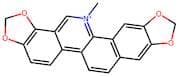
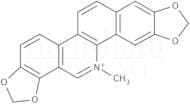
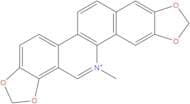
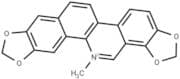
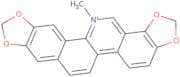
Sanguinarine est un alcaloïde benzophénanthridine principalement dérivé de la plante Sanguinaria canadensis, communément appelée racine de sang. Il se caractérise par son apparence cristalline jaune à orange et a une formule moléculaire de C20H17NO4. Sanguinarine présente une gamme d'activités biologiques, y compris des propriétés antimicrobiennes, anti-inflammatoires et des propriétés anticancéreuses potentielles, ce qui le rend intéressant tant pour les applications médicinales qu'agricoles. Le composé fonctionne en interagissant avec diverses voies cellulaires, influençant des processus tels que l'apoptose et la prolifération cellulaire. Sanguinarine est également connu pour sa capacité à inhiber certaines enzymes et a été étudié pour ses effets sur la santé bucco-dentaire, en particulier en relation avec la maladie parodontal. Cependant, il est important de noter que, bien que Sanguinarine ait un potentiel thérapeutique, il peut également présenter des effets cytotoxiques à des concentrations plus élevées. Comme beaucoup de composés naturels, des recherches supplémentaires sont nécessaires pour comprendre pleinement ses mécanismes d'action et ses applications potentielles en médecine et dans l'industrie.
Formule :C20H14NO4
InChI :InChI=1S/C20H14NO4/c1-21-8-15-12(4-5-16-20(15)25-10-22-16)13-3-2-11-6-17-18(24-9-23-17)7-14(11)19(13)21/h2-8H,9-10H2,1H3/q+1
Code InChI :InChIKey=INVGWHRKADIJHF-UHFFFAOYSA-N
SMILES :C[N+]=1C2=C(C=3C(C1)=C4C(=CC3)OCO4)C=CC=5C2=CC6=C(C5)OCO6
Synonymes :- (1,3)-Benzodioxolo(5,6-c)-1,3-dioxolo(4,5-i)phenanthridinium, 13-methyl-
- 13-Methyl[1,3]Benzodioxolo[5,6-C][1,3]Dioxolo[4,5-I]Phenanthridin-13-Ium
- 13-Methyl[1,3]benzodioxolo[5,6-c]-1,3-dioxolo[4,5-i]phenanthridinium
- Brn 3915507
- Dimethylenedioxy benzphenanthridine
- Pseudochelerythrine
- Sangrovit
- Sanguinarin
- Sanguinarium
- Unii-Av9Vk043Ss
- Sanguinarine
Trier par
Degré de pureté (%)
0
100
|
0
|
50
|
90
|
95
|
100
7 produits concernés.
[1,3]Benzodioxolo[5,6-c]-1,3-dioxolo[4,5-i]phenanthridinium, 13-methyl-
CAS :Formule :C20H14NO4Degré de pureté :97%Couleur et forme :SolidMasse moléculaire :332.3295Sanguinarine
CAS :Formule :C20H14NO4Degré de pureté :(HPLC) ≥ 98.0%Couleur et forme :Orange powderMasse moléculaire :332.33Sanguinarine
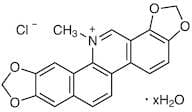
CAS :Sanguinarine possesses anticancer, antimicrobial, anti-inflammatory, and antioxidant properties, it has therapeutic potential in preventing the neurodegenerative diseases, it may be used to develop a potential therapeutic drug for treating cardiac remodeling and heart failure and shows protective effects on teeth and alveolar bone health. Sanguinarine can inhibit osteoclast formation and bone resorption via suppressing RANKL-induced activation of NF-κB and ERK signaling pathways, and can protect against cardiac hypertrophy and fibrosis via inhibiting NF-κB activation.Formule :C20H14NO4Degré de pureté :95%~99%Masse moléculaire :332.334Sanguinarine Chloride Hydrate
CAS :Formule :C20H14ClNO4·xH2ODegré de pureté :>98.0%(HPLC)Couleur et forme :Light yellow to Brown powder to crystalMasse moléculaire :367.79 (as Anhydrous)Sanguinarine
CAS :Sanguinarine (Pseudochelerythrine) is a specific inhibitor of Rac1b with anti-microbial, anti-oxidant and anti-inflammatory properties.Formule :C20H14NO4Degré de pureté :99.04% - 99.76%Couleur et forme :SolidMasse moléculaire :332.33Sanguinarine
CAS :Sanguinarine is a benzophenanthridine alkaloid, which is derived from plants such as Sanguinaria canadensis (bloodroot) and certain species of the Papaveraceae family. With its distinctive polycyclic structure, sanguinarine has been extensively studied for its diverse biological activities. It primarily exerts its action by binding to nucleic acids and proteins, leading to the inhibition of various cellular processes. Its mode of action involves intercalating into DNA, disrupting replication and transcription, and altering enzyme activities by forming stable complexes with protein thiol groups.
Formule :C20H14NO4Degré de pureté :Min. 95%Couleur et forme :PowderMasse moléculaire :332.33 g/mol
![[1,3]Benzodioxolo[5,6-c]-1,3-dioxolo[4,5-i]phenanthridinium, 13-methyl-](/_next/image/?url=https%3A%2Fstatic.cymitquimica.com%2Fproducts%2FIN%2Fthumb%2FDA002O8W.jpg&w=3840&q=75)