CAS 24502-78-1
:Acétylshikonine
Description :
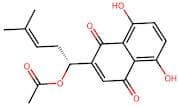
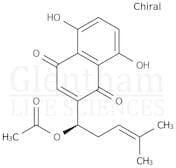
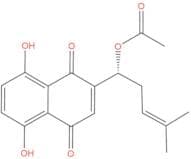
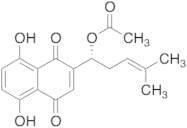
Acétylshikonine est un composé naturel classé comme un dérivé de naftoquinone, principalement extrait des racines de la plante Lithospermum erythrorhizon, communément connue sous le nom de gromwell violet. Ce composé se caractérise par sa structure chimique distinctive, qui comprend un système d'anneau de naphtalène avec divers groupes fonctionnels, contribuant à son activité biologique. Acétylshikonine présente une gamme de propriétés pharmacologiques, y compris des activités anti-inflammatoires, antimicrobiennes et antioxydantes, ce qui le rend intéressant en chimie médicinale et en recherche sur les produits naturels. Il est souvent étudié pour ses applications thérapeutiques potentielles, en particulier dans la cicatrisation des plaies et la régénération de la peau. Le composé est généralement soluble dans des solvants organiques, et sa stabilité peut être influencée par des facteurs tels que le pH et l'exposition à la lumière. De plus, la bioactivité de Acétylshikonine est attribuée à sa capacité à moduler diverses voies cellulaires, ce qui a incité des recherches sur ses mécanismes d'action et ses utilisations potentielles dans le traitement de diverses maladies. Dans l'ensemble, Acétylshikonine représente un composé significatif dans le domaine des produits naturels avec des applications prometteuses en santé et en médecine.
Formule :C18H18O6
InChI :InChI=1S/C18H18O6/c1-9(2)4-7-15(24-10(3)19)11-8-14(22)16-12(20)5-6-13(21)17(16)18(11)23/h4-6,8,15,20-21H,7H2,1-3H3/t15-/m1/s1
Code InChI :InChIKey=WNFXUXZJJKTDOZ-OAHLLOKOSA-N
SMILES :O=C1C=2C(C(=O)C=C1[C@@H](CC=C(C)C)OC(C)=O)=C(O)C=CC2O
Synonymes :- (1R)-1-(5,8-dihydroxy-1,4-dioxo-1,4-dihydronaphthalen-2-yl)-4-methylpent-3-en-1-yl acetate
- (R)-1-(5,8-Dihydroxy-1,4-dioxo-1,4-dihydronaphthalen-2-yl)-4-methylpent-3-en-1-yl acetate
- 1,4-Naphthalenedione, 2-[(1R)-1-(acetyloxy)-4-methyl-3-penten-1-yl]-5,8-dihydroxy-
- 1,4-Naphthalenedione, 2-[(1R)-1-(acetyloxy)-4-methyl-3-pentenyl]-5,8-dihydroxy-
- 1,4-Naphthalenedione, 2-[1-(acetyloxy)-4-methyl-3-pentenyl]-5,8-dihydroxy-, (R)-
- 1,4-Naphthoquinone, 5,8-dihydroxy-2-(1-hydroxy-4-methyl-3-pentenyl)-, 2-acetate, (+)-
- 1-(5,8-Dihydroxy-1,4-Dioxo-1,4-Dihydronaphthalen-2-Yl)-4-Methylpent-3-En-1-Yl Acetate
- 2-[(1R)-1-(Acetyloxy)-4-methyl-3-penten-1-yl]-5,8-dihydroxy-1,4-naphthalenedione
- Acetylshikonin
- NSC 110199
Trier par
Degré de pureté (%)
0
100
|
0
|
50
|
90
|
95
|
100
7 produits concernés.
1,4-Naphthalenedione, 2-[(1R)-1-(acetyloxy)-4-methyl-3-penten-1-yl]-5,8-dihydroxy-
CAS :Formule :C18H18O6Degré de pureté :98%Couleur et forme :SolidMasse moléculaire :330.3319Acetylshikonin
CAS :Acetylshikonin, an AChE inhibitor and a non-selective cytochrome P450 inhibitor, is derived from Comfrey and has anticancer and anti-inflammatory properties.Formule :C18H18O6Degré de pureté :92.45% - 99.74%Couleur et forme :SolidMasse moléculaire :330.33Ref: TM-T5S2343
1mg42,00€5mg88,00€10mg135,00€25mg255,00€50mg378,00€100mg560,00€500mg1.216,00€1mL*10mM (DMSO)88,00€Acetylshikonin
CAS :Produit contrôléApplications Acetylshikonin is the main ingredient of Zicao, which has used in clinics as a traditional Chinese for thousands of years. It exerts anti-obesity and anti-NAFLD effects through the regulation of lipid metabolism and anti-inflammatory effects. Also, it is a 1,4-naphthoquinone pigment extracted from the roots of Lithospermum erythrorhizon with anti-tumor effects.
Not a dangerous good if item is equal to or less than 1g/ml and there is less than 100g/ml in the package
References Su, M., et al.: Mol., 21, 976/1-976/14 (2016); Koike, A., et al.: Biol. Pharm. Bull., 39, 969-976 (2016)Formule :C18H18O6Couleur et forme :NeatMasse moléculaire :330.33Acetylshikonin
CAS :Acetylshikonin is a naphthoquinone derivative, which is a natural bioactive compound extracted from the roots of Lithospermum erythrorhizon and other Boraginaceae plants. Its mechanism of action involves multiple pathways, including the inhibition of topoisomerase, disruption of microtubule dynamics, and induction of apoptosis in cancer cells. These biochemical interactions lead to its potential as an anti-cancer agent.Formule :C18H18O6Degré de pureté :Min. 98 Area-%Couleur et forme :Brown PowderMasse moléculaire :330.33 g/mol
![1,4-Naphthalenedione, 2-[(1R)-1-(acetyloxy)-4-methyl-3-penten-1-yl]-5,8-dihydroxy-](/_next/image/?url=https%3A%2Fstatic.cymitquimica.com%2Fproducts%2FIN%2Fthumb%2FDA002OCT.jpg&w=3840&q=75)