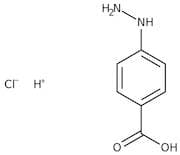
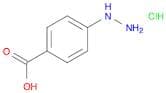
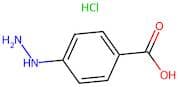
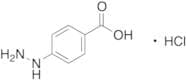
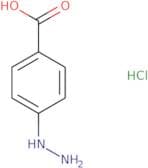
CAS 24589-77-3
:Acide benzoïque, 4-hydrazinyl-, chlorhydrate (1:1)
- (4-Carboxyphenyl)hydrazine monohydrochloride
- 4-Carboxyphenylhydrazine Hydrochloride
- 4-Carboxyphenylhydrazinium chloride
- 4-Hydrazino-Benzoicacimonohydrochloride
- 4-Hydrazinobenzoic Acid Hcl
- 4-Hydrazinobenzoic Acid Hydrochloride
- 4-Hydrazinylbenzoic Acid
- 4-Hydrazinylbenzoic Acid Hydrochloride (1:1)
- 4-Hydrazinylbenzoic acid hydrochloride
- Benzoic acid, 4-hydrazino-, monohydrochloride
- Benzoic acid, 4-hydrazinyl-, hydrochloride (1:1)
- Benzoic acid, p-hydrazino-, hydrochloride
- Benzoic acid, p-hydrazino-, monohydrochloride
- Bio-Farma Bf001082
- Labotest-Bb Lt01596126
- P-Carboxyphenyl Hydrazine Hcl
- Voir plus de synonymes
4-Hydrazinobenzoic acid hydrochloride, 98%
CAS :4-Hydrazinobenzoic acid hydrochloride is an important raw material and intermediate used in organic synthesis, pharmaceuticals, agrochemicals and dyestuff fields. It may be used for the preparation of 4-(3-(2-(tert-butoxycarbonylamino)ethyl)-5-hydroxy-1H-pyrazol-1-yl)benzoic acid. This Thermo ScienFormule :C7H9ClN2O2Degré de pureté :98%Couleur et forme :White to pale cream to pale yellow to pale brown, Crystals or powder or crystalline powderMasse moléculaire :188.614-Hydrazinobenzoic acid, HCl
CAS :Formule :C7H9ClN2O2Degré de pureté :98%Couleur et forme :SolidMasse moléculaire :188.61164-Hydrazinobenzoic acid hydrochloride
CAS :4-Hydrazinobenzoic acid hydrochlorideDegré de pureté :98%Couleur et forme :PowderMasse moléculaire :188.61g/mol4-Hydrazinylbenzoic acid hydrochloride
CAS :Formule :C7H9ClN2O2Degré de pureté :95%Couleur et forme :SolidMasse moléculaire :188.614-Hydrazinobenzoic Acid Hydrochloride
CAS :Produit contrôléApplications 4-Hydrazinobenzoic acid hydrochloride (cas# 24589-77-3) is a useful research chemical.
Formule :C7H8N2O2·HClCouleur et forme :NeatMasse moléculaire :188.6124-Hydrazinobenzoic acid hydrochloride
CAS :4-Hydrazinobenzoic acid hydrochloride is a chemical species that has an oxidative effect on DNA. It is a reactive oxygen species (ROS) that changes the hydrogen spectrum of water. The hydrogen bond is broken and the electrons in the molecule are excited to a higher energy level, which results in ROS formation. 4-Hydrazinobenzoic acid hydrochloride also inhibits mitochondrial function and causes heart disease by increasing blood pressure and weakening the heart muscle. This compound can be used as a cancer treatment for human cells, because it suppresses genes that promote cell growth. In addition, 4-hydrazinobenzoic acid hydrochloride may inhibit endothelial cell proliferation in animal experiments.
Formule :C7H8N2O2•HClDegré de pureté :Min. 95%Couleur et forme :PowderMasse moléculaire :188.61 g/mol