CAS 24939-03-5
:Poly(I:C)
Description :
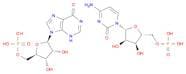
Poly(I:C), ou acide polyinosinique-polycytidylique, est une molécule d'ARN double brin synthétique qui sert d'immunostimulant puissant. Elle est principalement reconnue pour son rôle dans la simulation des infections virales, activant ainsi la réponse immunitaire, notamment par la stimulation des récepteurs de type Toll (TLRs), en particulier TLR3. Cette activation conduit à la production de diverses cytokines et interférons, renforçant les défenses antivirales de l'organisme. Poly(I:C) est souvent utilisé dans la recherche et les applications thérapeutiques, y compris le développement de vaccins et l'immunothérapie contre le cancer, en raison de sa capacité à induire une réponse immunitaire robuste. La substance est généralement caractérisée par son poids moléculaire élevé et est soluble dans l'eau, ce qui la rend adaptée à divers essais biologiques. De plus, Poly(I:C) peut être modifié pour améliorer sa stabilité et son efficacité, par exemple par l'incorporation de modifications chimiques qui augmentent sa résistance à la dégradation par les nucléases. Dans l'ensemble, Poly(I:C) est un outil précieux en immunologie et en recherche thérapeutique, contribuant à notre compréhension des mécanismes immunitaires et des stratégies de traitement potentielles.
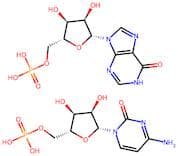
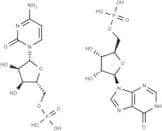
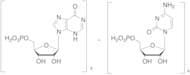
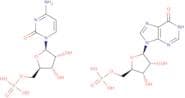
Formule :(C10H13N4O8P)x·(C9H14N3O8P)x
InChI :InChI=1S/C10H13N4O8P.C9H14N3O8P/c15-6-4(1-21-23(18,19)20)22-10(7(6)16)14-3-13-5-8(14)11-2-12-9(5)17;10-5-1-2-12(9(15)11-5)8-7(14)6(13)4(20-8)3-19-21(16,17)18/h2-4,6-7,10,15-16H,1H2,(H,11,12,17)(H2,18,19,20);1-2,4,6-8,13-14H,3H2,(H2,10,11,15)(H2,16,17,18)/t4-,6-,7-,10-;4-,6-,7-,8-/m11/s1
Code InChI :InChIKey=ACEVNMQDUCOKHT-ZLOOHWKQSA-N
SMILES :O[C@H]1[C@H](N2C3=C(N=C2)C(=O)N=CN3)O[C@H](COP(=O)(O)O)[C@H]1O.O[C@H]1[C@@H](O[C@H](COP(=O)(O)O)[C@H]1O)N2C(=O)N=C(N)C=C2
Synonymes :- 4-amino-1-(5-O-phosphonopentofuranosyl)pyrimidin-2(1H)-one - 9-(5-O-phosphonopentofuranosyl)-3,9-dihydro-6H-purin-6-one (1:1)
- 5'-Cytidylic Acid - 5'-Inosinic Acid (1:1)
- 5′-Cytidylic acid, homopolymer, complex with 5′-inosinic acid homopolymer (1:1)
- 5′-Cytidylic acid, polymers, complex with 5′-inosinic acid polymers (1:1)
- 5′-Inosinic acid homopolymer-5′-cytidylic acid homopolymer complex (1:1)
- 5′-Inosinic acid, homopolymer, complex with 5′-cytidylic acid homopolymer (1:1)
- 5′-Inosinic acid, polymers, complex with 5′-cytidylic acid polymers (1:1)
- NSC 120949
- NSC 123233
- NSC 128576
- Poly I:C
- Poly I:C Polyinosinicacid-polycytidylic acid
- Poly(C).poly(I)
- Poly(C:I)
- Poly(I)-poly(C)
- Poly(I).poly(C) complex
- Poly(cytidylic acid)-poly(inosinic acid)
- Poly(rI)-poly(rC)
- Poly(rI:rC)
- Polycytidylic-polyinosinic acid
- Polycytidysic acid
- Polyinosinate-polycytidylate complex
- Polyinosinate:polycytidylate
- Polyinosine-polycytidylic acid
- Polyinosinic acid-polycytidylic acid
- Polyinosinic acid:polycytidylic acid complex
- Polyinosinic-polycytidylic acid complex
- Voir plus de synonymes
Trier par
Degré de pureté (%)
0
100
|
0
|
50
|
90
|
95
|
100
8 produits concernés.
5'-Inosinic acid, homopolymer, complex with 5'-cytidylic acidhomopolymer (1:1)OTHER CA INDEX NAMES:5'-Cytidylic acid, homopolymer, complex with 5'-inosinic acidhomopolymer (1:1)
CAS :Formule :C21H35N7O16P2Degré de pureté :90%Couleur et forme :SolidMasse moléculaire :703.4874Polyinosinic-polycytidylic acid
CAS :Polyinosinic-polycytidylic acid (Poly(I:C)) is a synthetic double-stranded RNA (dsRNA) analog and an immunostimulant that acts as the most potent IFN inducer.Formule :(C10H13N4O8P)x·(C9H14N3O8P)xDegré de pureté :90%Couleur et forme :SolidMasse moléculaire :671.406Poly(I:C) (~90%)
CAS :Produit contrôléApplications Poly(I:C) is a toll-like receptor 3 dsRNA inflammatory stimulant.
References Smith, G.A., et al.: PLoS One, 10, e0121072 (2015); Dauletbaev, N., et al.: J. Immunol., 195, 2829 (2015); Broering, R., et al.: J. Viral Hepatitis, 21, 480 (2014); Colapicchioni, V., et al.: J. Mater. Chem. B: Mater. Biol. Med., 3, 7408 (2015)Formule :H2(C10H11N4O8P)n·H2(C9H12N3O8P)nDegré de pureté :~90%Couleur et forme :NeatMasse moléculaire :671.4Polyinosinic acid-polycytidylic acid, homopolymer (1:1)
CAS :Polyinosinic acid-polycytidylic acid (Poly I:C), an agonist of TLR3 toll-like receptors, is a synthetic double-stranded RNA analog, consisting of polyinosinic acid (poly I) paired with polycytidylic acid (poly C), forming a stable duplex structure.PolyI:C stimulates the secretion of pro-inflammatory cytokines and type I interferon through its interaction with endosomal Toll-like receptor 3 (TLR-3) and the cytoplasmic receptors melanoma differentiation-associated gene 5 (MDA-5) and retinoic acid-inducible gene I (RIG-I). This immunostimulant activity makes Poly I:C a useful vaccine adjuvant and is used in vaccine formulations. Poly I:C and its stabilized analogs (e.g., poly-ICLC) are also being actively researched for their dual role in oncology: directly targeting tumors and acting as immune potentiators. For example Poly I:C can induce apoptosis in tumor cells and stimulate immunogenic cell death and is therefore being explored alongside chemotherapy, radiotherapy, and checkpoint inhibitors, helping to overcome resistance mechanisms and strengthen treatment outcomes.We can supply PolyI:C to all stages of your project - from R&D and preclinical phases right up to GMP commercial manufacture. Contact our team for custom Poly I:C products. For more on poly I:C read out blog 'Poly I:C: A Vaccine Adjuvant With Oncological Potential.'Formule :(C10H13N4O8P)x•(C9H14N3O8P)xCouleur et forme :PowderPolyinosinic acid-polycytidylic acid, homopolymer (1:1)
CAS :Polyinosinic acid-polycytidylic acid (Poly I:C), an agonist of TLR3 toll-like receptors, is a synthetic double-stranded RNA analog, consisting of polyinosinic acid (poly I) paired with polycytidylic acid (poly C), forming a stable duplex structure.PolyI:C stimulates the secretion of pro-inflammatory cytokines and type I interferon through its interaction with endosomal Toll-like receptor 3 (TLR-3) and the cytoplasmic receptors melanoma differentiation-associated gene 5 (MDA-5) and retinoic acid-inducible gene I (RIG-I). This immunostimulant activity makes Poly I:C a useful vaccine adjuvant and is used in vaccine formulations. Poly I:C and its stabilized analogs (e.g., poly-ICLC) are also being actively researched for their dual role in oncology: directly targeting tumors and acting as immune potentiators. For example Poly I:C can induce apoptosis in tumor cells and stimulate immunogenic cell death and is therefore being explored alongside chemotherapy, radiotherapy, and checkpoint inhibitors, helping to overcome resistance mechanisms and strengthen treatment outcomes.We can supply PolyI:C to all stages of your project - from R&D and preclinical phases right up to GMP commercial manufacture. Contact our team for custom Poly I:C products. For more on poly I:C read out blog 'Poly I:C: A Vaccine Adjuvant With Oncological Potential.'Formule :(C10H13N4O8P)x•(C9H14N3O8P)xDegré de pureté :(Hplc-Ms) Min. 95.0 Area-%