CAS 250220-36-1
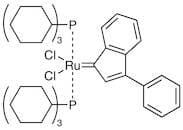
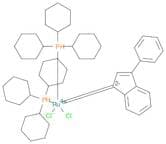
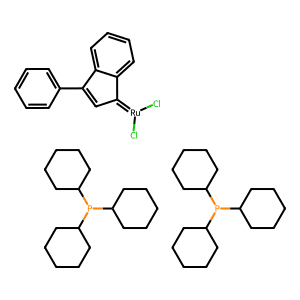
:(SP-5-31)-Dichloro(3-phényl-1H-indène-1-ylidène)bis(tricyclohexylphosphine)ruthénium
Description :
(SP-5-31)-Dichloro(3-phényl-1H-indène-1-ylidène)bis(tricyclohexylphosphine)ruthénium, avec le numéro CAS 250220-36-1, est un complexe de métal de transition présentant le ruthénium comme atome central. Ce composé se caractérise par sa coordination avec deux ligands tricyclohexylphosphine et un groupe dichloro, qui contribue à sa réactivité et à sa stabilité. La présence du ligand 3-phényl-1H-inden-1-ylidène améliore ses applications potentielles en catalyse, en particulier dans les réactions de métathèse des oléfines. Le volume stérique fourni par les ligands tricyclohexylphosphine peut influencer les propriétés électroniques du centre de ruthénium, affectant son activité catalytique. De plus, la structure du composé permet une géométrie unique qui peut faciliter des interactions spécifiques avec des substrats dans des réactions chimiques. Dans l'ensemble, ce complexe de ruthénium suscite de l'intérêt en chimie organique synthétique et en science des matériaux en raison de son utilité potentielle dans divers processus catalytiques.
Formule :C51H76Cl2P2Ru
InChI :InChI=1S/2C18H33P.C15H10.2ClH.Ru/c2*1-4-10-16(11-5-1)19(17-12-6-2-7-13-17)18-14-8-3-9-15-18;1-2-6-12(7-3-1)15-11-10-13-8-4-5-9-14(13)15;;;/h2*16-18H,1-15H2;1-9,11H;2*1H;/q;;-2;;;+4/p-2
Code InChI :InChIKey=GQENVXMWULCZBE-UHFFFAOYSA-L
SMILES :[P]([Ru+4]([P](C1CCCCC1)(C2CCCCC2)C3CCCCC3)([Cl-])([Cl-])=[C-2]4C=5C(C(=C4)C6=CC=CC=C6)=CC=CC5)(C7CCCCC7)(C8CCCCC8)C9CCCCC9
Synonymes :- (3-Phenyl-1H-Inden-1-Ylidene)Bis(Tricyclohexylphosphine)Ruthenium(Iv) Dichloride Tetrahydrofuran Adduct
- (3-Phenyl-1H-indene-1-ylidene)bis(tricyclohexylphosphine)ruthenium dichloride
- (SP-5-31)-Dichloro(3-phenyl-1H-inden-1-ylidene)bis(tricyclohexylphosphine)ruthenium
- Dichloro(3-phenyl-1H-inden-1-ylidene)bis(tricyclohexylphosphine) ruthenium(II)
- Ruthenium, dichloro(3-phenyl-1H-inden-1-ylidene)bis(tricyclohexylphosphine)-, (SP-5-31)-
- Umicore M1
- dichloro(3-phenyl-1H-inden-1-ylidene)ruthenium - tricyclohexylphosphane (1:2)
Trier par
Degré de pureté (%)
0
100
|
0
|
50
|
90
|
95
|
100
4 produits concernés.
(3-Phenyl-1H-inden-1-ylidene)bis(tricyclohexylphosphine)ruthenium(II) Dichloride
CAS :Formule :C51H76Cl2P2RuDegré de pureté :>97.0%(T)Couleur et forme :Amber to Brown powder to crystalMasse moléculaire :923.09Bis(tricyclohexylphosphine)-3-phenyl-1H-inden-1-ylideneruthenium(IV) dichloride
CAS :Formule :C51H76Cl2P2RuDegré de pureté :97%Couleur et forme :SolidMasse moléculaire :923.0727(3-Phenyl-1H-Inden-1-Ylidene)Bis(Tricyclohexylphosphine)Ruthenium(II) Dichloride
CAS :(3-Phenyl-1H-Inden-1-Ylidene)Bis(Tricyclohexylphosphine)Ruthenium(II) DichlorideDegré de pureté :97%Masse moléculaire :923.09g/molBis(tricyclohexylphosphine)-3-phenyl-1H-inden-1-ylideneruthenium(IV) dichloride
CAS :Bis(tricyclohexylphosphine)-3-phenyl-1H-inden-1-ylideneruthenium(IV) dichloride is a catalyst that is composed of a ruthenium complex. The catalyst has the ability to efficiently catalyze reactions in organic solvents and soluble inorganic substrates. This catalyst is compatible with a wide range of functional groups, including alcohols, amines, thiols, and carboxylic acids. It has been shown to be reusable and high activity. Bis(tricyclohexylphosphine)-3-phenyl-1H-inden-1-ylideneruthenium(IV) dichloride has been shown to be an efficient catalyst for the filtration reaction.Formule :C51H76Cl2P2RuDegré de pureté :95%NmrMasse moléculaire :923.07 g/mol