CAS 250692-65-0
:Trier par
Degré de pureté (%)
0
100
|
0
|
50
|
90
|
95
|
100
4 produits concernés.
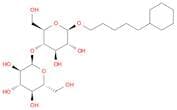
5-Cyclohexylpentyl β-D-maltoside
CAS :Formule :C23H42O11Degré de pureté :≥ 99.0% (β + α)Couleur et forme :White powderMasse moléculaire :494.57CYMAL-5
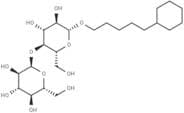
CAS :Cymal-5 is an additive for gel-based membrane proteomics.Formule :C23H42O11Couleur et forme :SolidMasse moléculaire :494.575-Cyclohexylpentyl-4-O-(a-D-glucopyranosyl)-b-D-glucopyranoside
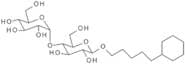
CAS :The glycosylation process is a chemical reaction in which an organic molecule is attached to a sugar or other carbohydrate. The product of this process is known as a glycoside. Glycosylations are important in the synthesis of complex carbohydrates and glycoconjugates. The most common glycosidic bond that is formed is between the hydroxyl group of a saccharide (such as glucose) and the amino group of another saccharide (such as N-acetylglucosamine). The most common type of glycosylation reaction is the formation of an O-glycosidic bond between two sugars, such as glucose and N-acetylgalactosamine, to form the disaccharide lactose. There are many different types of glycosylations, including methylation, Click modification, fluorination, saccharide modification, and custom synthesis. Methylation: Methylation is a chemical reaction where one or more hydFormule :C23H42O11Degré de pureté :Min. 95%Couleur et forme :PowderMasse moléculaire :494.57 g/mol