


CAS 25316-40-9
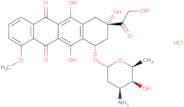
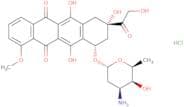
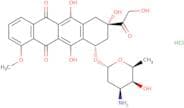
:Chlorhydrate de doxorubicine
Description :
Chlorhydrate de doxorubicine est un antibiotique anthracycline couramment utilisé en chimiothérapie contre le cancer. Il se caractérise par sa couleur rouge vif et est connu pour son activité antitumorale puissante. Le composé agit en intercalant l'ADN, inhibant ainsi la synthèse des acides nucléiques et perturbant la réplication des cellules cancéreuses. La doxorubicine est soluble dans l'eau et présente un profil de solubilité dépendant du pH, ce qui est important pour sa formulation et son administration. Son mécanisme d'action implique également la génération de radicaux libres, contribuant à ses effets cytotoxiques. Cependant, l'utilisation de la doxorubicine est associée à plusieurs effets secondaires, y compris la cardiotoxicité, qui limite sa dose cumulative. Elle est généralement administrée par voie intraveineuse et est souvent utilisée en combinaison avec d'autres agents chimiothérapeutiques pour améliorer l'efficacité contre diverses malignités, y compris le cancer du sein, la leucémie et les lymphomes. En raison de ses avantages thérapeutiques significatifs et des risques potentiels, une surveillance et une gestion attentives sont essentielles pendant le traitement.
Formule :C27H29NO11·ClH
InChI :InChI=1S/C27H29NO11.ClH/c1-10-22(31)13(28)6-17(38-10)39-15-8-27(36,16(30)9-29)7-12-19(15)26(35)21-20(24(12)33)23(32)11-4-3-5-14(37-2)18(11)25(21)34;/h3-5,10,13,15,17,22,29,31,33,35-36H,6-9,28H2,1-2H3;1H/t10-,13-,15-,17-,22+,27-;/m0./s1
Code InChI :InChIKey=MWWSFMDVAYGXBV-RUELKSSGSA-N
SMILES :OC=1C2=C([C@@H](O[C@H]3C[C@H](N)[C@H](O)[C@H](C)O3)C[C@@](C(CO)=O)(O)C2)C(O)=C4C1C(=O)C=5C(C4=O)=C(OC)C=CC5.Cl
Synonymes :- (1S,3S)-3,5,12-trihydroxy-3-(hydroxyacetyl)-10-methoxy-6,11-dioxo-1,2,3,4,6,11-hexahydrotetracen-1-yl 3-amino-2,3,6-trideoxy-alpha-L-lyxo-hexopyranoside hydrochloride (1:1)
- (1S,3S)-3,5,12-trihydroxy-3-(hydroxyacetyl)-10-methoxy-6,11-dioxo-1,2,3,4,6,11-hexahydrotetracen-1-yl 3-amino-2,3,6-trideoxyhexopyranoside hydrochloride (1:1)
- (8S-Cis)-10-((3-Amino-2,3,6-Trideoxy-Alpha-L-Lyxo-Hexopyranosyl)Oxy)-7,8,9,10-Tetrahydro-6,8,11-Trihydroxy-8-(Hydroxyacetyl)-1-Methoxynaphthacene-5,12-Dione Hydrochloride
- (8S-cis)-10-[(3-Amino-2,3,6-tridesoxy-α-L-lyxo-hexopyranosyl)oxy]-7,8,9,10-tetrahydro-6,8,11-trihydroxy-8-(hydroxyacetyl)-1-methoxynaphthacen-5,12-dionhydrochlorid
- (8S-cis)-10-[(3-amino-2,3,6-trideoxy-α-L-lyxo-hexopyranosyl)oxy]-7,8,9,10-tetrahydro-6,8,11-trihydroxy-8-(hydroxyacetyl)-1-methoxynaphthacene-5,12-dione hydrochloride
- (8S-cis)-10-[(3-amino-2,3,6-tridesoxi-α-L-lyxo-hexopiranosil)oxi]-7,8,9,10-tetrahidro-6,8,11-trihidroxi-8-(hidroxiacetil)-1-metoxinaftaceno-5,12-diona, clorhidrato
- (8S-cis)-10-[(3-amino-2,3,6-tridesoxy-α-L-lyxo-hexopyrannosyl)oxy]-7,8,9,10-tetrahydro-6,8,11-trihydroxy-8-(hydroxyacetyl)-1-methoxynaphtacene-5,12-dione, chlorhydrate
- 5,12-Naphthacenedione, 10-[(3-amino-2,3,6-trideoxy-α-<span class="text-smallcaps">L</span>-lyxo-hexopyranosyl)oxy]-7,8,9,10-tetrahydro-6,8,11-trihydroxy-8-(2-hydroxyacetyl)-1-methoxy-, hydrochloride (1:1), (8S,10S)-
- 5,12-Naphthacenedione, 10-[(3-amino-2,3,6-trideoxy-α-<span class="text-smallcaps">L</span>-lyxo-hexopyranosyl)oxy]-7,8,9,10-tetrahydro-6,8,11-trihydroxy-8-(hydroxyacetyl)-1-methoxy-, hydrochloride, (8S,10S)-
- 5,12-Naphthacenedione, 10-[(3-amino-2,3,6-trideoxy-α-<span class="text-smallcaps">L</span>-lyxo-hexopyranosyl)oxy]-7,8,9,10-tetrahydro-6,8,11-trihydroxy-8-(hydroxyacetyl)-1-methoxy-, hydrochloride, (8S-cis)-
- 5,12-Naphthacenedione, 10-[(3-amino-2,3,6-trideoxy-α-L-lyxo-hexopyranosyl)oxy]-7,8,9,10-tetrahydro-6,8,11-trihydroxy-8-(2-hydroxyacetyl)-1-methoxy-, hydrochloride (1:1), (8S,10S)-
- 5,12-Naphthacenedione, 10-[(3-amino-2,3,6-trideoxy-α-L-lyxo-hexopyranosyl)oxy]-7,8,9,10-tetrahydro-6,8,11-trihydroxy-8-(hydroxyacetyl)-1-methoxy-, hydrochloride, (8S,10S)-
- 5,12-Naphthacenedione, 10-[(3-amino-2,3,6-trideoxy-α-L-lyxo-hexopyranosyl)oxy]-7,8,9,10-tetrahydro-6,8,11-trihydroxy-8-(hydroxyacetyl)-1-methoxy-, hydrochloride, (8S-cis)-
- ADM hydrochloride
- ADR
- Adriablastina CS
- Adriacin
- Adriamycin
- Adriamycin, hydrochloride
- Adriblastin
- Adriblastina
- Adriblastina RD
- Adrosal
- Ameisu hydrochloride
- Caelyx pegylated liposomal
- DOX HCl
- Doxolipad
- Doxorubicin, HCl
- Doxorubicin-LANS
- Doxorubicin-TEVA
- Doxourbicin HCl
- Fi 106
- Fi 6804
- Hydroxydaunorubicin hydrochloride
- Lipo-Dox
- Lipodox
- Myocet liposomal
- Voir plus de synonymes
Trier par
Degré de pureté (%)
0
100
|
0
|
50
|
90
|
95
|
100
Doxorubicin hydrochloride - Bio-X ™
CAS :Doxorubicin hydrochloride is an inhibitor of topoisomerase II with anti-neoplastic activity and belongs to the class of anthracyclines. It is cytotoxic, and interferes with the topoisomerase II-mediated repair of DNA causing accumulation of mutations. Doxorubicin also leads to the generation of reactive oxygen species (ROS), which further damages DNA as well as proteins and membranes. Doxorubicin is used as a chemotherapy treatment for various types of cancer, including breast cancer, lung cancer, ovarian cancer, and leukaemia. However, the compound presents with a risk of developing cardiomyopathy as well as drug resistance.Formule :C27H29NO11•HClDegré de pureté :Min. 95%Couleur et forme :PowderMasse moléculaire :579.98 g/molDoxorubicin HCl
CAS :<p>Doxorubicin (DOX) is an antineoplastic chemotherapy drug used to treat breast, ovarian and pancreatic cancers. It is an antitumor antibiotic that inhibits DNA topoisomerase II. DOX interferes with the topoisomerase II-mediated repair of DNA causing accumulation of mutations. It also leads to the generation of reactive oxygen species (ROS), which further damage DNA as well as proteins and membranes. However, the compound presents with a risk of developing cardiomyopathy as well as drug resistance. Pegylated liposomal doxorubicin has also been developed to treat breast and ovarian cancers, myeloma, and HIV-related Kaposi’s sarcoma.</p>Formule :C27H29NO11·HClDegré de pureté :Min. 98 Area-%Couleur et forme :Red PowderMasse moléculaire :579.98 g/molDoxorubicin hydrochloride
CAS :Formule :C27H30ClNO11Degré de pureté :95.0%Couleur et forme :Solid, Crystalline Powder or Granules or PowderMasse moléculaire :579.98Doxorubicin hydrochloride, 10 mg/ml aqueous solution
CAS :<p>Doxorubicin hydrochloride, 10 mg/ml aqueous solution, is a chemotherapeutic agent, which is an anthracycline antibiotic derived from the bacterium *Streptomyces peucetius var. caesius*. Its mode of action involves the intercalation into DNA, disrupting the replication and transcription processes crucial for cancer cell proliferation. Additionally, it generates free radicals that cause further damage to cellular structures and inhibit topoisomerase II, thereby preventing the unwinding of DNA necessary for replication.</p>Formule :C27H29NO11•HClDegré de pureté :Min. 95%Couleur et forme :PowderMasse moléculaire :579.98 g/molDes-[(4-Amino-2,3,6-trideoxy-hexapyranosyl)oxy)-1-methyl] 2-Carboxylate Doxorubicin
CAS :Produit contrôléFormule :C20H12O7Couleur et forme :NeatMasse moléculaire :364.305



![Des-[(4-Amino-2,3,6-trideoxy-hexapyranosyl)oxy)-1-methyl] 2-Carboxylate Doxorubicin](/_next/image/?url=https%3A%2Fstatic.cymitquimica.com%2Fproducts%2FTR%2Fthumb%2FD558001.jpg&w=3840&q=75)


