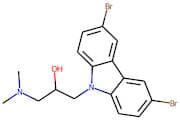
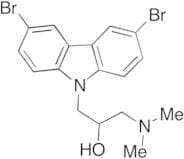
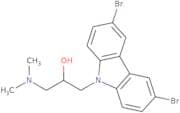
CAS 253449-04-6
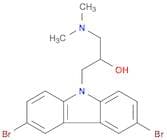
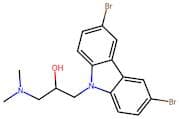
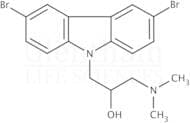
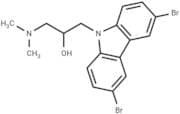
:1-(3,6-dibromo-9H-carbazol-9-yl)-3-(diméthylamino)propan-2-ol
- 1-(3,6-Dibromo-carbazol-9-yl)-3-dimethylamino-propan-2-ol
- 1-(3,6-Dibromocarbazol-9-yl)-3-(dimethylamino)propan-2-ol
- 3,6-Dibromo-α-[(dimethylamino)methyl]-9H-carbazole-9-ethanol
- 9H-Carbazole-9-ethanol, 3,6-dibromo-α-[(dimethylamino)methyl]-
- 9H-carbazole-9-ethanol, 3,6-dibromo-alpha-[(dimethylamino)methyl]-
- Wiskostatin
- 1-(3,6-DIBROMO-9H-CARBAZOL-9-YL)-3-(DIMETHYLAMINO)PROPAN-2-OL
- 3,6-Dibromo-9-[3-(dimethylamino)-2-hydroxyprop-1-yl]-9H-carbazole, 3-(3,6-Dibromo-9H-carbazol-9-yl)-N,N-dimethyl-2-hydroxypropylamine
- 3,6-Dibromo-α-[(dimethylamino)methyl]-9H-cabazole-9-ethanol
- 1-(3,6-Dibromo-9H-carbazol-9-yl)-3-(dimethylamino)propan-2-ol 97%
- Wiskostatin - CAS 253449-04-6 - Calbiochem
Wiskostatin
CAS :Formule :C17H18Br2N2ODegré de pureté :98%Couleur et forme :SolidMasse moléculaire :426.1456Wiskostatin
CAS :Wiskostatin selectively inhibits N-WASP, key in actin polymerization, linked to Wiskott-Aldrich Syndrome.Formule :C17H18Br2N2ODegré de pureté :99.84% - 99.97%Couleur et forme :White SolidMasse moléculaire :426.151-(3,6-Dibromo-9H-carbazol-9-yl)-3-(dimethylamino)propan-2-ol
CAS :1-(3,6-Dibromo-9H-carbazol-9-yl)-3-(dimethylamino)propan-2-olFormule :C17H18Br2N2ODegré de pureté :97%Couleur et forme : white crystalline powderMasse moléculaire :426.15g/molWiskostatin
CAS :Produit contrôléApplications Wiskostatin is an selective inhibitor of neural Wiskott-Aldrich syndrome protein (WASP).
Not a dangerous good if item is equal to or less than 1g/ml and there is less than 100g/ml in the package
References Peterson, J.R., et al.: Nat. Struct. Mol. Biol., 11, 747 (2004)Formule :C17H18Br2N2OCouleur et forme :NeatMasse moléculaire :426.151-(3,6-Dibromo-9H-carbazol-9-yl)-3-(dimethylamino)propan-2-ol
CAS :1,3-Bis(3,6-dibromo-9H-carbazol-9-yl)-2-(dimethylamino)propanol (1,3BDCP) is a potential biomarker for cancer tissues. It has been shown to induce autophagy in vitro and in vivo. 1,3BDCP increases the production of growth factor β1 to inhibit cell proliferation and promote apoptosis. It also induces cytosolic Ca2+ release through increased membrane permeability. 1,3BDCP is an autophagy inducer and promotes pluripotent cells with apical properties. This compound can be used as a chemical probe for chemical biology research due to its constant pressure behavior and chemical reactivity.
Formule :C17H18Br2N2ODegré de pureté :Min. 95%Masse moléculaire :426.15 g/mol