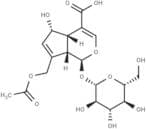
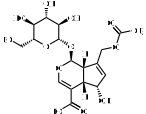
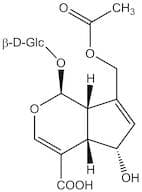
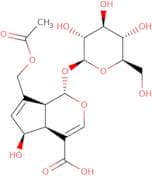
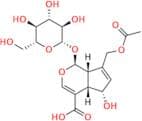
CAS 25368-11-0
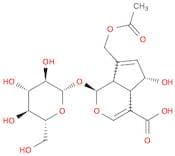
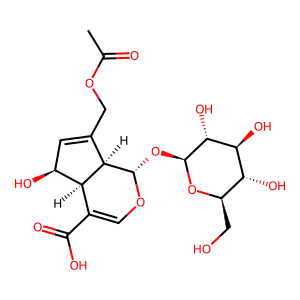
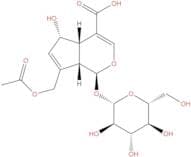
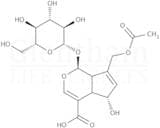
:Acide asperulosidique
Description :
Acide asperulosidique est un glycoside iridoïde d'origine naturelle, principalement trouvé dans diverses espèces de plantes, en particulier dans la famille des Rubiaceae. Il se caractérise par sa structure moléculaire complexe, qui comprend un groupe sucre attaché à un noyau iridoïde. Ce composé est connu pour ses propriétés pharmacologiques potentielles, y compris des activités anti-inflammatoires, antioxydantes et antimicrobiennes. Acide asperulosidique est souvent étudié pour son rôle dans la médecine traditionnelle et ses applications thérapeutiques potentielles. Il est généralement soluble dans des solvants polaires, ce qui facilite son extraction à partir de matériaux végétaux. La stabilité et la réactivité du composé peuvent être influencées par des facteurs environnementaux tels que le pH et la température. De plus, sa présence dans des formulations à base de plantes souligne son importance en phytothérapie et dans la recherche sur les produits naturels. Dans l'ensemble, Acide asperulosidique représente un sujet d'étude intéressant en raison de ses propriétés bioactives et de ses avantages potentiels pour la santé.
Formule :C18H24O12
InChI :InChI=1S/C18H24O12/c1-6(20)27-4-7-2-9(21)12-8(16(25)26)5-28-17(11(7)12)30-18-15(24)14(23)13(22)10(3-19)29-18/h2,5,9-15,17-19,21-24H,3-4H2,1H3,(H,25,26)/t9-,10+,11+,12-,13+,14-,15+,17-,18-/m0/s1
Code InChI :InChIKey=DGDWCRWJRNMRKX-DILZHRMZSA-N
SMILES :O([C@H]1[C@]2([C@@](C(C(O)=O)=CO1)([C@@H](O)C=C2COC(C)=O)[H])[H])[C@@H]3O[C@H](CO)[C@@H](O)[C@H](O)[C@H]3O
Synonymes :- Cyclopenta[c]pyran-4-carboxylic acid, 1α-(β-D-glucopyranosyloxy)-1,4aα,5,7aα-tetrahydro-5β-hydroxy-7-(hydroxymethyl)-, 7-acetate
- (1S,4aS,5S,7aS)-7-[(Acetyloxy)methyl]-1-(β-D-glucopyranosyloxy)-1,4a,5,7a-tetrahydro-5-hydroxycyclopenta[c]pyran-4-carboxylic acid
- Cyclopenta[c]pyran-4-carboxylic acid, 7-[(acetyloxy)methyl]-1-(β-D-glucopyranosyloxy)-1,4a,5,7a-tetrahydro-5-hydroxy-, (1S,4aS,5S,7aS)-
- Asperulosidic acid
- Cyclopenta[c]pyran-4-carboxylic acid, 7-[(acetyloxy)methyl]-1-(β-D-glucopyranosyloxy)-1,4a,5,7a-tetrahydro-5-hydroxy-, [1S-(1α,4aα,5β,7aα)]-
Trier par
Degré de pureté (%)
0
100
|
0
|
50
|
90
|
95
|
100
9 produits concernés.
Asperulosidic acid
CAS :Formule :C18H24O12Degré de pureté :98%Couleur et forme :SolidMasse moléculaire :432.3760Asperulosidic acid
CAS :Asperulosidic acid has been recently used in chinese medicine as a useful drug against some tumors. It has anticlastogenic activity, since the anticlastogenic irridoids have an alpha-unsaturated carbonyl group, this structure is considered to play an important role in the anticlastogenicity. Asperulosidic acid can inhibit the seed germination and growth of seedlings of large crabgrass. Asperulosidic acid, and 6-O-(beta-D-glucopyranosyl)-1-O-octanoyl-beta-D-glucopyranose are effective in suppressing 12-O-tedtradecanoylphorbol-13-acetate (TPA)- or epidermal growth factor (EGF)-induced cell transformation and associated AP-1 activity.Formule :C18H24O12Degré de pureté :95%~99%Couleur et forme :PowderMasse moléculaire :432.378Asperulosidic acid
CAS :Formule :C18H24O12Degré de pureté :≥ 98.0%Couleur et forme :White to off-white solidMasse moléculaire :432.38Asperulosidic acid
CAS :Asperulosidic acid (ASPA) has anti-tumor, anti-oxidant, and anti-inflammatory activities. ASPA is related to the inhibition of inflammatory cytokines.Formule :C18H24O12Degré de pureté :99.47%Couleur et forme :SolidMasse moléculaire :432.38Ref: TM-TN1410
1mg120,00€2mg170,00€5mg260,00€1mL*10mM (DMSO)286,00€10mg432,00€25mg708,00€50mg964,00€100mg1.288,00€Asperulosidic acid
CAS :Natural glycosideFormule :C18H24O12Degré de pureté :≥ 90.0 % (HPLC)Couleur et forme :PowderMasse moléculaire :432.38Asperulosidic acid
CAS :Asperulosidic acid is a glycoside derivative that belongs to the natural compounds. It has been shown to be an enzyme inducer in bacteria, yeast and plants. Asperulosidic acid can be found in the leaves of asperula odorata, a plant commonly known as sweet woodruff. It is also found in fructus asperuli, which is made from the fruit of asperula odorata. Asperulosidic acid has been shown to increase the activity of enzymes such as β-glucuronidase and esterase in bacteria, which may have an effect on their metabolism. This compound also increases the activity of proteases and other enzymes in plants and yeast. The matrix effect can be used to determine the concentration of this compound by measuring its effects on enzyme activity. Matrix effects can be measured using a plate test or by plasma mass spectrometry. Asperulosidic acid has been shown to have growthFormule :C18H24O12Degré de pureté :Min. 95%Couleur et forme :SolidMasse moléculaire :432.38 g/mol