CAS 25501-32-0
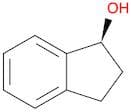
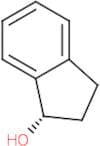
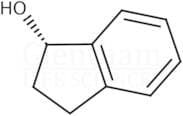
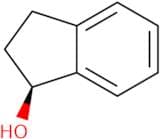
:S(+)-1-indanol
Description :
S(+)-1-indanol, avec le numéro CAS 25501-32-0, est un composé organique chiral qui appartient à la classe des indanols, qui sont des dérivés de l'indane. Ce composé présente un groupe hydroxyle (-OH) attaché à la structure de l'indane, spécifiquement à la position 1, contribuant à ses propriétés uniques. S(+)-1-indanol se caractérise par sa nature optiquement active, ce qui signifie qu'il peut faire tourner la lumière polarisée plane en raison de son centre chiral. Il est généralement un liquide ou un solide incolore à jaune pâle, selon sa pureté et sa forme. Le composé est soluble dans des solvants organiques et a une solubilité limitée dans l'eau. S(+)-1-indanol suscite l'intérêt dans divers domaines, y compris la pharmacie et la synthèse organique, en raison de ses applications potentielles dans le développement de catalyseurs et d'intermédiaires chiraux. Sa stéréochimie joue un rôle crucial dans sa réactivité et ses interactions dans les systèmes biologiques, ce qui en fait un composé précieux pour la recherche en synthèse asymétrique et en chimie médicinale.
Formule :C9H10O
InChI :InChI=1/C9H10O/c10-9-6-5-7-3-1-2-4-8(7)9/h1-4,9-10H,5-6H2/t9-/m0/s1
SMILES :c1ccc2c(c1)CC[C@@H]2O
Synonymes :- (S)-(+)-1-Hydroxyindan
- (1S)-2,3-Dihydro-1H-indene-1β-ol
- (1S)-Indan-1β-ol
- (3S)-Indan-3-ol
- (S)-2,3-Dihydro-1H-indene-1β-ol
- [1S,(+)]-1-Indanol
- (1S)-2,3-dihydro-1H-inden-1-ol
- (S)-(+)-1-Indanol
Trier par
Degré de pureté (%)
0
100
|
0
|
50
|
90
|
95
|
100
5 produits concernés.
(S)-2,3-Dihydro-1H-inden-1-ol
CAS :Formule :C9H10ODegré de pureté :97%Couleur et forme :SolidMasse moléculaire :134.1751(S)-2,3-Dihydro-1H-inden-1-ol
CAS :(S)-2,3-Dihydro-1H-inden-1-olDegré de pureté :97%Masse moléculaire :134.18g/mol(S)-(+)-1-Indanol
CAS :(S)-(+)-1-Indanol is a substrate for the human liver alcohol dehydrogenase and can be used to study the enzyme. The molecule has two phenyl groups that are capable of forming hydrogen bonds with other molecules. The hydrogen bond is a relatively weak, noncovalent interaction between two polar molecules. It can be formed by the donation of a lone pair of electrons from one side of an oxygen atom in one molecule to a lone pair of electrons on another oxygen atom in another molecule. This type of bond is responsible for many important biological processes, including DNA replication and protein folding. The (S)-(+)-1-Indanol can also undergo carbonyl reduction, which is the conversion of an organic compound containing a carbonyl group into a corresponding hydrocarbon derivative containing hydroxyl groups. The (S)-(+)-1-Indanol contains both hydroxyl and carbonyl functionalities that make it suitable for this process. (S)-Formule :C9H10ODegré de pureté :Min. 95%Couleur et forme :PowderMasse moléculaire :134.18 g/mol