CAS 256424-63-2
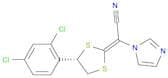
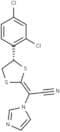
:(S,E)-2-(4-(2,4-Dichlorophenyl)-1,3-dithiolan-2-ylidene)-2-(1H-imidazol-1-yl)acetonitrile
CAS :Formule :C14H9Cl2N3S2Couleur et forme :SolidMasse moléculaire :354.2774(S)-Luliconazole-E-Isomer
CAS :Formule :C14H9Cl2N3S2Couleur et forme :Brown Yellow SolidMasse moléculaire :354.27Luliconazole, (+)-
CAS :Luliconazole, (+)- is a bioactive chemical.Formule :C14H9Cl2N3S2Couleur et forme :SolidMasse moléculaire :354.28(S)-Luliconazole
CAS :Produit contrôléApplications (S)-Luliconazole is the (S)--enantiomer of Luliconazole, an azole antifungal drug. Luliconazole was found to interfere with ergosterol biosynthesis in cell-free extracts of Candida albican, while no interference due to (S)-Luliconazole was found.
References Uhida, K., et al.: J. Infect. Chemother., 10, 216 (2004); Niwano, ., et al.: Antimicro. Agents Chemother., 42, 967 (1998); Niwanno, Y., et al.: Med. Mycol., 37, 351 (1999)Formule :C14H9Cl2N3S2Couleur et forme :NeatMasse moléculaire :354.28(S)-Luliconazole
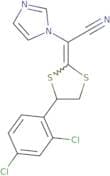
CAS :(S)-Luliconazole is an antifungal agent that is synthesized from an imidazole compound. This compound is biphenyl in structure and is often derived through chiral synthesis techniques to isolate the (S)-enantiomer, which is the active form that enhances pharmacological effects. Its mode of action involves inhibiting the enzyme lanosterol 14α-demethylase, an essential component in fungal cell membrane synthesis. This inhibition disrupts the production of ergosterol, a critical sterol in fungal membranes, ultimately leading to increased membrane permeability and cell death.
Formule :C14H9Cl2N3S2Degré de pureté :Min. 95%Masse moléculaire :354.3 g/molRef: 3D-GKA42463
Produit arrêté