CAS 25679-24-7
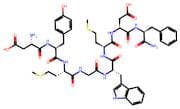
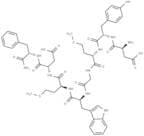
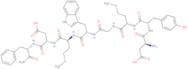
:fragment de cholécystokinine 26-33 amide*non sulfaté
Description :
Le fragment 26-33 de la cholécystokinine, non sulfaté, est un peptide dérivé de la molécule plus grande de cholécystokinine (CCK), qui joue un rôle crucial dans la digestion et la régulation de l'appétit. Ce fragment spécifique consiste en une séquence d'acides aminés impliqués dans la stimulation de la contraction de la vésicule biliaire et dans la promotion de la libération d'enzymes digestives par le pancréas. La forme non sulfatée indique qu'elle ne possède pas de modifications sulfatées, ce qui peut influencer son activité biologique et ses interactions avec les récepteurs. Le numéro CAS 25679-24-7 identifie de manière unique ce composé dans les bases de données chimiques, facilitant son étude et son application dans la recherche. Caractéristiquement, ce peptide est soluble dans l'eau et présente une activité biologique à des concentrations nanomolaires, ce qui le rend significatif dans les processus physiologiques. Son rôle dans le système gastro-intestinal et ses implications potentielles dans la régulation de l'appétit et de la satiété en font un sujet d'intérêt tant dans la recherche pharmacologique que nutritionnelle. Comprendre sa structure et sa fonction peut fournir des informations sur des approches thérapeutiques pour les troubles digestifs et la gestion de l'obésité.
Formule :C49H62N10O13S2
InChI :InChI=1/C49H62N10O13S2/c1-73-18-16-34(55-47(70)37(21-28-12-14-30(60)15-13-28)58-44(67)32(50)23-41(62)63)45(68)53-26-40(61)54-38(22-29-25-52-33-11-7-6-10-31(29)33)48(71)56-35(17-19-74-2)46(69)59-39(24-42(64)65)49(72)57-36(43(51)66)20-27-8-4-3-5-9-27/h3-15,25,32,34-39,52,60H,16-24,26,50H2,1-2H3,(H2,51,66)(H,53,68)(H,54,61)(H,55,70)(H,56,71)(H,57,72)(H,58,67)(H,59,69)(H,62,63)(H,64,65)
SMILES :CSCCC(C(=NCC(=NC(Cc1c[nH]c2ccccc12)C(=NC(CCSC)C(=NC(CC(=O)O)C(=NC(Cc1ccccc1)C(=N)O)O)O)O)O)O)N=C(C(Cc1ccc(cc1)O)N=C(C(CC(=O)O)N)O)O
Synonymes :- Cholecystokinin Octapeptide (desulfated)
- H-Asp-Tyr-Met-Gly-Trp-Met-Asp-Phe-NH2
- N-[(2S)-2-hydrazino-3-phenylpropanoyl]-L-alpha-aspartyl-L-methionyl-L-tryptophylglycyl-N-[(1S,4S)-4-amino-5-carboxy-1-(4-hydroxybenzyl)-2,3-dioxopentyl]-L-methioninamide
- Alpha-Aspartyltyrosylmethionylglycyltryptophylmethionyl-Alpha-Aspartylphenylalaninamide
Trier par
Degré de pureté (%)
0
100
|
0
|
50
|
90
|
95
|
100
6 produits concernés.
Cholecystokinin Octapeptide (desulfated)
CAS :Bachem ID: 4003323.
Formule :C49H62N10O13S2Degré de pureté :98.1%Couleur et forme :White LyophilisateMasse moléculaire :1063.22Cholecystokinin Octapeptide, desulfated
CAS :Cholecystokinin Octapeptide, desulfatedDegré de pureté :≥95%Masse moléculaire :1063.21g/molCholecystokinin Octapeptide, desulfated
CAS :Cholecystokinin Octapeptide, desulfated (CCK Octapeptide, non-sulfated) is an octapeptide composed of 8 amino acids from cholecystokinin-8.Formule :C49H62N10O13S2Degré de pureté :97.12%Couleur et forme :SolidMasse moléculaire :1063.21CCK octapeptide Cholecystokinin (26-33)
CAS :The octapeptide cholecystokinin (26-33), known as CCK-8, has the full biological activity of the full-length cholecystokinin (CCK). CCK acts as a hormone and neurotransmitter and is found in the GI and central nervous systems. CCK-8 is a satiety peptide that inhibits food intake.CCK-8 can also inhibit amanitin uptake into hepatocytes.Formule :C49H62N10O13S2Masse moléculaire :1,063.21 g/molCCK-Octapeptide (26-33) (Non-Sulfated Form)
CAS :CCK-Octapeptide (26-33) is a peptide that is a member of the cholecystokinin family of peptides. CCK-Octapeptide (26-33) is an activator of the CCK receptor and can be used for research purposes. This peptide has been shown to inhibit ion channels, which are proteins that regulate the flow of ions across cell membranes, and may be used as a pharmacological tool or research tool.
Formule :C49H62N10O13S2Degré de pureté :Min. 95%Masse moléculaire :1,063.2 g/molCholecystokinin Octapeptide (desulfated)
CAS :Cholecystokinin octapeptide (CCK-8) is a peptide hormone that is secreted from the pancreas. It is a conjugate of CCK and desulfated cholinesterase, which has been shown to have surfactant properties. The concentration-response curves for CCK-8 are biphasic, with an initial increase in contractility followed by a decrease. This response is caused by activation of both the B2 and B1 receptors in the paraventricular nucleus of the hypothalamus and subsequently release of pancreatic enzymes into the bloodstream. CCK-8 has also been shown to stimulate protein synthesis in gland cells such as those found in the pancreas.Formule :C49H62N10O13S2Degré de pureté :Min. 95%Masse moléculaire :1,063.21 g/mol