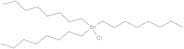
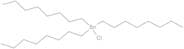
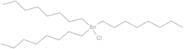
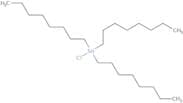
CAS 2587-76-0
:Chlorure de trioctyltine
Description :
Chlorure de trioctyltine, avec le numéro CAS 2587-76-0, est un composé organostannique caractérisé par ses trois groupes octyles attachés à un atome d'étain, ainsi qu'un ion chlorure. Il apparaît sous forme de liquide incolore à jaune pâle et est connu pour ses propriétés hydrophobes, ce qui le rend insoluble dans l'eau mais soluble dans des solvants organiques. Ce composé est principalement utilisé comme stabilisant dans la production de PVC et comme biocide dans diverses applications, y compris les peintures antifouling et les préservatifs pour bois. Chlorure de trioctyltine présente une toxicité, en particulier pour les organismes aquatiques, et soulève des préoccupations environnementales en raison de son potentiel de bioaccumulation. Il est important de manipuler cette substance avec précaution, en suivant les protocoles de sécurité appropriés pour minimiser l'exposition et l'impact environnemental. De plus, son utilisation est réglementée dans de nombreuses régions en raison de sa nature dangereuse, nécessitant le respect des directives et réglementations de sécurité dans les applications industrielles.
Formule :C24H51ClSn
InChI :InChI=1S/3C8H17.ClH.Sn/c3*1-3-5-7-8-6-4-2;;/h3*1,3-8H2,2H3;1H;/q;;;;+1/p-1
Code InChI :InChIKey=MCNGJXAXOJDJKO-UHFFFAOYSA-M
SMILES :[Sn](CCCCCCCC)(CCCCCCCC)(CCCCCCCC)Cl
Synonymes :- Chloro(Trioctyl)Stannane
- Chlorotrioctylstannane
- Chlorotrioctyltin
- NSC 65479
- Stannane, chlorotrioctyl-
- Tin, chlorotrioctyl-
- Tri-n-octyltin chloride
- Trioctylchlorostannane
- Trioctyltin chloride
Trier par
Degré de pureté (%)
0
100
|
0
|
50
|
90
|
95
|
100
4 produits concernés.
Trioctyltin chloride 1000 µg/mL in Methanol
CAS :Produit contrôléFormule :C24H51ClSnCouleur et forme :ColourlessMasse moléculaire :493.82Trioctyltin chloride
CAS :Produit contrôléFormule :C24H51ClSnCouleur et forme :NeatMasse moléculaire :493.82Tri-n-octylchlorotin
CAS :Produit contrôléStability Moisture Sensitive
Applications Tri-n-octylchlorotin is an octyltin compound used to study the growth and fatty acid of the microscopic fungus Cochliobolus lunatus. It is also an organotin reagents used to covalently functionalize oxide nanostructures and multi-walled C nanotubes.
Not a dangerous good if item is equal to or less than 1g/ml and there is less than 100g/ml in the package
References Felczak, A., et al.: Process Biochem., 49, 295-300 (2014); Gomathi, A., et al.: J. Mater. Chem., 19, 988-995 (2009);Formule :C24H51ClSnCouleur et forme :NeatMasse moléculaire :493.82Trioctyltin chloride
CAS :Trioctyltin chloride is a polymer that is synthesized by the reaction of two equivalents of tributyltin chloride with fatty acids. Trioctyltin chloride is reactive and can be extracted from a variety of sources using a variety of solvents. It has been used to extract chloride ions from mesenchymal stromal cells, which are cells that are involved in tissue repair. The trioctyltin chloride polymer can be used as an analytical method for 3β-hydroxysteroid dehydrogenase, which catalyzes the conversion of 3β-hydroxysteroids into 3-keto steroids. This reaction is reversible and it produces hydrogen ions as a product. The hydrogen ions cause the polymer to undergo ring-opening reactions, leading to the formation of polymeric matrixes on solid surfaces. These matrices have been used in membrane systems as well as in microextraction experiments for solid phase extraction with gas chromatography (SPE).Formule :C24H51ClSnDegré de pureté :Min. 95%Masse moléculaire :493.82 g/mol