CymitQuimica logo

CAS 26041-51-0

:

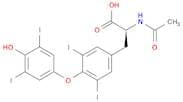
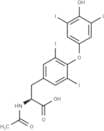
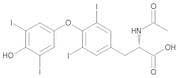
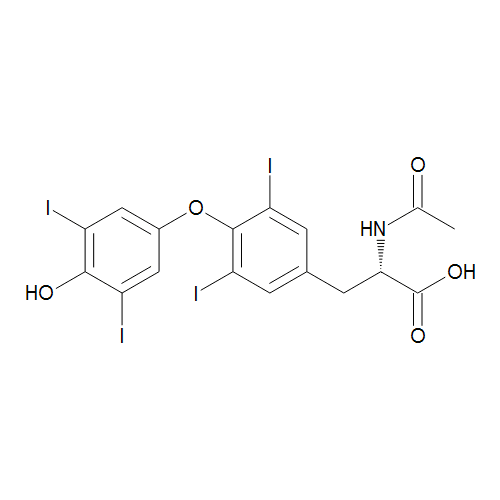
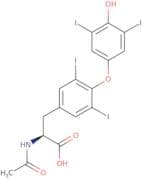
L-Tyrosine, N-acétyl-O-(4-hydroxy-3,5-diiodophényl)-3,5-diiodo-

Description :
L-Tyrosine, N-acétyl-O-(4-hydroxy-3,5-diiodophényl)-3,5-diiodo- est un dérivé synthétique de l'acide aminé L-tyrosine, caractérisé par la présence de plusieurs atomes d'iode et d'un groupe acétyle. Ce composé présente un groupe diiodophényle, qui contribue à ses propriétés chimiques uniques et à ses potentielles activités biologiques. La présence d'atomes d'iode améliore généralement la lipophilie du composé et peut influencer sa réactivité et son interaction avec les systèmes biologiques. L'acétylation du groupe amino peut affecter la solubilité et la stabilité du composé. En général, des composés comme celui-ci peuvent être étudiés pour leurs applications potentielles en pharmacie, notamment dans le contexte des analogues des hormones thyroïdiennes ou comme agents de radiomarquage dans les techniques d'imagerie. Les modifications structurelles spécifiques confèrent des caractéristiques distinctes qui peuvent être explorées dans divers contextes de biochimie et de chimie médicinale. Comme pour toute substance chimique, des précautions de sécurité et de manipulation doivent être observées, notamment en raison de la présence d'halogènes, qui peuvent poser des risques pour la santé.
Formule :C17H13I4NO5
Trier par

Degré de pureté (%)
0
100
|
0
|
50
|
90
|
95
|
100
10 produits concernés.
  • N-Acetyl Thyroxine (N-Acetyl-O-(4-hydroxy-3,5-diiodophenyl)-3,5-diiodo-L-tyrosine)

    CAS :
    Aromatic amino-alcohol-phenols, aromatic amino-acid-phenols and other aromatic amino compounds with oxygen function
    Formule :C17H13I4NO5
    Couleur et forme :Off-White Powder
    Masse moléculaire :818.69726
  • N-Acetyl-o-(4-hydroxy-3,5-diiodophenyl)-3,5-diiodo-l-tyrosine

    CAS :
    Formule :C17H13I4NO5
    Degré de pureté :95%
    Couleur et forme :Solid
    Masse moléculaire :818.9067

    Ref: IN-DA002RH5

    ne
    À demander
  • N-Acetylthyroxine

    CAS :
    <p>N-Acetylthyroxine</p>
    Degré de pureté :98%

    Ref: 54-OR1036797

    100mg
    424,00€
  • Levothyroxine Related Compound 5

    CAS :
    Formule :C17H13I4NO5
    Couleur et forme :Off-White Solid
    Masse moléculaire :818.91

    Ref: 4Z-L-4609

    5mg
    À demander
    10mg
    910,00€
    25mg
    1.638,00€
    50mg
    2.366,00€
    100mg
    À demander
  • N-Acetylthyroxine

    CAS :
    <p>N-Acetylthyroxine is a kind of Thyroxine analogue for the treatment of diagnosing and treating diabetes.</p>
    Formule :C17H13I4NO5
    Couleur et forme :Solid
    Masse moléculaire :818.91
  • N-Acetyl-L-Thyroxine (N-Acetyllevothyroxine)

    Produit contrôlé
    CAS :
    Formule :C17H13I4NO5
    Couleur et forme :Neat
    Masse moléculaire :818.91

    Ref: 86-MM0694.12

    25mg
    343,00€
    100mg
    1.364,00€
  • Levothyroxine N-Acetyl Impurity

    CAS :
    Formule :C17H13I4NO5
    Masse moléculaire :818.91

    Ref: ST-EA-CP-L18014

    10mg
    À demander
    25mg
    À demander
    50mg
    À demander
    100mg
    À demander
  • N-Acetyl L-Thyroxine(>90%)

    Produit contrôlé
    CAS :
    <p>Impurity Levothyroxine N-Acetyl Impurity; 1 N-Acetyl-T4 (USP)<br>Applications N-Acetyl L-Thyroxine (Levothyroxine N-Acetyl Impurity; 1 N-Acetyl-T4 (USP)) is a Thyroxine (T425600) analogue, a thyroid hormone for use in diagnosing and treating diabetes.<br>References Gonzales, M., et al.: J. Biol. Chem., 272, 11288 (1997), de Wolf, F., et al.: Pharm. Rev., 52, 207 (2000), Waner, M., et al.: Biophys. J., 87, 2701 (2004),<br></p>
    Formule :C17H13I4NO5
    Degré de pureté :>90%
    Couleur et forme :White To Off-White
    Masse moléculaire :818.91

    Ref: TR-A188890

    100mg
    233,00€
    250mg
    321,00€
    500mg
    572,00€
  • N-Acetyl L-thyroxine

    CAS :
    <p>N-Acetyl L-thyroxine is a molecule that has two acetyl groups, one at the amino and one on the phenol. It is synthesized by the addition of an acetyl group to thyronine. N-Acetyl L-thyroxine can be found in human serum and hydroxycobalamin. N-Acetyl L-thyroxine binds with proteins to form a labile complex. This binding can be increased with a hydroxyl group, diphenyl ether, or chlorine. N-Acetyl L-thyroxine is also involved in hormone synthesis and metabolism, as well as being converted into l-glutamic acid and then into acid analysis. Halogens are known to cause the cleavage of N-acetyl L-thyroxine at the C5 position, which leads to its degradation by oxidation.</p>
    Formule :C17H13I4NO5
    Degré de pureté :Min. 95%
    Couleur et forme :White Powder
    Masse moléculaire :818.91 g/mol

    Ref: 3D-FA17028

    1g
    917,00€
    50mg
    182,00€
    100mg
    290,00€
    250mg
    443,00€
    500mg
    609,00€
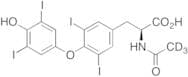
  • N-Acetyl L-Thyroxine-d3

    Produit contrôlé
    CAS :
    Formule :C17H10D3I4NO5
    Couleur et forme :Neat
    Masse moléculaire :821.93

    Ref: TR-A188893

    25mg
    1.008,00€