CAS 26170-87-6
:4-Phényl-2-thiophènecarboxaldéhyde
Description :
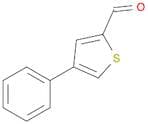
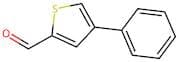
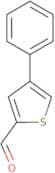
4-Phényl-2-thiophènecarboxaldéhyde est un composé organique caractérisé par sa structure aromatique, qui comprend un groupe phényle et un anneau de thiophène. Ce composé présente un groupe fonctionnel carboxaldéhyde (-CHO) attaché au thiophène, contribuant à sa réactivité et à ses applications potentielles en synthèse organique. Il apparaît généralement sous forme de liquide ou de solide jaunâtre à brunâtre, selon les conditions spécifiques et la pureté. La présence des groupes thiophène et phényle confère des propriétés électroniques uniques, le rendant intéressant en science des matériaux et en électronique organique. De plus, le composé peut présenter une activité biologique, qui peut être explorée pour des applications pharmaceutiques potentielles. Sa synthèse implique souvent des méthodes telles que la substitution aromatique électrophile ou d'autres réactions de couplage. Comme pour de nombreux composés organiques, des précautions de manipulation doivent être observées en raison de la toxicité ou de la réactivité potentielles. Dans l'ensemble, 4-Phényl-2-thiophènecarboxaldéhyde sert de bloc de construction précieux dans le développement de divers produits chimiques et applications de recherche.
Formule :C11H8OS
InChI :InChI=1S/C11H8OS/c12-7-11-6-10(8-13-11)9-4-2-1-3-5-9/h1-8H
Code InChI :InChIKey=TXIFKGWOQSVIMZ-UHFFFAOYSA-N
SMILES :C(=O)C1=CC(=CS1)C2=CC=CC=C2
Synonymes :- 2-Thiophenecarboxaldehyde, 4-phenyl-
- 4-Phenyl-2-thiophenecarboxaldehyde
- 4-Phenylthiophene-2-Carbaldehyde
- 4-Phenylthiophene-2-aldehyde
Trier par
Degré de pureté (%)
0
100
|
0
|
50
|
90
|
95
|
100
4 produits concernés.
2-Thiophenecarboxaldehyde, 4-phenyl-
CAS :Formule :C11H8OSDegré de pureté :97%Couleur et forme :SolidMasse moléculaire :188.24564-Phenylthiophene-2-Carbaldehyde
CAS :4-Phenylthiophene-2-CarbaldehydeDegré de pureté :98%Masse moléculaire :188.25g/mol4-Phenylthiophene-2-carboxaldehyde
CAS :4-Phenylthiophene-2-carboxaldehyde is an antimicrobial agent that exhibits a broad spectrum of activity against bacteria, fungi, and viruses. It has been shown to be effective at low concentrations of 0.5 ppm against both Gram-positive and Gram-negative bacteria. It is also a relatively stable compound that can be used in optical devices with yields of up to 95%. Ciprofloxacin is a ligand for this compound, forming a complex that is more stable than the free drug. This complex has been shown to have antibacterial activity against Staphylococcus aureus and methicillin resistant Staphylococcus aureus (MRSA). The catalytic reaction time for this compound is approximately 10 minutes. Lanthanides are also known to catalyze the reaction between 4-phenylthiophene-2-carboxaldehyde and amines, making it possible to produce 2-[(4-phenylthiopFormule :C11H8OSDegré de pureté :Min. 95%Masse moléculaire :188.25 g/mol