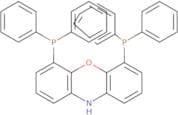
CAS 261733-18-0
:4,6-Bis(diphénylphosphino)phénoxazine
Description :
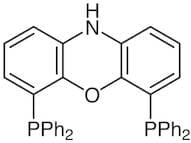
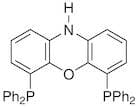
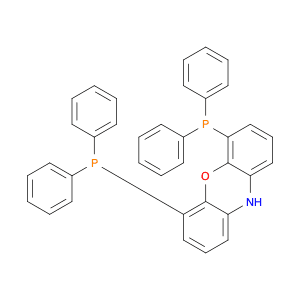
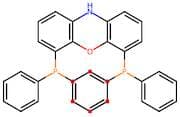
4,6-Bis(diphénylphosphino)phénoxazine est un composé chimique caractérisé par sa structure unique, qui comprend un noyau de phénoxazine substitué par deux groupes diphénylphosphino aux positions 4 et 6. Ce composé est remarquable pour ses applications potentielles en chimie de coordination et en catalyse, en particulier dans la formation de complexes métalliques. La présence des groupes diphénylphosphino améliore sa capacité à agir comme un ligand bidenté, facilitant les interactions avec les métaux de transition. La partie phénoxazine contribue aux propriétés électroniques du composé, le rendant adapté aux applications en électronique organique et en photochimie. De plus, le composé peut présenter des propriétés photophysiques intéressantes, telles que la fluorescence ou la phosphorescence, en fonction de son environnement et de la présence d'ions métalliques. Sa stabilité et sa réactivité peuvent varier en fonction des conditions spécifiques, y compris le solvant et la température. Dans l'ensemble, 4,6-Bis(diphénylphosphino)phénoxazine représente un élément de construction polyvalent dans le développement de matériaux avancés et de catalyseurs en chimie moderne.
Formule :C36H27NOP2
InChI :InChI=1/C36H27NOP2/c1-5-15-27(16-6-1)39(28-17-7-2-8-18-28)33-25-13-23-31-35(33)38-36-32(37-31)24-14-26-34(36)40(29-19-9-3-10-20-29)30-21-11-4-12-22-30/h1-26,37H
SMILES :c1ccc(cc1)P(c1ccccc1)c1cccc2c1Oc1c(cccc1P(c1ccccc1)c1ccccc1)N2
Synonymes :- 10H-phenoxazine, 4,6-bis(diphenylphosphino)-
- 4,6-Bis(diphenylphosphino)-10H-phenoxazine
- 4,6-bis(diphenylphosphanyl)-10H-phenoxazine
Trier par
Degré de pureté (%)
0
100
|
0
|
50
|
90
|
95
|
100
6 produits concernés.
4,6-Bis(diphenylphosphino)phenoxazine
CAS :Formule :C36H27NOP2Degré de pureté :>98.0%(HPLC)(N)Couleur et forme :White to Light gray to Green powder to crystalMasse moléculaire :551.574,6-Bis(diphenylphosphino)phenoxazine, min. 98% NIXANTPHOS
CAS :4,6-Bis(diphenylphosphino)phenoxazine, min. 98% NIXANTPHOS
Formule :C36H27NOP2Degré de pureté :min. 98%Couleur et forme :white to off-white pwdr.Masse moléculaire :551.5510H-Phenoxazine, 4,6-bis(diphenylphosphino)-
CAS :Formule :C36H27NOP2Degré de pureté :97%Couleur et forme :SolidMasse moléculaire :551.5532Ref: IN-DA002S0G
100gÀ demander250gÀ demander250mg19,00€100mg20,00€1g33,00€5g75,00€10g118,00€25g207,00€4,6-Bis(diphenylphosphino)-10H-phenoxazine
CAS :4,6-Bis(diphenylphosphino)-10H-phenoxazineFormule :C36H27NOP2Degré de pureté :98%Couleur et forme : faint green/grey powderMasse moléculaire :551.55g/mol4,6-BIS(DIPHENYLPHOSPHINO)PHENOXAZINE
CAS :Degré de pureté :97%Couleur et forme :SolidMasse moléculaire :551.5659794,6-Bis(diphenylphosphino)phenoxazine
CAS :The optimal reaction conditions for the cross-coupling of aryl halides with diphosphines are known. The reaction is catalyzed by palladium and is an efficient method for the synthesis of alkenes and alkynes. In this process, a nucleophilic attack on the carbon atom in the phosphine occurs, which generates a reactive intermediate that can undergo hydrogen bonding interactions with the aryl halide. This reaction is also called "Pd-catalyzed cross-coupling." The reaction proceeds through two steps: (1) oxidative carbonylation of the phenoxazine to form an enolate intermediate and (2) reductive elimination of chlorine from the chloroformate. The synergic effect between two molecules is seen when one molecule has a structural property that enhances or diminishes another molecule's properties. For example, if one molecule has a high electron density, then it may be able to stabilize negative charge on another molecule's atoms; ifFormule :C36H27NOP2Degré de pureté :Min. 95%Masse moléculaire :551.55 g/mol