CAS 26348-70-9
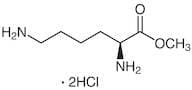
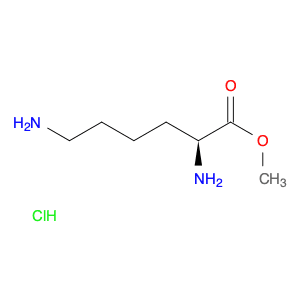
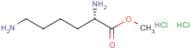
:L-Lysine, ester méthylique, chlorhydrate (1:2)
Description :
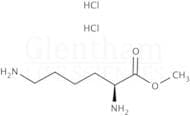
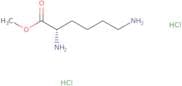
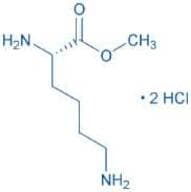
L-Lysine, ester méthylique, chlorhydrate (1:2) est un dérivé de l'acide aminé lysine, caractérisé par la présence d'un groupe ester méthylique et d'une forme de sel hydrochlorique. Ce composé est généralement une poudre cristalline blanche, soluble dans l'eau, ce qui améliore sa biodisponibilité et le rend adapté à diverses applications, y compris les compléments nutritionnels et les formulations pharmaceutiques. En tant que dérivé d'acide aminé, il joue un rôle dans la synthèse des protéines et peut être impliqué dans des processus métaboliques. La forme hydrochlorique améliore la stabilité et la solubilité, facilitant son utilisation dans les formulations. La L-Lysine est essentielle pour la santé humaine, contribuant à la croissance, à la réparation des tissus et à la production d'enzymes et d'hormones. Elle est également connue pour ses avantages potentiels dans le soutien de la fonction immunitaire et la promotion de l'absorption du calcium. Le profil de sécurité du composé est généralement favorable, mais comme toutes les substances, il doit être utilisé conformément aux directives recommandées pour éviter d'éventuels effets secondaires. Dans l'ensemble, la L-Lysine, ester méthylique, hydrochlorure est appréciée pour ses propriétés fonctionnelles tant dans les contextes diététiques que thérapeutiques.
Formule :C7H18Cl2N2O2
InChI :InChI=1/C7H16N2O2/c1-11-7(10)6(9)4-2-3-5-8/h6H,2-5,8-9H2,1H3/p+2/t6-/m0/s1
Code InChI :InChIKey=SXZCBVCQHOJXDR-ILKKLZGPSA-N
SMILES :[C@H](CCCCN)(C(OC)=O)N.Cl
Synonymes :- (5S)-6-methoxy-6-oxohexane-1,5-diaminium
- <span class="text-smallcaps">L</span>-Lysine dihydrochloride methyl ester
- <span class="text-smallcaps">L</span>-Lysine, methyl ester, dihydrochloride
- <span class="text-smallcaps">L</span>-Lysine, methyl ester, hydrochloride (1:2)
- H-Lys-OMe.2HCl
- H-Lys-OMe・2HCl
- L-Lysine Methyl Ester Dihydrochloride
- L-Lysine methyl・dihydrochloride
- Lysine methyl ester dihydrochloride
- Lysine, methyl ester, dihydrochloride, <span class="text-smallcaps">L</span>-
- Lysoome.2hcl
- Methyl <span class="text-smallcaps">L</span>-lysinate dihydrochloride
- Methyl Lysinate
- NSC 83256
- methyl L-lysinate dihydrochloride
- Lysine, methyl ester, dihydrochloride, L-
- L-Lysine, methyl ester, hydrochloride (1:2)
- (s)-2,6-diaminohexanoic acid methyl ester dihydrochloride
- H-LYS-OME
- L-Lysine Methyl Ester 2HCl
- METHYL (S)-2,6-DIAMINOHEXANOIC ACID DIHYDROCHLORIDE
- L-LYSINE METHYL ESTER DIHCL
- L-LYSINE METHYL ESTER DIHYDROCHLORIDE SALT
- L-Lysine methyl·dihydrochloride
- LYSINE-OME 2 HCL
- L-LYSINE METHYL ESTER DIHYDROCHLORIDE 99%
- L-Lysinemethylesterdihydrochloride,99%
- H-L-Lys-OMe*2HCl
- LYS.OME.2HCL
- Methyl L-Lysine Dihydrochloride
- Voir plus de synonymes
Trier par
Degré de pureté (%)
0
100
|
0
|
50
|
90
|
95
|
100
9 produits concernés.
L-Lysine Methyl Ester Dihydrochloride
CAS :Formule :C7H16N2O2·2HClDegré de pureté :>98.0%(N)Couleur et forme :White to Almost white powder to crystalMasse moléculaire :233.13L-Lysine methyl ester dihydrochloride, 99%
CAS :L-Lysine methyl ester dihydrochloride is used in the production of lysine methyl ester based cationic surfactants and hydrogels. This Thermo Scientific Chemicals brand product was originally part of the Alfa Aesar product portfolio. Some documentation and label information may refer to the legacy brFormule :C7H18Cl2N2O2Degré de pureté :99%Couleur et forme :White to pale cream, Crystals or powder or crystalline powderMasse moléculaire :233.13L-Lysine, methyl ester, hydrochloride (1:2)
CAS :Formule :C7H18Cl2N2O2Degré de pureté :95%Couleur et forme :SolidMasse moléculaire :233.1360L-Lysine methyl ester dihydrochloride
CAS :L-Lysine methyl ester dihydrochlorideDegré de pureté :98%Masse moléculaire :233.14g/molL-Lysine methyl ester dihydrochloride
CAS :Formule :C7H16N2O2·2HClDegré de pureté :≥ 98.0%Couleur et forme :White to almost white powder or crystalsMasse moléculaire :233.14H-Lys-OMe.2HCl
CAS :M03024 - H-Lys-OMe.2HCl
Formule :C7H18Cl2N2O2Degré de pureté :95%Couleur et forme :SolidMasse moléculaire :233.13L-Lysine Methyl Ester Dihydrochloride
CAS :Produit contrôléApplications Used in the synthesis of peptides containing histidine and lysine.
References Bizzozero, S., et al.: Eur. J. Biochem., 122, 251 (1982), Schellenberger, V., et al.: Biochim. Biophys Acta., 869, 54 (1986), Jakubke, H., et al.: Biol. Chem., 377, 455 (1996),Formule :C7H18Cl2N2O2Couleur et forme :NeatMasse moléculaire :233.14L-Lysine methyl ester 2HCl
CAS :L-Lysine methyl ester 2HCl is a lysine derivative that has been synthesized by reacting L-lysine with methanol and hydrochloric acid. This compound's cytotoxicity has been demonstrated in an inhibition study using calf thymus dna. L-Lysine methyl ester 2HCl contains amide, acid, and ester linkages, as well as hydrogen bonds that are typical of natural compounds. It is also biologically active and has a molecular weight of 246.3 g/mol. The chemical structure of this compound consists of a central l-lysine molecule with two methyl groups on the nitrogen atom. The compound also contains a carboxyl group on the end of the chain and an ester group on the second carbon atom from the end of the chain. L-Lysine methyl ester 2HCl can be found in soybeans and bovine fetal tissue. It exhibits morphological properties similar to otherFormule :C7H16N2O2·2HClDegré de pureté :Min. 95%Couleur et forme :PowderMasse moléculaire :233.14 g/molH-Lys-OMe · 2 HCl
CAS :Bachem ID: 4002480.
Formule :C7H16N2O2·2HClDegré de pureté :> 99%Couleur et forme :White PowderMasse moléculaire :233.14