


CAS 267241-99-6
:1,3'-bipyrrolidine
Description :
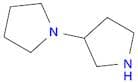
1,3'-bipyrrolidine, identifié par son numéro CAS 267241-99-6, est un composé organique bicyclique comportant deux cycles de pyrrolidine reliés par une liaison simple. Ce composé présente des caractéristiques typiques des hétérocycles contenant de l'azote, y compris un degré de basicité relativement élevé en raison de la présence d'atomes d'azote dans sa structure. La structure moléculaire contribue à son potentiel en tant que ligand en chimie de coordination et en tant que bloc de construction en synthèse organique. 1,3'-bipyrrolidine est généralement un liquide ou un solide incolore à jaune pâle, selon sa forme spécifique et sa pureté. Il est soluble dans des solvants organiques polaires, ce qui améliore son utilité dans diverses réactions chimiques. Le composé peut également présenter des propriétés pharmacologiques intéressantes, ce qui en fait un sujet d'intérêt en chimie médicinale. Cependant, comme pour de nombreux composés contenant de l'azote, il est essentiel de le manipuler avec précaution, en tenant compte de sa toxicité et de sa réactivité potentielles. Dans l'ensemble, 1,3'-bipyrrolidine est un composé polyvalent avec des applications tant en recherche qu'en milieu industriel.
Formule :C8H16N2
InChI :InChI=1/C8H16N2/c1-2-6-10(5-1)8-3-4-9-7-8/h8-9H,1-7H2
SMILES :C1CCN(C1)C1CCNC1
Trier par
Degré de pureté (%)
0
100
|
0
|
50
|
90
|
95
|
100
2 produits concernés.
[1,3']Bipyrrolidinyl
CAS :<p>[1,3']Bipyrrolidinyl (BPY) is an antibacterial agent that binds to the receptor site on bacteria and inhibits bacterial growth. It has been shown to be effective against a number of Gram-negative bacteria including Haemophilus influenzae, Escherichia coli, and Pseudomonas aeruginosa. BPY has been found to hydrate at physiological pH and is eliminated from the body primarily in urine. BPY has also been found to have good plasma exposure due to its high lipid solubility. The affinity of BPY for bacterial ribosomes is greater than other antibacterial agents such as carboxylates or fluoroquinolones. The binding of BPY with bacterial ribosomes inhibits protein synthesis and cell division, leading to cell death by inhibiting the production of proteins vital for cell division.</p>Formule :C8H16N2Degré de pureté :Min. 95%Masse moléculaire :140.23 g/mol

![[1,3']Bipyrrolidinyl](/_next/image/?url=https%3A%2Fstatic.cymitquimica.com%2Fproducts%2F3D%2Fthumb%2FSKA24199.jpg&w=3840&q=75)
