

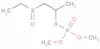
CAS 2674-91-1
:Oxydeprofos
Description :
Oxydeprofos est un composé organophosphoré principalement utilisé comme insecticide et acaricide dans les applications agricoles. Il se caractérise par sa capacité à inhiber l'acétylcholinestérase, une enzyme essentielle au bon fonctionnement du système nerveux chez les insectes, entraînant paralysie et mort. La structure chimique de Oxydeprofos comprend un atome de phosphore lié à de l'oxygène et du soufre, contribuant à son activité biologique. Il s'agit généralement d'un liquide incolore à jaune pâle avec une légère odeur. Oxydeprofos est modérément soluble dans l'eau et a une solubilité plus élevée dans les solvants organiques, ce qui facilite son application dans diverses formulations. En raison de sa toxicité potentielle pour les organismes non ciblés, y compris les humains et la faune, son utilisation est réglementée dans de nombreux pays. Des mesures de sécurité sont essentielles lors de la manipulation de cette substance, car elle peut présenter des risques pour la santé par inhalation, contact cutané ou ingestion. La persistance environnementale et la bioaccumulation potentielle sont également des considérations dans son application et sa gestion dans les pratiques agricoles.
Formule :C7H17O4PS2
InChI :InChI=1S/C7H17O4PS2/c1-5-14(9)6-7(2)13-12(8,10-3)11-4/h7H,5-6H2,1-4H3
Code InChI :InChIKey=JAYZFNIOOYPIAH-UHFFFAOYSA-N
SMILES :P(SC(CS(CC)=O)C)(OC)(OC)=O
Synonymes :- 2-Propanethiol, 1-(ethylsulfinyl)-, S-ester with O,O-dimethyl phosphorothioate
- Ai3-25674
- Bay 23655
- Bayer 23655
- Brn 1711537
- Caswell No. 366
- EPA Pesticide Chemical Code 366100
- ESP
- ESP (pesticide)
- Ent 25,674
- Estox
- Metasystox-S
- O,O-Dimethyl S-(2-(ethylsulfinyl)-1-methylethyl) phosphorothioate
- O,O-Dimethyl S-[2-(ethylsulfinyl)isopropyl] thiophosphate
- O,O-Dimethyl-S-(ethylsulfinyl-(2-isopropyl)) phosphorothioate
- Oxydeprofos
- Oxydeprofos [ISO]
- Oxyphionfos
- Phosphorothioic acid, O,O-dimethyl S-(ethylsulfinyl-(2-isopropyl)) ester
- Phosphorothioic acid, S-(2-(ethylsulfinyl)-1-methylethyl) O,O-dimethyl ester
- S 410
- S-2-Aethylsulfinyl-1-methyl aethyl-O,O dimethyl-monothiophosphat
- S-2-Aethylsulfinyl-1-methyl aethyl-O,O dimethyl-monothiophosphat [German]
- S-2-Ethyl-sulfinyl-1-methyl-ethyl-O,O-dimethyl-monothiofosfaat
- S-2-Ethyl-sulfinyl-1-methyl-ethyl-O,O-dimethyl-monothiofosfaat [Dutch]
- S-2-Ethyl-sulphinyl-1-methyl-ethyl-O,O-dimethyl phosphorothiolate
- S-2-Etil-sulfinil-1-metil-etil-O,O-dimetil-monotiofosfato
- S-2-Etil-sulfinil-1-metil-etil-O,O-dimetil-monotiofosfato [Italian]
- S-[1-(ethylsulfinyl)propan-2-yl] O,O-dimethyl phosphorothioate
- S-[2-(Ethylsulfinyl)-1-methylethyl] O,O-dimethyl phosphorothioate
- S410
- Thiometan
- Thiophosphate de O,O-dimethyle et de S-2-(isopropylsulfinyl)-ethyle
- Voir plus de synonymes
Trier par
Degré de pureté (%)
0
100
|
0
|
50
|
90
|
95
|
100
1 produits concernés.
Oxydeprofos
CAS :Oxydeprofos is a potent tumor kinase inhibitor that has shown promising results in the treatment of cancer. It works by inhibiting the activity of specific kinases involved in cell growth and survival, leading to apoptosis or programmed cell death. Oxydeprofos is an analog of chloroquine, which is used to treat malaria and has been found to have anticancer properties. In addition, Oxydeprofos has been shown to inhibit the activity of dabigatran, a drug used to prevent blood clots. Studies have demonstrated that Oxydeprofos can effectively inhibit the growth of human cancer cells in vitro and in vivo, making it a promising candidate for further development as an anticancer agent. Its presence can be detected in urine samples following administration.Formule :C7H17O4PS2Degré de pureté :Min. 95%Masse moléculaire :260.3 g/mol

