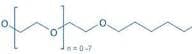
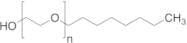
CAS 27252-75-1
:Éther octylique de polyéthylène glycol
Description :
Éther octylique de polyéthylène glycol, avec le numéro CAS 27252-75-1, est un tensioactif non ionique et un membre de la famille des polyéthylènes glycols (PEG). Il se caractérise par son squelette hydrophile en polyéthylène glycol et un groupe octyle hydrophobe, ce qui lui confère des propriétés amphiphiles, le rendant efficace dans diverses applications. Ce composé apparaît généralement sous forme de liquide ou de solide incolore à jaune pâle, selon son poids moléculaire et sa formulation. Il est soluble dans l'eau et les solvants organiques, ce qui améliore son utilité dans des formulations telles que des émulsifiants, des solubilisants et des dispersants dans les produits pharmaceutiques, cosmétiques et applications industrielles. Éther octylique de polyéthylène glycol présente une faible toxicité et est généralement considéré comme sûr pour une utilisation dans les produits de soin personnel. Ses propriétés tensioactives lui permettent de réduire la tension superficielle, facilitant le mélange des phases huile et eau. De plus, il peut améliorer la stabilité des émulsions et augmenter la biodisponibilité des ingrédients actifs dans les formulations. Dans l'ensemble, sa structure unique et ses propriétés en font un ingrédient polyvalent dans divers processus chimiques et industriels.
Formule :(C2H4O)nC8H18O
InChI :InChI=1/C10H22O2/c1-2-3-4-5-6-7-9-12-10-8-11/h11H,2-10H2,1H3
Code InChI :InChIKey=ZQCIMPBZCZUDJM-UHFFFAOYSA-N
SMILES :CCCCCCCCOCCO
Synonymes :- Aduxol Hex 05B
- Berol EP 35
- Dehydol 04
- Dehydol 04DEO
- Ethoxylated octyl alcohol
- Glycols, polyethylene, monooctyl ether
- Novel II 8-7
- Octyl alcohol, ethoxylated
- Pionin D 1002
- Poly(oxy-1,2-ethanediyl), alpha-octyl-omega-hydroxy-
- Poly(oxy-1,2-ethanediyl), α-octyl-ω-hydroxy-
- Poly(oxyethylene) monooctyl ether
- Poly(oxyethylene) octyl ether
- Polyethoxylated octanol
- Polyethylene glycol mono-n-octyl ether
- Polyethylene glycol monooctyl ether
- Polyethylene glycol octyl ether
- Polyethylene glycol octyl monoether
- Polyoxyethylene mono(n-octyl) ether
- THM Schkopau W-OF
- Texofor N
- Texofor N 12
- Texofor N 4
- Trycol 5887
- Trycol ST 8049
- n-Octyl polyethylene glycol ether
- n-Octyl-polyoxyethylene
- n-Octylpolyoxyethylene
- α-Octyl-ω-hydroxy-poly(oxyethylene)
- Voir plus de synonymes
Trier par
Degré de pureté (%)
0
100
|
0
|
50
|
90
|
95
|
100
4 produits concernés.
n-Octylpolyoxyethylene
CAS :Octyl-POE solubilizes membrane proteins. The CMC value is 6.6 mM.Couleur et forme :ColourlessPoly(Ethylene Glycol) Octyl Ether
CAS :Poly(Ethylene Glycol) Octyl EtherDegré de pureté :98%Masse moléculaire :174.28g/moln-Octylpolyoxyethylene
CAS :n-Octylpolyoxyethylene (n-OPEO) is a synthetic surfactant that is used as an antimicrobial agent. It has been shown to be effective against a wide variety of bacteria, including Mycobacterium tuberculosis and Staphylococcus aureus. The mechanism by which n-OPEO exerts its antibacterial efficacy is not yet fully understood. It may inhibit the growth of bacteria by disrupting their cell membranes, or it may interfere with the synthesis of proteins needed for bacterial growth.Formule :C8H18O(C2H4O)nCouleur et forme :Clear LiquidMasse moléculaire :174.28n-Octyl-oligo-oxyethylene
CAS :Produit contrôléApplications n-Octyl-oligo-oxyethylene is a detergent for useful solubilization, purification and crystallization of proteins.
Not a dangerous good if item is equal to or less than 1g/ml and there is less than 100g/ml in the packageFormule :(C2H4O)nC8H18OCouleur et forme :NeatMasse moléculaire :174.28