CAS 2757-90-6
:Agaritine
Description :
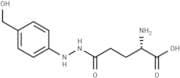
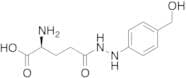
Agaritine, avec le numéro CAS 2757-90-6, est un composé naturellement présent principalement dans certaines espèces de champignons, en particulier ceux du genre Agaricus, comme le champignon de Paris commun. Il est classé comme un dérivé de la phénylhydrazine et est connu pour ses potentielles activités biologiques, y compris des propriétés antioxydantes. Agaritine est un solide cristallin blanc à jaune pâle qui est soluble dans l'eau et les solvants organiques. Sa structure chimique présente un groupe hydrazine, qui contribue à sa réactivité et à ses potentielles implications pour la santé. Bien que Agaritine ait été étudié pour ses effets sur la santé humaine, y compris sa possible cancérogénicité, le risque global associé à sa consommation dans les champignons comestibles reste un sujet de recherche en cours. De plus, la stabilité de Agaritine peut être influencée par des facteurs tels que la température et le pH, ce qui peut affecter sa présence dans les produits alimentaires. Dans l'ensemble, Agaritine est un composé intéressant dans le domaine de la mycologie et de la chimie alimentaire, justifiant une enquête plus approfondie sur ses propriétés et effets.
Formule :C12H17N3O4
InChI :InChI=1S/C12H17N3O4/c13-10(12(18)19)5-6-11(17)15-14-9-3-1-8(7-16)2-4-9/h1-4,10,14,16H,5-7,13H2,(H,15,17)(H,18,19)/t10-/m0/s1
Code InChI :InChIKey=SRSPQXBFDCGXIZ-JTQLQIEISA-N
SMILES :N(NC(CC[C@@H](C(O)=O)N)=O)C1=CC=C(CO)C=C1
Synonymes :- (2S)-2-Amino-5-{2-[4-(hydroxymethyl)phenyl]hydrazino}-5-oxopentanoic acid (non-preferred name)
- (2S)-2-amino-5-{2-[4-(hydroxymethyl)phenyl]hydrazinyl}-5-oxopentanoic acid (non-preferred name)
- <span class="text-smallcaps">L</span>-Glutamic acid, 5-[2-[4-(hydroxymethyl)phenyl]hydrazide]
- Agaritine
- Glutamic acid, 5-[2-(α-hydroxy-p-tolyl)hydrazide], <span class="text-smallcaps">L</span>-
- L-Glutamic Acid 5-[2-[4-(Hydroxymethyl)phenyl]hydrazide]
- L-Glutamic acid, 5-(2-(4-(hydroxymethyl)phenyl)hydrazide) (9CI)
- b-N-[g-L(+)-Glutamyl]-4-hydroxymethylphenylhydrazine
- β-N-[γ-<span class="text-smallcaps">L</span>(+)-Glutamyl]-4-hydroxymethylphenylhydrazine
- Glutamic acid, 5-[2-(α-hydroxy-p-tolyl)hydrazide], L-
Trier par
Degré de pureté (%)
0
100
|
0
|
50
|
90
|
95
|
100
4 produits concernés.
L-Glutamic acid, 5-[2-[4-(hydroxymethyl)phenyl]hydrazide]
CAS :Formule :C12H17N3O4Masse moléculaire :267.2811Agaritine
CAS :Agaritine develops from mushrooms.Formule :C12H17N3O4Couleur et forme :SolidMasse moléculaire :267.285Agaritine
CAS :Agaritine is a natural compound found in the mushroom Agaricus. It has been shown to be carcinogenic in vitro and in vivo. Agaritine is a genotoxic compound and has been shown to inhibit fatty acid synthesis. It also binds to metal hydroxides, such as calcium hydroxide, forming a complex that is insoluble in water and toxic to cells. Agaritine forms an adduct with DNA during light exposure, which may lead to mutations or cancerous changes in cells. This compound has not been studied extensively for its toxicity or carcinogenicity potential.
Formule :C12H17N3O4Degré de pureté :Min. 95%Masse moléculaire :267.28 g/mol
![L-Glutamic acid, 5-[2-[4-(hydroxymethyl)phenyl]hydrazide]](/_next/image/?url=https%3A%2Fstatic.cymitquimica.com%2Fproducts%2FIN%2Fthumb%2FDA002U3S.jpg&w=3840&q=75)